



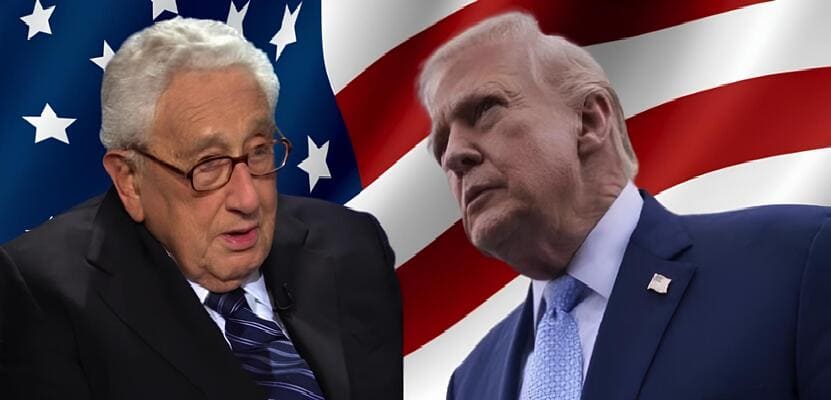
World Geostrategic Insights interview with Thomas A. Schwartz on Kissinger’s legacy in current U.S. politics, how his thinking can help address today’s geopolitical challenges, and the “Kissingerian” nuances in Trump’s approach to foreign policy.

Thomas A. Schwartz is a distinguished professor of history and political science at Vanderbilt University, Nashville, Tennessee, United States. He is a leading historian of international relations, known for his in-depth analyses of Henry Kissinger’s thought, and one of his major contributions in this field is his book titled “Henry Kissinger and American Power: A Political Biography”, published in 2020 by Hill and Wang. He has served as president of the Society for Historians of American Foreign Relations (SHAFR) and has been a member of the U.S. Department of State’s Historical Advisory Committee.
Q1 – Professor Schwartz, in your book *Henry Kissinger and American Power: A Political Biography*, you challenge the traditional view of Henry Kissinger as a detached master of Realpolitik, a skilled chess player who acted solely on the basis of grand strategy. On the contrary, you present him as a political actor endowed with great sensitivity. Can you explain why it is not possible to separate Kissinger’s foreign policy from American domestic policy?
A1 – You describe the thesis of my book quite accurately. I believe that Kissinger was a political actor, and that he realized he needed to assess foreign policy issues through a political lens. My argument would be that this is a fundamental structural fact of the American system of government, which makes no real distinction between foreign and domestic policies, especially in the way they affect the contest for power. Foreign policy is a part of the contest for power at home, and Kissinger recognized, much as he lamented it.
Q2 – At first glance, Donald Trump and Henry Kissinger seem like opposites: the former an instinct-driven populist and advocate of “America First,” the latter an elitist academic of classical geopolitics. Yet, many analysts have identified profound Kissingerian nuances in Trump’s approach. For example, both share a deep skepticism toward multilateralism. What is your opinion? Can Trump’s “America First” be considered a transactional variant of Kissingerian Realpolitik?
A2 – You are correct to see certain similarities in Kissinger and Trump’s skepticism toward multilateralism. Kissinger was never as entranced as many Americans were with the virtues of multilateral institutions – recall his famous line about Europe – if I want to know what Europe thinks, whom do I call? But unlike Trump, Kissinger knew how to conceal his realism about multilateralism and those institutions and avoid unnecessarily antagonizing those who put their faith in them. Trump seems to go out of his way to attack these institutions in ways that cause unnecessary friction, something Kissinger would never do.
Q3 – One of the main pillars of Kissinger’s strategy was “triangulation”: reaching out to China to isolate and put pressure on the Soviet Union. During the Trump presidency, there was much speculation about a “reverse Kissinger”—that is, an attempt to reach out to Putin’s Russia to stem China’s rise. Do you think Trump actually tried to implement this strategy?
A3 – The “reverse Kissinger” may have been considered at one point in the Trump Presidency – perhaps in the first term. But if it has been considered more recently, this would have been a serious case of diplomatic malpractice. There are few indications that the West can drive any wedge between Russia and China, and anyone who knows the history of the Nixon and Kissinger strategy would know how different the conditions were in the 1969-1972 period from what they are today.
Q4 – Trump has definitively broken with the policy of “engagement” with China inaugurated by Nixon and Kissinger in 1972, triggering a tariff war and open rivalry. What is your view on the prospects for U.S.-China relations, particularly in light of Trump’s recent visit to Beijing?
A4 – This is a tricky question to answer, as Trump’s policy toward China has gone through many changes. Yes, he has broken with the policy of engagement, but he still celebrates his friendship with Xi in a manner not unlike the way Nixon did with Mao or Kissinger did with Zhao. We seem to be in a period of competitive rivalry with China, economically still connected, competing technologically, and clearly military rivals. Much remains uncertain, and much will depend on China’s decisions regarding Taiwan.
Q5 – Henry Kissinger was born in Germany and was deeply immersed in European culture. Nevertheless, he never hesitated to bypass Europe. Donald Trump has shaken up Europe by calling NATO “obsolete,” questioning Article 5 on collective defense, and accusing European allies of being “free-riders” on security. Can Trump’s policy be linked in any way to Kissinger’s transatlantic diplomacy of the 1970s? What is your view on the future prospects for transatlantic relations?
A5 – I have actually written an article about this, focusing on Kissinger’s “Year of Europe,” diplomacy, one of his greatest failures. Kissinger had hoped to reinvigorate the Atlantic Alliance, but the combination of the Watergate scandal and the Yom Kippur War frustrated his efforts and created divisions with the European allies. The title of my article, “A Frankenstein Monster,” was the way Nixon referred to the European Union, a term Trump would have used as well. Here is the article “A Frankenstein Monster’: Henry Kissinger, Richard Nixon, and the Year of Europe,” Journal of Transatlantic Studies, Vol. 17 (1) 2019, 110-128.
The interesting thing is that Soviet policies, particularly their continuing military threat to Europe, helped bring the United States and Europe back together, and after Nixon resigned, Kissinger helped President Gerald Ford heal the problems in the alliance. There is the possibility that a post-Trump America might also try to restore a better relationship with Europe. It won’t be the same as in the heyday of the alliance, but the persistence of the Russian threat may bring America and Europe back together.
Q6 – In the debate over possible scenarios for a peace agreement between Russia and Ukraine, two visions clash: on the one hand, the legalistic and idealistic approach, which demands the full restoration of Kyiv’s territorial sovereignty; on the other, ruthless Realpolitik, which suggests painful territorial compromises in exchange for lasting stability. Henry Kissinger, who had always opposed Ukraine’s entry into NATO, changed his position before his death, arguing that Ukraine must join NATO to prevent it from remaining a perpetual “no man’s land.” In your view, what form should a realistic peace agreement take today? What should the current U.S. administration’s position be?
A6 – I have been an ardent supporter of Ukraine and ideally would like to see the restoration of its territory and sovereignty. However, as a historian, I have often thought the best that could be achieved would be the Korean model of a cold peace, with a divided Ukraine defended by NATO and a border where the fighting has stopped. Perhaps some type of demilitarized zone could be added. I think this would allow Ukraine to develop economically and politically in a way that would make it attractive to the Eastern regions, much as South Korea has developed compared to North Korea.
Q7 – Henry Kissinger was one of the main architects of “détente” with the Soviet Union, based on the assumption that Moscow was a rational actor with whom to coexist through a rigid balance of power and arms control treaties. Is this realist approach still applicable today? How do you view the prospects for U.S.-Russia relations, also taking into account the evolution of U.S. domestic politics?
A7 – The United States must have some type of relationship with Russia if only because it is a nuclear power with the capacity to destroy the United States in a nuclear war. It must communicate with Russia to prevent such a war, but beyond that, the relationship will probably remain minimal as long as Putin continues the war in Ukraine and perhaps as long as he is in power. Americans accept this even if they deeply dislike Russia.
Q8 – The current conflict between the United States and Iran—which has culminated in intense bombing and a naval blockade of the Strait of Hormuz—has reignited historic tensions with European allies, who are torn between formal support for Washington and deep apprehension over a global energy crisis. Given that Henry Kissinger viewed Iran as a key player in the Middle Eastern balance of power and that in 1973 he experienced a similar rift with Europe during the oil crisis, how do you assess current European reactions? How would Kissinger have managed this military escalation to force Tehran into a nuclear deal without compromising transatlantic cohesion?
A8 – My own sense is that Kissinger would have made a greater effort to explain to European nations why the United States believed it needed to act against Iran and would have requested their assistance without threats or bullying. He could be as blunt and as tough as Trump, although he was far more diplomatic, and recognized the difference between the public stance of governments and what they might be prepared to do behind the scenes. Kissinger also would have been willing to exhaust diplomatic efforts with the Iranians in order to convince the Europeans that force was necessary.
Let me close by saying that Kissinger believed America needed to “conduct diplomacy with subtlety, flexibility, maneuver, and imagination in the pursuit of our interests. We must be thoughtful in defining our interests. We must prepare against the worst contingency and not only plan for the best. We must pursue limited objectives and many objectives simultaneously.” This is a Kissinger quote from p. 411 of my book but it captures the degree to which such thinking seems to have disappeared from Washington these days.
Thomas A. Schwartz – Professor of history and political science at Vanderbilt University, author of the book “Henry Kissinger and American Power: A Political Biography”.