



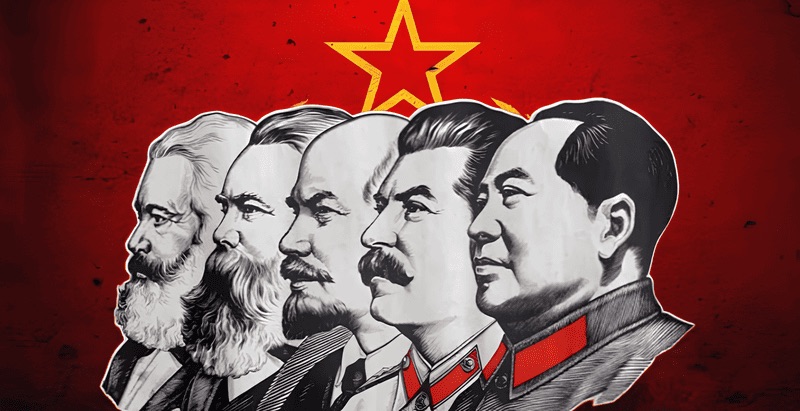
Part 3 of a series entitled Global Ideology and Human Value by Sunny Lee, Founder and President at CGPS (Center for Global Peace and Security), and Director at IKUPD (Institute for Korea-U.S. Political Development), Washington DC.
After World War II, the world was divided into the democratic West and the communist bloc, highlighting conflicting ideologies.

The late-18th century industrial revolution fueled imperialism and capitalism, leading to capitalist exploitation of laborers and widening inequality. Marx argued that this volatile system would cause economic crises, increasing unemployment and misery for the working class, thereby inspiring communism and the fight for labor rights and equality.
The Soviet Union (Union of Soviet Socialist Republics, or USSR) was a vast transcontinental socialist state that existed from 1922 until its dissolution in 1991. As the world’s first constitutionally communist state, inspired by the ideology of Marxism-Leninism, it was one of the major global superpowers and a rival to the United States from 1945 to 1991, during the so-called Cold War, a period of intense geopolitical and ideological hostility between the United States (which represented democratic capitalism) and the Soviet Union (which represented authoritarian communism).
Indeed, following World War II, the Soviet Union (USSR) solidified its control over Eastern Europe to establish a strategic buffer zone and spread communist ideology, with the installation of pro-Soviet governments, which effectively divided Europe into rival Cold War blocs.
Moreover, the Chinese Communist Party (CCP) took control of mainland China in 1949.
Communist ideology faded after the collapse of the Soviet Union bloc in 1991. A wave of peaceful revolutions swept across Eastern Europe, bringing an end to Soviet-backed communist rule and freeing the region from the dominance of the USSR. The Baltic states—Estonia, Latvia, and Lithuania—formally reasserted their independence in 1991 and transitioned to democracy. Georgia, Moldova, and Armenia also moved toward democracy, despite their political instability, while Ukraine’s road to democracy reached a historic turning point in 2013, with the launch of the EuroMaidan movement, which fundamentally shifted the nation away from Russian influence and toward European democratic nations.
Russia, on the other hand, emerged from the collapse of the Soviet Union as an authoritarian state. Although it maintains the constitutional façade of a democratic, multi-party, semi-presidential republic, power is in reality heavily concentrated in the hands of the president, who is backed by a controlled media, and there are limited mechanisms to curb the leader’s actions, particularly given the practice of suppressing political dissent.
Despite the ideological failures of the Soviet Union, communism persists in countries like China, North Korea, Vietnam, Cuba, and Laos,
China remained a one-party authoritarian state governed by the Communist Party of China (CPC). However, while the state’s official ideology remains rooted in communism, its economy incorporates vast capitalist principles, making it a hybrid system. Nevertheless, despite adopting capitalist practices, the Chinese government suppresses political dissent.
China, currently poses a significant challenge to U.S. hegemony, especially due Xi Jinping’s leadership marked by the “Chinese Dream” and the “Belt and Road Initiative.”
North Korea is a repressive, impoverished state that threatens international security with nuclear weapons. It represents an extreme authoritarianism, with the elimination of opposition and cult of personality. It is a highly centralized totalitarian state officially functioning as a socialist republic. It is a dynastic dictatorship, where the power has been held exclusively by the Kim family since the state’s inception. North Korea’s primary allies are China and Russia.
Vietnam, Cuba, and Laos continue to be governed by a one-party communist system.
Vietnam, like China, maintains a communist one-party system while implementing market reforms. Its economy is highly dynamic and export-driven, while Vietnam’s repression of political dissent is less severe than China’s.
Cuba is a communist state characterized by a one-party system and the suppression of political dissent. In the 1980s, aid from the Soviet Union accounted for 70% of Cuba’s trade and over 20% of its GDP. Following the collapse of the Soviet Union, Cuba has established strong trade relations with China, Bolivia, and Venezuela, and has also implemented economic reforms and encouraged foreign investment. Yet in 2026, it remains a lower-middle-income country experiencing a severe economic crisis
Laos is ruled by an authoritarian regime heavily influenced by communism. Despite the economic reforms launched in 1986, the country suffers from isolation and poverty, and no free elections have been held in 50 years. Over 75% of the population lives on less than $2 a day. According to the IMF, Laos’s public debt exceeds 108% of GDP and is largely owed to China. The regime has sided with North Korea in support of Russia’s war in Ukraine.
National Crisis and Systemic Transformation
Countries ruled by communist labor parties, based on Marx-Leninism, might face serious dilemmas that hinder national development. These issues have often led to regime collapse, fueled by economic inefficiencies, political stagnation, and disruptive transitions. Although countries such as China, North Korea, Cuba, Vietnam and Laos have kept communist parties in power, only those that adapted through economic reforms avoided economic collapse. Indeed, strict centralized planning might result in shortages of basic goods and services, while corruption erodes public trust and global market isolation stifles growth.
Political repression fuels dissent and unrest, while sanctions exacerbate domestic problems. The one-party system inevitably stifles political freedom, leading to the arrest of critics and the potential collapse of the government due to protests or coups.
Social crises arise from outdated infrastructure and a lack of welfare, while state-controlled media limits expression and worsens inequality. Brain drain hampers national potential as skilled professionals seek opportunities abroad.
A systemic transformation can address the crisis. Open dialogue among citizens can pinpoint their needs, leading to economic reforms and reduced state control. Political pluralism, free elections, and strengthened civil societies are crucial. Investments in education and technology, along with targeted welfare programs, can mitigate inequalities. An open government system can adapt strategies for better outcomes. Ultimately, systemic transformation is key to achieving economic prosperity and political freedom, addressing the crises inherent in a communist framework.
Authoritarianism and Global Threats
Professor Grzegorz Ekiert, a prominent political scientist at Harvard University, conceptualizes democratic backsliding as a stealthy, systemic erosion of democratic norms driven by both political elites and public demand. In his framework, this process is defined by deliberate strategies to dismantle the checks and balances of a liberal democracy from within.
Concurrently, the rise of authoritarian regimes, marked by concentrated executive power and weakened political institutions, has been overlooked. Both trends reflect anti-liberal policies, especially in post-communist nations.
North Korea exemplifies the fragility of authoritarian regimes, revealing vulnerabilities influenced by both internal dynamics and external pressures. North Korea’s extreme regime has damaged the perception of communism, suggesting it impedes human progress.
Ideological Survival of Communism
Communism has faltered due to the crises that have struck communist countries, while capitalism, influenced by democratic values, prevails. Nevertheless, China, as a superpower, is strengthening its national competitiveness, demonstrating that while communism is in decline, the nation is revitalizing itself through economic reforms and military power. However, authoritarianism, deteriorating social conditions, the suppression of political dissent, and human rights violations could threaten stability.
Adapting to global capitalism allows communism to survive rather than face a definitive end. The ideological appeal of communism can persist unless authoritarianism stifles dissent. Although it is far removed from its original egalitarian ideals, communism can adapt to survive by focusing on economic sustainability, political stability, and technological integration.
Communism should reform and transform by embracing not only a capitalist but also a democratic vision. If human rights abuses cease, authoritarianism may no longer be viewed as intolerable. Although communism historically dominated half of the world, its survival hinges on respecting human values; otherwise, it risks total extinction amid civil unrest.
Author: Sunny Lee – Founder and President at CGPS (Center for Global Peace and Security), and Director at IKUPD (Institute for Korea – U.S. Political Development), Washington DC. Sunny Lee is the author of 115 academic books in politics (original English and in German, French, Russian, Polish, Dutch, Italian, Spanish, and Portuguese). She is a bestseller writer not only in politics but also in literature on Amazon. Her recent book is titled: “The Influence on Humankind’s Peace through Korean Reunification: Creating new paradigm in social science by interdisciplinary research.”
(The opinions expressed in this article are solely those of the author and do not necessarily reflect the views of World Geostrategic Insights).
READ ALSO
Part 1 Democracy and Human Value – Ideological Transformation for Human Society
Part 2 Liberalism and Neoliberalism – Capital Globalism and Individual Freedom