



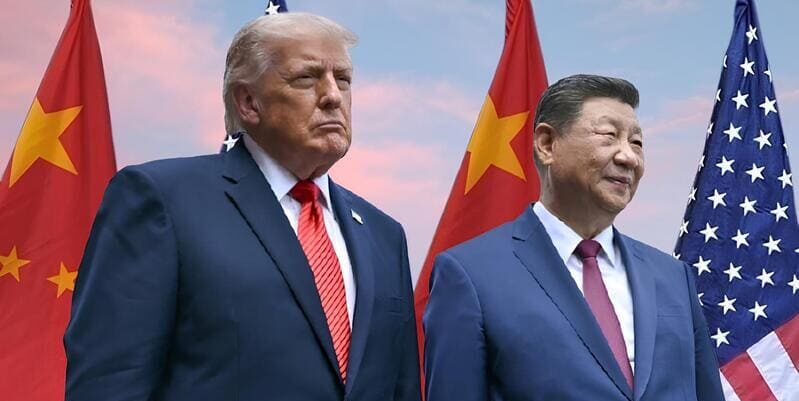
According to The New York Times, during Trump’s recent travel to China, Xi Jinping offered Washington a choice: Accept China as an equal power with red lines that must not be crossed or risk a superpower collision. (Pierson and Kuo, 2026).

The risk of a superpower collision is, indeed, an important one due to two considerations. First, because China sees the U.S. as a shrinking power and behaves more boldly. Second, because the U.S. sees China as an ascendant power and might decide to confront it while it is still on top.
Emboldened China
The first risk was clearly expressed by The Economist: “Many of China’s leading intellectuals and officials believe the American power is terminally on the wane. This has been expressed most authoritatively in Xi Jinping’s dictum that ‘the East is rising and the West is declining’. (He has been diplomatically enough not to say explicitly it is China versus America)…But since Mr. Trump’s return to power there has been an upswell: he is seen as both a symptom and an accelerant of American decline…The essential question is how China responds to its own assessment of a diminished America. One possibility is that its leaders might opt to behave more aggressively, seeing more space opening up as America shrinks”. (The Economist, 2026).
The simple fact that Xi Jinping warned Trump about China’s red lines, mainly Taiwan, under the not-so-subtle threat of a major power confrontation, is the best example of that country’s new emboldened attitude.
The danger of war under this situation would fall under the so-called Power Transition Theory. A theory about the nature of conflicts developed by A.F.K. Organsky at the University of Michigan -and later expanded by other authors such as Douglas Lemke- that aims at explaining trends between warring states in the past 500 years. (Organsky, 1968; Lemke, 2002).
According to this theory, transitional periods are particularly worrisome as emerging powers feeling emboldened and dissatisfied are prone to initiate conflicts.
Insecure United States
However, hegemonic anxiety may work the other way around. According to this perspective, it is the leading power which tends to trigger war before the emergent one becomes too powerful.
It is the classical Thucydides Trap: “Thucydides repeats, ‘the growth of the power of Athens, and the alarm that this inspired in Sparta, made war inevitable’ (…) The distinction clarifies what Thucydides keeps trying to tell us: that the fear inspired by the growth of Athenian power caused the Peloponnesian War” (Lewis Gaddis, 2019, p.p. 59, 66).
An anxious United States, indeed, may precipitate war while it still remains as the prevalent military power. Martin Jacques believes that an increasingly insecure U.S. becomes a matter of serious concern: “The greatest danger is not the rise of China but how the United States will react to China’s rise and its own consequent loss of primacy…In my view the concern should not be so much China but the United States”. (Jacques, 2019).
Rising power syndrome vs. ruling power syndrome
An emerging buoyed up power and an insecure leading one make, indeed, a very dangerous combination. Graham Allison makes the distinction between the “rising power syndrome” and the “ruling power syndrome”. In his words: “The first highlights a rising state’s enhanced sense of itself, its interests, and its entitlement to recognition and respect. The second is essentially the mirror image of the first, the established power exhibiting an enlarged sense of fear and insecurity as it faces intimations of ‘decline’”. (Allison, 2018, location 905/8432).
Whereas the “rising power syndrome” or the “ruling power syndrome” determines the outcome, only one thing is certain: We live in a critical moment in history. The only thing that at this point in time provides a break in relation to an imminent confrontation, is that both parties seem unprepared to take the initiative.
Indeed, on the Chinese side, Xi Jinping has recently purged the country’s top military brass, making it highly risky to begin a war under an untested leadership. On the American side, on the other hand, Trump has irrationally depleted in Iran huge amounts of offensive and defensive ammunition vital for a potential confrontation with China. As a result, neither side would be interested in being caught up in a war under such diminished circumstances. This provides a temporary respite in an otherwise greatly dangerous situation.
References:
Allison, Graham (2018). Destined for War. Boston: Mariner Books.
Jacques, Martin (2019). “When China and the U.S. Collide: The End of Stability and the Birth of a New Cold War”, JPI Peace Net, 24 June.
Lemke, Douglas (2002). Regions of War and Peace. Cambridge: Cambridge University Press.
Lewis Gaddis, John (2019). On Grand Strategy. London: Penguin Books.
Organsky, A.F.K. (1968). World Politics. New York: Random House.
Pierson, David and Kuo, Lily (2026). “Xi Pitches His Vision for Avoiding Superpower Collision”, The New York Times, May 15.
The Economist (2026). “China thinks America is declining but still uniquely dangerous”, May 9.
Author: Alfredo Toro Hardy, PhD – Retired Venezuelan career diplomat, scholar and author. Former Ambassador to the U.S., U.K., Spain, Brazil, Ireland, Chile and Singapore. Author or co-author of thirty-six books on international affairs. Former Fulbright Scholar and Visiting Professor at Princeton and Brasilia universities. He is currently an Honorary Fellow of the Geneva School of Diplomacy and International Relations and a member of the Review Panel of the Rockefeller Foundation Bellagio Center.
(The opinions expressed in this article belong only to the author and do not necessarily reflect the views of World Geostrategic Insights).