



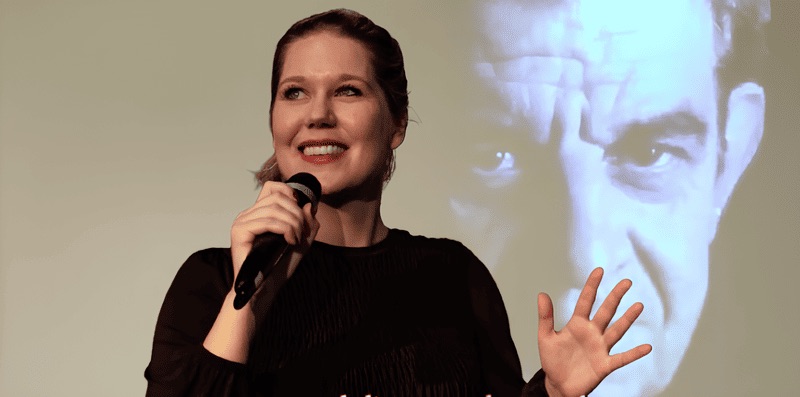
World Geostrategic Insights interview with Nina Krajnik on the key issues facing Slovenia and global politics, their symptoms, the influence of the historical context, possible solutions, and role of psychoanalysis.

Dr. Nina Krajnik is a Slovenian philosopher, writer, and psychoanalyst. She is the founder and president of the Slovenian Association for Lacanian Psychoanalysis and the international movement “Lakan Balkan.” She is the Director of the Institute for War and Environmental Trauma (IWET), whose activities include conducting clinical field research and providing psychosocial support in war zones, such as the districts of Kharkiv, Kiev, and Bucha in Ukraine. She also carries out humanitarian activities on behalf of vulnerable populations. Dr. Krajnik is the author of numerous works on science, philosophy, art, and literature and is the editor-in-chief of the Juno publishing series. She has applied psychoanalytic perspectives to the analysis of Slovenian politics and ran as a candidate in the 2022 Slovenian presidential election.
Q1 – What are the main challenges facing Slovenia today?
A1 – The main challenge is not merely the existence of social, political, or institutional problems. The real problem is that these issues are acknowledged only at a declarative level, while their fundamental cause is consistently avoided and excluded from articulation. This cause is the process of transitional privatization that began with the establishment of Slovenia in 1990.
By privatization, I am not simply referring to the shift to a market economy after the collapse of Yugoslav socialism. I mean, above all, the privatisation of social property and the appropriation of access to public money. This process is crucial for understanding the inequality that defines Slovenian society today, as it created a division between the victims and beneficiaries of privatization. The same logic runs through other post-socialist and post-communist countries, where, in cases such as Russia or Ukraine, it led to the formation of an oligarchic class.
The result is that all the segments of the state – public institutions, regulatory bodies, the judiciary, academia, the media, the cultural sphere – today function primarily as mechanisms for managing and stabilizing the outcomes of privatisation. Their role is not to safeguard public welfare, but to reproduce the material and symbolic dominance of the winners of the privatization process. Naturally, at the direct expense of the people and society as a whole.
What is essential to understand about the contemporary Slovenian political landscape is that the privatization of access to public money is a deeply anti-democratic process. And anti-democratic processes produce anti-democratic effects. This is the reason for the entire spectrum of toxic consequences that characterize the country’s political and social life. As Roberto Esposito said, “what is common is not my own.” Yet in Slovenia, treating the common as if it were one’s own eroded any chance of a social bond, because it emptied the common of its every meaning.
Q2 – How would you address those issues?
A2 – If we understand transitional privatization not just as an economic rupture but as a psychopolitical trauma that was never symbolically processed, then we must first acknowledge this: the foundations of the Slovenian state were fractured already at their point of origin. The inability to recognize and work through this fact is what continues to cripple institutional functioning, undermine the rule of law, and entrench hopelessness and cynicism among the people.
This is hardly surprising. When a state is established on the basis of legalistic concealment of transitional plunder and the absence of a collective agreement on justice, its institutions cannot function as guardians of the common good, but only as administrators of a predatory order. But by doing this, they actually demonstrate that they were never symbolically constituted – only usurped. On a daily basis, they reveal not only that the old Yugoslav order collapsed without any adequate symbolic replacement but, above all, that this symbolic replacement has not appeared to this very day. And when the law exists in a country that after the collapse of a former system was unable to ensure any adequate symbolic replacement, it can only take the form of a perverse law – that is, a law that exists in order to be violated. When the common has no meaning, the law becomes only a prolongation of personal interests. But this is neither an accident nor an anomaly. It is not the result of one political camp misusing the law against another, nor a consequence of the intellectual incapacity to establish the legal framework. It is a symptom of an unprocessed historical rupture.
For this reason, it is not enough to “fix” legislation or to “clean up” institutions, as Slovenian officials like to express themselves. Technical adjustments, bureaucratic fine-tuning, and surface-level solutions do not touch the core of the problem. What Slovenia needs is a complete symbolic reform and a genuine ethical rehabilitation: a public acknowledgment of historical abuses that started in 1990, an exposure of the fantasies that still govern our social reality, and a courageous confrontation with the fact that a legal form without ethical substance produces nothing but a simulacrum of a state – a hollow form without substantive legitimacy.
Without this, people will continue to live in a place where everyone is “playing the game,” yet no one believes in the rules. And until such a symbolic cut happens, the country will remain a hostage to its past – a state without a democratic future, because it never dared to look into its own anti-democratic beginning.
Q3 – You ran in the last Slovenian presidential election. How would your experience as a psychoanalyst and philosopher prepare you for the role of President of Slovenia?
A3 – Psychoanalysis engages with what is excluded — with what has been repressed, forgotten, or disavowed, but what nevertheless inevitably defines us. In this sense, the announcement of my candidacy in the presidential elections sought to confront the question of whether Slovenia has the capacity to face its repressed questions, and, moreover, not only what, but who is excluded. My program aimed at changing discourse, that is, at transforming the way we approach and speak about political issues today. Politics, in my view, is not just a set of administrative procedures or party structures. Politics happens when people think. Or, more precisely, when they are able to think beyond conventional frames and take action against the destructive currents in which they are trapped.
We live in a world that is rapidly changing, on the verge of geopolitical tensions and increasingly destructive forms of power. But is this really the change we want to see? Is this really how we want the world to be transformed? Or is it possible to initiate change through the way we articulate politics, and to foster a form of speech that is not based on the simulation or normalization of the toxic, but on a discourse that opens up space for thought and enables different forms of action? This is the role of psychoanalysis in politics, and today it is more necessary than ever.
Q4 – As the Director of the Institute for War and Environmental Trauma (IWET), you have conducted fieldwork in war zones, such as Bucha in Ukraine. What are the specific symptoms that emerge from current political crises and war, and which existing trauma models we may overlook?
A4 – When one finds oneself surrounded by political madness, such as war, the major question becomes how it is even possible to live without going mad. How can one live in a society where there is no law which would protect life… How can one keep going when not only stability is lost, but the very hope for stability in the future… As G. K. Chesterton once said: “A madman is not someone who has lost his mind. A madman is someone who has lost everything – except his mind.” To experience war means to experience complete vulnerability, exposure, abandonment, and the deprivation of every meaningful connection to the world and its supposed values.
To be with someone in the midst of war has therefore always meant, for me, to evoke the possibility that these connections can still exist. Not because of idealism – because in such circumstances idealism does not exist – but as an act of resistance against the collapse of human bonds. To be present when the world hits hard, means not letting someone fall into the abyss of a traumatic event, but to demonstrate that even in times of complete ethical failure there is always something that can bind us together. And that we should never give up on that.
Q5 – You are known for introducing Lacanian psychoanalysis to the Western Balkans. What specific aspects of Lacan’s work did you find most relevant or necessary for the Slovenian and Balkan contexts?
A5 – I have found a particular relevance in the psychoanalysis of trauma and in what, in Lacan’s legacy, we can call the singularity of the subject. The history of nation-building, oppressive regimes, ethnic cleansing, genocide, war, and post-war killings has left societies trapped in cycles of identification that today function as tools for the repetition of trauma.
Concretely, this means that one can quickly identify with ready-made identities – whether national, religious, gender-based, or, to the same extent, their anti-national, anti-religious, or anti-gender counterparts. These identifications are built upon the conviction that they have suffered because of them – that they suffered precisely because they are Muslims, Serbs, Croats, male, female, communists, Catholics, Orthodox, anti-nationalist, atheist, non-binary etc. While in fact these mass identifications are true only for the ideology that indeed exercised violence over them. The subject in this case tends to identify with the gaze and the speech of the aggressor, and in doing so, actually becomes a victim for the second time.
Because once this occurs, trauma easily enters the apparatus of governance, where it becomes a mechanism for measuring ideological and legal power, and begins to produce new forms of segregation: who suffered more, who suffered less, who suffered rightly, and who suffered wrongly. In this situation, there is no possibility for the restoration of the dignity of those who have experienced trauma and injustice. Instead, from one generation to the next, nothing is transmitted but hatred, exploitation, and ideological persuasion.
The singularity of the subject has therefore proven to be a healing concept. It liberates the individual from mass identities and opens the possibility of taking a position in the actuality of one’s own life. It awakens what is distinctive in each and every one, which is precisely the condition that makes it possible to be truly together with others.
Q6 – What was your primary motivation for founding SINGULARIS – Global School of Clinical Studies, and what gap in global clinical education does it aim to fill?
A6 – SINGULARIS emerged from my ten-year international program of seminars and study formats, through which I brought together world-renowned psychoanalysts, psychiatrists, and psychologists, as well as philosophers, artists, filmmakers, political theorists, diplomats, anthropologists, historians, medical doctors, nuclear physicists, and war correspondents from more than forty countries – from Japan and India to the USA, South America, the Middle East, Ukraine, and across Europe. It became a unique, top-tier space for the sharing of knowledge and experience that has taken a global dimension.
But what matters in clinical formation is more than the transmission of knowledge; it is the awakening of desire and courage. Many educational institutions today exemplify precisely the opposite, and it is not difficult to see why. Universities are largely just the extensions of prevailing power structures. And as contemporary power tightens around a systematic degradation and an impoverishment of knowledge, universities follow, trapped in the fantasy of their own dominance and universality. The result is that they replace thought with procedure, formation with evaluation, responsibility with profitability and budgetary obsession, and thus become nothing more than a fancy guardians of a dead time.
Every education begins where knowledge ceases to protect itself through such maneuvers. Clinical formation does not proceed from mastery, but from a lack – the lack that ignites a desire and from the courage not to close it.
Q7 – As editor of the independent series Juno, you aim to publish works that are intellectually daring and aesthetically refined. What voices or perspectives do you feel are currently underrepresented in mainstream psychoanalytic publishing?
A7 – I have great respect for everyone involved in publishing, because a book is not like any other object in the world – it is a world in itself. Yet when it comes specifically to psychoanalytic publishing, a problem arises if psychoanalysis is no longer approached as a subversive practice, but as an ideological mystification.
One such widespread ideological mystification is the reduction of psychoanalysis to psychotherapy – meaning a domesticated technical service that pushes symptoms into the realm of personal psychopathology, without taking into account the analysis of a social bond. But another ideological mystification – particularly present in Slovenia, but by no means limited to it – is so-called “theoretical psychoanalysis.” The problem with the latter is not only that it excludes clinical practice, but that it has been used to legitimize transitional privatization and new social inequality, serving as an ideological cover-up. These two tendencies constitute a mass production of publishing today and suffocate the potential.
To open space for books that cut through this suffocating air inspired me to found Juno. The name comes from Virgil’s Aeneid and Juno’s words: Flectere si neque superos, Acheronta movebo — “If I cannot bend the will of the higher powers, I will move the underworld.” For me, this line captures the ethos of the series, as well as ethos of psychoanalysis and politics today. Transformation in our lives does not occur at the level of rational intentions, but through the unconscious. Just as the struggle for justice in politics ain’t gonna be answered from above, it’s going to have to happen from below. And this is why psychoanalysis, for me, is the most subversive form of politics.
Dr. Nina Krajnik – Slovenian Psychoanalyst, Philosopher, and Writer.