



By Alamgir Gul
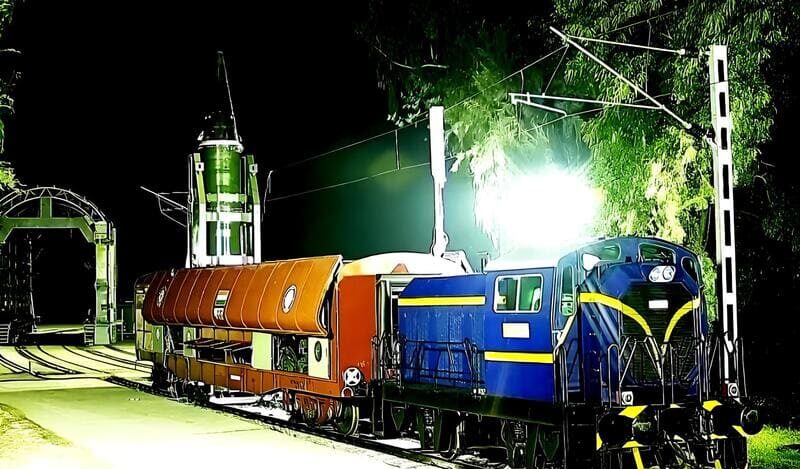
The recent test of the rail-based variant of the Agni-Prime (Agni-P) missile by India is not just technically a milestone but also a strategically consequential action that will increase the risks of miscalculation, arms competition, and crisis instability between the nuclear adversaries of South Asia.

Although the capabilities of New Delhi are manifested as the tools of deterring and strategic autonomy, the Agni-P attributes canisterized, solid-fuel agility, and rail mobility, make concealment fast, survivable launch a high value that significantly complicates the management of crisis to adversaries and peacetime restraint.
In a technical sense, Agni-Prime is a generational change of the medium-range missiles force of India, which is reported to have a range of between 1,000 and 2,000 kilometers and is reportedly a two-stage, solid-propellant missile, transported and fired off-road and rail. These characteristics reduce pre-launch schedules, expand dispersal capabilities of launchers, and minimize exposure to pre-emptive attack, exactly what states are looking to give them confidence of second-strike survivability.
Theoretically, survivable and mobile forces help in making deterrence stabilizing since they make retaliation possible following an attack in an asymmetric and densely proximate geography. In practice, they may do just the opposite in South Asia, where mobility contributes to concealment. The concept of rail-integration, especially, implies that the assets of the missiles can be merged into civilian systems, making it difficult to gather intelligence and provide early warning. In the case of Pakistan, where strategic depth and geography are far different than India, the possibility of dispersed rail-mobile MRBMs creates serious operational concerns: the lack of information about launcher locations, reduced decision-making time, and the risk that it will lead to pre-emptive or launch-on-warning postures, which were less urgent in the past.
There are many politico-strategic risks of such advancements. First, uncertainty on deployment and preparedness enhances the risk of false or worst-case assumptions in times of crisis. In case Islamabad cannot be certain that it is dealing with regular rail traffic, exercises, and the clandestine release of strategic equipment, political leadership and military commanders will be pressured, both in the domestic and institutional sense, to act in a way that puts the fuse on the use of nuclear arms in a shorter period of time. Second, mobility increases the instability of the crisis by enabling salvos and misleading actions: a force capable of moving on rail can be used to launch the salvo or a dispersal wave, making it more difficult to intercept and identify, and thus promoting the threat of unintentional escalation. This threat has recently been pointed out by analysts and regional observers on the test.
Third, signaling and psychological effects are important. An obvious display of rail-launched missiles presents a forceful national and global statement of technological capabilities and strategic distances. Rarely does strategic signaling in South Asia happen in a vacuum, any emerging Indian capability has always been understood in the perspective of balance and vulnerability for Pakistan. The canisterization, fast-response nature of the Agni-P can be viewed as reducing the barrier to arms-race dynamics: Pakistan find it necessary to respond in some form or other: whether in the form of more delivery systems, survivability, more decoys, or doctrinally (a change in the alert status or a change in reliance on early-warning), all of which has a cost, risks danger, and exposes their action to misunderstanding on the other side.
Pakistan has maintained the policy of credible minimum deterrence and strategic restraint for peace and stability in South Asia, but on the other hand, India`s acquisition of high end missile systems including Agni-P with increased range and precision indicates a shift in its doctrinal posture towards a counter force and an aggressive nuclear policy. The rationale of such developments is India`s lust for strategic dominance and preemptive advantage of strike, which is basically blurring the lines between defensive deterrence and offensive preparedness. This will not only destabilize the region, but it will also increase the arms race causing new dangers of miscalculation in a nuclearized region. For Pakistan, such changing dynamics, requires effective countermeasures such as modernization of technology, better command and control mechanism and a variety of deterrent forces to maintain the deterrence balance. As long as Pakistan keeps on promoting dialogue and restraint, it should also maintain the credibility of its deterrence to be adaptive and well-proportioned to the ever growing strategic ambitions of India so that the balance in South Asia remains stable and there is no tendency towards instability.
It is not logical to consider the desire of India to possess modern and survivable systems of delivery in such an environment with hegemonic ambitions, where strategic modernization cannot be isolated from the implications at the regional level. The Agni-P is, then, is not a technological achievement but, agonizing strategic externality: it has the potential of reducing deterrence to politics of anxious competition and coercion. The policy need, as in the case of Pakistan or the region, in general, is apparent, that is not to confuse credible deterrence with imaginative diplomacy, and a new commitment of actions that would put predictability and restraint back on track.
Author: Alamgir Gul – Research Officer at Balochistan Think Tank Network (BTTN), at BUITEMS, Quetta. He is a Gold Medalist and holds a Postgraduate Research Degree in Peace and Conflict Studies from National Defence University Islamabad, Pakistan.
(The opinions expressed in this article are solely those of the author and do not necessarily reflect the views of World Geostrategic Insights).