



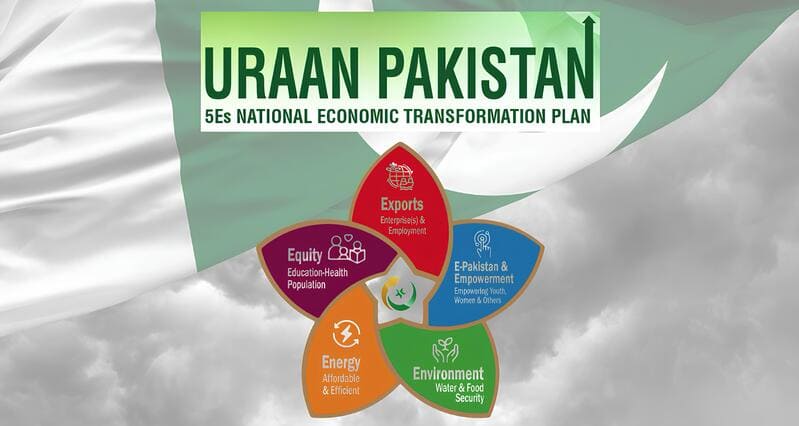
When the Government of Pakistan unveiled the Uraan Pakistan framework built around the five pillars of Exports, E-Pakistan, Energy and Infrastructure, Environment and Sustainability, and Equity and Empowerment, it promised nothing less than an economic re-imagining.

The vision of a trillion-dollar economy by 2035 projected confidence, daring, and a belief that Pakistan could rewrite its development story through productivity, digital innovation, and inclusion.
For a country too long trapped in cycles of boom and bust, Uraan Pakistan sounded like lift-off. But as we look closer at the numbers, regional disparities, and institutional realities of 2025, it becomes clear that the gap between aspiration and capacity remains painfully wide.
The macroeconomic fundamentals tell a sobering story. Pakistan’s GDP grew by barely 2.38 percent in FY 2023-24, while the investment-to-GDP ratio hovered near 13 percent, far below the 25-30 percent typically needed for rapid take-off.
Inflation, though moderating from the 30 percent peaks of 2023, continues to suffocate real incomes and business sentiment. Exports, the first “E” in the plan have stagnated, dominated by low-value textiles that make up almost 60 percent of export receipts.
Industrial output remains sluggish, contracting by more than one percent in FY 2024-25, and Pakistan’s export-to-GDP ratio at around 10 percent is among the lowest in Asia. To reach the trillion-dollar goal, Pakistan would need consistent 8-to-10 percent growth for a decade, a rate it has never sustained in its history.
Behind these national averages are the structural and regional asymmetries that make uniform transformation elusive. Punjab and Sindh dominate the economic landscape, producing the bulk of exports, digital start-ups, and industrial capacity, while Khyber Pakhtunkhwa and Balochistan remain largely peripheral.
Karachi alone generates more than half of Pakistan’s export value, while Balochistan’s literacy rate struggles around 42 percent. Digital readiness mirrors this divide: Punjab scores 0.213 on the national Digital Development Index, Sindh 0.209, KP 0.196, and Balochistan just 0.135.
The imbalance reveals not only economic inequality but also uneven institutional capability. Fiscal surpluses – Punjab’s Rs 212 billion, Sindh’s Rs 137 billion, KP’s Rs 56 billion, and Balochistan’s Rs 112 billion suggest improved accounting discipline, yet execution remains poor. KP slashed its education spending by 78 percent in one year, while Punjab cut 22 percent despite a third of its children being out of school.
Human capital remains Pakistan’s deepest fault line. Over 26 million children are out of school; provincial rates range from 32 percent in Punjab to 69 percent in Balochistan. The female labour-force participation rate remains below 23 percent, among the lowest in South Asia. Most women work in informal or unpaid roles, and the majority of the workforce lacks technical or digital skills.
Digital progress offers glimmers of hope. In FY 2023-24, mobile and internet banking transactions rose by 89 percent to Rs 12.7 trillion, broadband penetration reached 57 percent, and IT-enabled services began showing export potential. Yet these achievements remain urban-centric and fragile.
Unfortunately large swathes of rural Pakistan remain unconnected, and the digital economy still contributes little to GDP. The promise of E-Pakistan of digitally powered governance and entrepreneurship will fade unless infrastructure, affordability, and literacy improve simultaneously.
Energy and infrastructure, the third pillar of Uraan, remain both opportunity and obstacle. Installed capacity now exceeds 46,600 MW, but circular debt, poor transmission, and chronic losses cripple the sector. Provincial power dues have soared beyond Rs 160 billion, while Sindh, despite vast renewable potential, has spent less than 3 percent of its allocated energy-development funds in a decade.
Nationally, infrastructure investment averages a meagre 2.1 percent of GDP, the lowest in the region. These constraints, coupled with outdated logistics and expensive power, severely limit industrial competitiveness and export diversification.
Pakistan’s political economy compounds these structural weaknesses. Policy inconsistency, bureaucratic inertia, and short-term politics erode investor confidence. Each electoral cycle resets priorities; reforms rarely outlive governments.
Yet even within these limitations lie possibilities. The country’s youthful population, expanding digital base and strategic geography gives it potential leverage if managed wisely. Provincial comparative advantages could complement rather than compete: Punjab’s manufacturing base, Sindh’s ports and finance, KP’s tourism and remittances, and Balochistan’s mineral and energy reserves.
But opportunity is not the same as readiness. The gap between Pakistan’s aspirations and its execution capacity remains vast. The Uraan Pakistan plan aspires to modernize governance, elevate exports, digitize services, and empower people, but these ambitions will remain rhetorical if the institutional machinery cannot deliver.
The history of Pakistan’s development planning is replete with well-written documents that never survived the politics of implementation. As policymakers, scholars, and practitioners gathering at the University of Oxford for the Uraan Pakistan Conference to deliberate on this vision, they confront a question that cuts to the heart of Pakistan’s development dilemma; can the country move beyond dreaming big to delivering steadily?
Pakistan has never lacked visionaries, it has lacked continuity. Conferences can inspire, policies can be drafted, targets can be set but unless the state cultivates discipline, institutional memory, and public trust, even the most elegant blueprint will remain paper-thin. The challenge, therefore, is not simply to celebrate aspiration but to forge the political and administrative muscle to act on it.
At Oxford, amid the optimism of global engagement, Pakistan must also embrace introspection. Economic transformation is not achieved through slogans or fiscal surpluses but through systems that outlast governments.
It requires investment in children, in teachers, in engineers, and in the credibility of public institutions. It requires leaders who plan beyond the next election. If Uraan Pakistan is to soar, it must first build the runway of governance and human capital from which real flight is possible.
The dream of a trillion-dollar Pakistan is not an illusion; it is an equation of growth, inclusion, stability, and trust. At Oxford, the real test is not whether Pakistan dares to dream, but whether it finally learns how to deliver.
Ambition without realism risks becoming rhetoric. The Uraan Pakistan initiative, bold in design and noble in intent, offers a potential flight path to prosperity but it must overcome gravity first. For that, Pakistan needs political reform, institutional discipline, and sustained investment in its people. Only then can Uraan move from aspiration to achievement and Pakistan truly begin its long-promised economic transformation.
Author: Mirza Abdul Aleem Baig – President of Strategic Science Advisory Council (SSAC) – Pakistan. He is an independent observer of global dynamics, with a deep interest in the intricate working of techno-geopolitics, exploring how science & technology, international relations, foreign policy and strategic alliances shape the emerging world order.
(The views expressed in this article belong only to the author and do not necessarily reflect the views of World Geostrategic Insights).