



There are numerous dimensions to the current joint military conflict between the U.S. and Israel against Iran. A core aspect of this conflict has been the geopolitics of natural resources, particularly oil and LNG.

This is not surprising given how fundamental these things are to the global economy and with the Iranians shutting off the Strait of Hormuz, through which twenty percent of the world’s oil is transported, global energy prices could skyrocket; and, potentially, cause a global economic crisis. However, there is another aspect to this conflict that is going relatively overlooked that demands our attention. Namely, water.
A truism of geopolitical studies is that the unequal distribution of natural resources often shapes geopolitical patterns. The Pacific Institute published a ‘Water Conflict Chronology 2025 Update’ which stated that, “The total number of recorded water-related conflict events has risen sharply over the past fifteen years…Growth continued in 2024, with an additional 18 percent increase over the previous year.” Mounting drought-driven scarcity and inadequate water access has led to many conflicts in recent years.
It is also well-known that Iran has been confronting an unprecedented water crisis. As Scott N. Romaniuk, Erzsébet N. Rózsa, and László Csicsmann pointed out before the conflict began, rivers that once sustained agriculture and settlements have been drying and drought cycles have become more frequent and severe with this past autumn being one of the driest periods in the past twenty years. The Isfahan region, which has been one of Iran’s most important cultural, economic, and architectural zones, lies in one of the driest parts of Iran where rainfall has fallen, temperatures have risen, and groundwater reserves have been depleted. Also well-known is the water scarcity facing the Gulf Cooperation Council (GCC) countries. While these countries are rich in oil and gas reserves, they are poor in water resources and arable land. The GCC thus faces “severe water challenges due to aridity, urbanization, and population growth.”
Since President Donald Trump launched “major combat operations” against Iran, the latter has responded by launching missiles and drones against military installations, urban centers, airports, and buildings throughout the Gulf states. Even more crucially, they have been targeting the Gulf Cooperation Council (GCC)’s energy infrastructure. This is significant because, as one analyst noted, it undoes America’s attempt to de-risk the region and places in jeopardy the “unique selling point and business models that have underpinned the Gulf states’ global rise.”
Oil is, of course, a critical resource to attack. Since the Gulf states sell oil in dollars (also known as the petrodollar) and they do so in exchange for U.S. security which underwrites their ability to anchor their currencies to the dollar, recycle surpluses into U.S. financial markets, and rely on American military protection as the ultimate guarantor of their regimes’ survival, if the Iranians can prove they strike at the foundation of their prosperity consistently and effectively, the stakes will be raised. Where the stakes could be raised that much further is by both sides engaging in attacks on water sources. This is an existential, geostrategic concern.
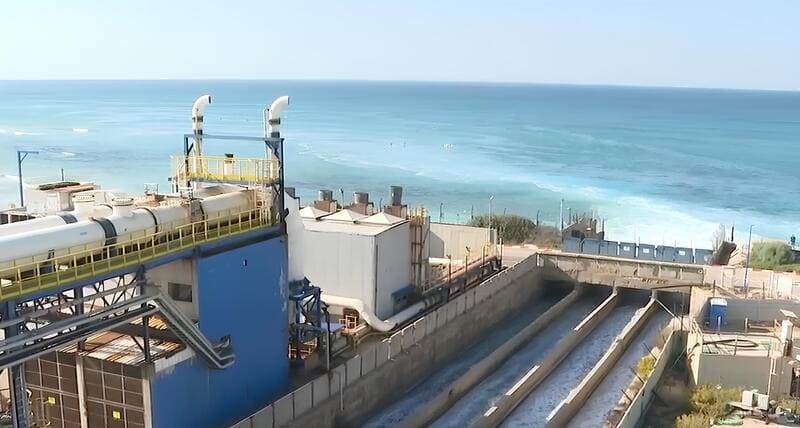
Due to water scarcity in Iran and the Gulf, these states get a lot of their drinking water from desalination plants. These are factories that convert salty sea water into clean drinking water. In essence, these are necessary infrastructures for the perpetuation of human existence in much of the Middle East. Kuwait gets 90 percent of all its drinking water from desalination, Oman gets 86 percent from desalination, 70 percent in Saudi Arabia, and 42 percent for the UAE. In 2009, a leaked U.S. State Department diplomatic cable suggested that “a hostile act against Saudi Arabia’s desalination plant at Jubail would force Riyadh to evacuate ‘within a week,’ as the plant at that time provided Riyadh with over 90 percent of its drinking water.”
These desalination plants are big, out in the open, immovable, and thus not inconspicuous. If this conflict escalates further and it becomes even more of an existential battle than the belligerents currently believe it to be, the targeting of water supplies will likely become a central feature of strategic planning. If this war moved beyond oil and missiles into the deliberate targeting of water systems, it would enter a different strategic category altogether. Water infrastructure is about biological survival itself.
Consider a hypothetical escalation in which Iran begins sustained attacks on desalination plants along the Arabian Gulf. These are the literal source of drinkable water for millions of people. Unlike oil exports, which can sometimes be rerouted or stored, municipal water supply operates on a tight daily schedule. If production is interrupted for even a few days, then distribution networks begin to falter. If production is interrupted for a week, then urban life, and life in general, will degrade rapidly as hospitals will have to ration, sanitation systems will become strained, and bottled water prices will spike. As a rule of thumb, a person can survive without water for three days. If the Iranians keep the Strait of Hormuz closed, then the Gulf states will have their food imports reduced massively. This is not an ideal situation to be in.
The strategic logic for Tehran in such a scenario would not necessarily be annihilation, however, but coercion. By demonstrating that Gulf monarchies cannot guarantee drinking water under American protection, Iran would be attacking their social contracts themselves. These regimes trade political acquiescence for stability and material provision. Water is the most elemental of those provisions. If desalination capacity is perceived as vulnerable, the credibility of the broader security architecture erodes. Conversely, if Israel, with U.S. backing, targets Iranian dams, aqueducts, or pumping stations—especially in provinces already strained by drought and groundwater depletion—then Iran faces heightened prospects of destabilization and existential crisis. Its internal water crisis has already periodically sparked protests. A calculated strike on water systems feeding major population centres could compound environmental stresses into not only political, but biological catastrophe.
As opposed to other shocks, water shocks are more immediate and physiological. They test state capacity at the level of daily life. The strategic paradox is stark. Weaponizing water might offer short-term leverage, but it risks long-term destabilization that neither side can fully control. A region already facing intensifying heat and declining precipitation would find its ecological stress fused with military escalation. In such an environment, deterrence becomes more fragile, because the stakes are no longer abstract measures of influence but the functioning of cities themselves.
In sum, the argument that “hydro-politics will shape the 21st century” is becoming a truism as time passes, and the current conflict in the Middle East is proving that. If there is no access to water, not only will there be no life, but—experts agree—there will be no peace. Since the Israelis see Iran as an existential threat, and the Iranians see their struggle against Israel and the U.S. as existential and holy, it is conceivable that as the conflict escalates each side will aim to cut down the roots of life itself. They will likely begin with water.
Author: Bailey Schwab, PhD – Foreign policy researcher specialising in U.S. strategy, presidential doctrines, and the evolution of Western statecraft from the late Cold War to the present. He is currently a Visiting Fellow at the Hungarian Institute of International Affairs, Budapest.
(The opinions expressed in this article belong only to the author and do not necessarily reflect the views of World Geostrategic Insights).
Image source: i24News (A seawater desalination plant in Israel).