



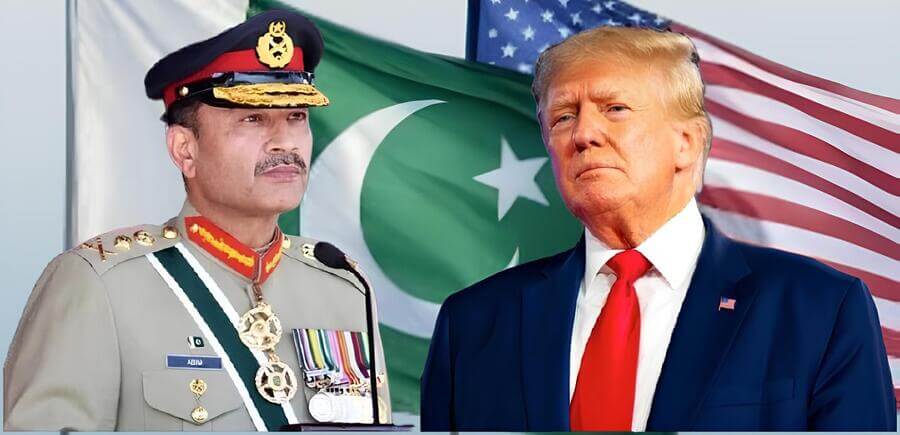
World Geostrategic Insights interview with Yasir Masood on the significance of the meeting between Pakistani Army Chief of Staff, Field Marshal Asim Munir, and US President Donald Trump, at the White House on June 18; how influential Munir currently is in Pakistan; Trump’s role in stopping the military confrontation between India and Pakistan last May; whether Pakistan’s divergences with India, and its close relations with China, inevitably complicate the improvement of relations with the US; and Pakistan’s position in the ongoing conflict between Israeli/US and Iran.

Dr. Yasir Masood is a Beijing-based Pakistani political and security analyst, specializing in BRI, CPEC, South Asian and Indo-Pacific geopolitics, China-US relations, and Chinese foreign policy. He holds a PhD in International Relations from UIBE, Beijing, with research on the Balochistan conflict and regional stability. A former Media and Publications Director at the Centre of Excellence for CPEC, he has conducted fieldwork in Gwadar and regularly contributes to international media and think tanks.
Q1 – On June 18, US President Donald Trump received the head of the Pakistani army, Field Marshal Asim Munir, at the White House. Munir and Trump discussed how to strengthen cooperation between the two countries in various areas, including economic development, artificial intelligence, energy, and emerging technologies. What is the significance of this meeting? Could Munir’s visit to the US signal a potential strategic shift in US-Pakistan relations?
A1 – I believe the June 18, 2025, White House meeting between President Trump and Field Marshal Syed Asim Munir was a landmark for Pakistan. It marked the first occasion that a sitting US president hosted Pakistan’s army chief alone at the White House for a two-hour one-on-one meeting, reflecting the significant diplomatic weight given to this interaction, suggesting Washington now sees Islamabad as more than a counterterrorism partner. Trump called it ‘an honour’, praising Munir for defusing May’s India–Pakistan standoff when two very smart people, Munir and Modi, decided not to keep going with that war, and those are two big nuclear powers.
That moment did not come out of nowhere. Since the early Cold War, when Pakistan joined US defence pacts and received military and economic aid, the relationship has weathered Vietnam, Afghanistan and post-9/11 operations. The US has provided Pakistan with significant financial support, including $7.5 billion in civilian and military aid from 2002–2011 (Congressional Research Service, 2024). In my view, each crisis strained ties, yet common interests endured. This visit both honoured that history and aimed to redefine it for today’s challenges.
Fresh border tensions with India in May and the Iran–Israel flare-up made deeper engagement urgent. As I see it, Munir pressed Pakistan’s ‘multi-vector’ approach and touted USD 6 trillion in mineral reserves as confirmed by Pakistan’s Inter-Services Public Relations. He floated zero-tariff deals for US energy, agriculture, technology firms, and proposed using surplus 2,000 MW of power for bitcoin mining operations, blockchain nodes, and AI data hubs, as US media reported.
Security was not forgotten, as United States Central Command (centcom) commander Army General Michael Kurilla, a couple of weeks back, praised Pakistan as a ‘phenomenal partner in the world of counter-terrorism’, citing the nation’s struggle against terrorism in Balochistan and against terrorist groups like the Islamic State-Khorasan (IS-K). This also highlights Pakistan’s continued utility as a kinetic ally due to its geographic proximity to Iran and Afghanistan. Yet the real pivot was economic, reframing Pakistan as a growth market and stability partner rather than only a defence ally. To my understanding, this shift was important, and think tanks, business forums and media channels quickly picked up on that message.
Yet goodwill can be fleeting. When Pakistan nominated Trump for the 2026 Nobel Peace Prize, he struck Iranian targets 24 hours later, underscoring how regional shocks can upend diplomacy in a day. I think it was an overambitious, miscalculated move on the part of Pakistan. Instead, it should have convinced Trump to save Palestine from the clutches of Israel, a repressive apartheid regime, pulverizing innocent Palestinians to ashes under militarized might, burying them beneath the rubble of their own homes. Only then would Trump have deserved to be nominated for the Nobel Peace Prize.
Behind the smiles, Islamabad ran coordinated media campaigns and expert briefings to assert its own agency. In my opinion, President Trump’s open recognition of Pakistan’s role effectively defied India’s long-standing position of no third-party mediation, allowing Pakistan to cast itself as a constructive partner in promoting regional stability.
Before leaving, Munir invited Trump to Pakistan, signalling a willingness to diversify ties. Pakistan wants broader economic support, more leverage with the IMF and a buffer against an increasingly close US–India defence partnership.
In summation, this meeting may well mark the beginning of a strategic recalibration in US-Pakistan ties, provided both sides can follow through on the economic and diplomatic openings created. Pakistan has perhaps made clear that it intends to be a full partner, actively shaping its future rather than remaining a passive recipient of external decisions.
Q2 – This meeting is noteworthy because it marks the first time a US president has invited a Pakistani military leader who is not the head of state. How influential is Munir currently in Pakistan?
A2 – Field Marshal Syed Asim Munir is exceptionally influential and popular in Pakistan. His May 2025 promotion as only the second Field Marshal, while still retaining his position as the Chief of Army Staff, signalled trust in his judgement after recent regional tests.
A recent poll conducted by Gallup Pakistan showed that 93 percent of respondents viewed the army more favourably after the May standoff with India, largely crediting Field Marshal Munir’s leadership. Operation Bunyan-Al-Marsoos is widely seen as having averted a broader conflict — a view even echoed by President Donald Trump. The way Pakistan’s military responded to India’s aggression and the decisive outcome of that debacle reshaped Pakistan’s image within 48 hours. It emerged not only as a responsible nuclear power but also as a stabilising force in South Asia. The credit goes to Munir’s leadership and Pakistan’s ability to expose India’s hollow claims of regional dominance.
In the past, he showed his acumen as the Chief of Army Staff while handling issues with Iran and Afghanistan, which earned him respect across military and civilian institutions. He often underlines Pakistan’s technology, agriculture, and energy strengths, which have opened serious discussions in policy and business circles about reimagining Pakistan as more than a security partner. Proposals such as using surplus power for tech projects illustrate how he links security concerns to economic thinking. On internal security, his calls to eradicate militancy and extremism ring true for many Pakistanis, suggesting he grasps ground realities.
He deals with civilian leaders through quiet coordination rather than public statements, allowing space to advance priorities without friction. Internationally, his role is now tied to Pakistan’s image as a stabilising force in South Asia. Meetings like the one at the White House reinforce that shift. Taken together, his rank, crisis handling, economic focus and internal stability agenda place him at the heart of national decision-making. Few here or abroad would doubt the depth of his influence.
Q3 – Trump has taken credit for stopping the recent conflict between India and Pakistan, praising both Prime Minister Narendra Modi and Munir and suggesting that their cooperation prevented a potential nuclear war. However, India has denied any third-party involvement, saying that the ceasefire was achieved through direct military talks between India and Pakistan. Where does the truth lie?
A3 – From my perspective, Pakistan’s position aligns with President Trump’s claim of playing a role in halting the conflict. Both the military and civilian leadership publicly thanked him, and the government went as far as nominating him for the 2026 Nobel Peace Prize, calling his engagement decisive in avoiding a larger war.
India’s denial of third-party involvement does not hold up under scrutiny. After unilaterally revoking Article 370 in 2019, it weakened its own claim of keeping regional issues strictly bilateral, whether on Kashmir, the Indus Water Treaty, or security-related matters.
Operationally, I believe Pakistan’s response through Operation Bunyan-Al-Marsoos, which resulted in the downing of six Indian jets, changed the course of events. That shift in momentum prompted India to quietly opt for a ceasefire to avoid deeper embarrassment. Incidents like Pahalgam fit a recurring pattern as false-flag attempts to build pressure.
India’s long-standing support for proxy groups operating within Pakistan severely undermines its claim of innocence. According to the Global Terrorism Index 2025, terrorist attacks in Pakistan rose by 45 percent to 1,099 incidents in 2024, making it the second most affected country globally. This surge is largely attributed to cross-border interference, which makes India’s narrative of victimhood both unfounded and difficult to accept in light of Pakistan’s ongoing struggle against terrorism on its soil.
Trump, for his part, has repeatedly taken credit for preventing a nuclear escalation, praising both Modi and Munir. I thoroughly believe that Trump’s intervention came at a crucial moment and helped prevent the conflict from spiralling further.
Though India continues to wrongly claim that direct military talks led to the ceasefire, my reading is that Pakistan’s leverage on the ground, its measured response, and Washington’s timely diplomatic push were the real drivers behind the breakthrough, with India pleading for a ceasefire.
At the same time, India’s repeated violations of international norms in Kashmir weaken its claim that such matters should stay bilateral. In that context, third-party involvement marks a diplomatic gain for Pakistan in terms of both substance and perception.
Q4. General Asim Munir emphasized the potential for broader and more cooperative relations between the US and Pakistan, based on mutual respect and strategic interests, and reiterated Pakistan’s commitment to peace and stability in South Asia, affirming its proactive role in managing tensions and contributing to a rules-based international order, despite ongoing challenges. However, many analysts believe that the tense relations between Pakistan and India, and Pakistan’s close relations with China, inevitably complicate its relations with the US, and its ability to play a diplomatic balancing role in the region, not least because the country is heavily dependent on Chinese military support and economic investment, particularly through the China-Pakistan Economic Corridor (CPEC). What is your view?
A4 – The view that Islamabad renewed amity with Washington can disturb relations with China is not convincing. Let me reiterate that Pakistan has always extended an olive branch to its neighbours and beyond. It remained committed to the UN Charter and other international binding agreements as a responsible nuclear state. A typical example of Pakistan’s balancing role can be attributed to the historical rapprochement between China and America in the 1970s, which channelled the impasse between both states. China and the US benefited a lot from this. As diplomat Agha Hilaly, Pakistan’s ambassador to Washington, helped facilitate Henry Kissinger’s secret trip to Beijing via Islamabad in July 1971, it opened the channel that led to Nixon’s visit in 1972. Kissinger later praised Pakistan for its key role in that breakthrough. Pakistan can still balance Beijing and Washington, considering the ongoing trade war and other conflicting issues.
Indeed, Pakistan’s partnership with China is a major anchor of its foreign policy, and especially the China-Pakistan Economic Corridor, a lifeline to its growth and stability. Likewise, Gwadar port in Balochistan, at the mouth of the Strait of Hormuz, is vital for China’s hydrocarbon reserves as an alternative shortest land route to the Xinjiang region and beyond to mainland China. Gwadar Port is commonly hailed as a ‘zipper of Eurasia’ for a reason. Its critical geostrategic location benefits not only Pakistan but China and other Central Asian states if CPEC is to expand its tentacles beyond the bilateral framework as a true component of regional connectivity.
Both Pakistan and China enjoy long-standing defence cooperation. In this recent India-Pakistan high-voltage clash, Pakistan’s Air Force, along with military troops, tested China’s technology in real-time warfare. It proved highly effective, offering Pakistan and China renewed credibility as defence partners in the Global South.
In my view, Pakistan wants to promote a ‘no-camp politics’ approach, seeking to maintain cooperation with both global powers. This strategy grants Islamabad ‘considerable diplomatic space’ to work with Beijing and Washington, leveraging its foreign policy as open and adaptive. Of course, this balancing act requires careful navigation, especially given regional sensitivities and global power competition, but Pakistan’s diplomatic history suggests it is well-equipped for the task.
Q5 – Munir and Trump also addressed tensions between Iran and Israel, stressing the need for peaceful solutions. However, we are witnessing an escalation of the conflict, with the direct involvement of the US in attacks against Iran. Pakistan has strong ties with Iran. What’s its stand? Can it play a positive role in such a conflict?
A5 – Islamabad has been strongly condemning the Israeli unprovoked aggression against Iran, particularly the US strikes on Iran’s nuclear sites, calling it a ‘blatant provocation’ and a serious violation of international law and the UN Charter. Pakistan has raised its voice in favour of Iran in the UN Security Council, the OIC, and other multilateral forums for Iran’s right of defence under the UN Charter. Islamabad has also been reaching out to Iranian officials in Tehran against these attacks, carried out despite Iran’s nuclear assets being under IAEA scrutiny.
It was against this backdrop that, while responding to these questions, a dramatic overnight cycle of escalation, de-escalation, escalation, and ceasefire unfolded on 23–24 June 2025. The US decided to bomb Iran’s nuclear sites even though both the IAEA and US intelligence said there was no active bomb programme. Iran struck back with missiles on the US base in Qatar, then pelted Israel again even after President Trump declared a ‘complete and total ceasefire.’ The whole episode has laid bare how Washington’s diplomatic clout has evaporated and how easily Trump, swayed by Netanyahu’s urgings and prone to sudden mood swings, can steer the world toward a dangerous brink.
With this ceasefire, whether sustainable or fragile, a few takeaways stand out for the global order in my view: (a) there is absolute global disorder; only the hegemonic and militarily powerful can survive, (b) all international institutions are complicit in reinforcing this disorder, and (c) weaker states are left to fight for their own survival. It is a sorry outlook for a global order that now stands completely ruptured.
In this broader regional context, being a neighbour of Iran while sharing around 509 km of border on the southwestern frontier of Balochistan, Pakistan feels strategic vulnerabilities if Israel occupies Iranian airspace. Even in the case of a pro-Israel regime change, Indian-sponsored militant factions like the Balochistan Liberation Army (BLA) and Balochistan Liberation Front (BLF) could build hideouts in the resource-rich yet restive region of Balochistan, threatening both CPEC and regional stability under the Indo-Israeli nexus. This could also disturb Pakistan’s security calculus and inflame sectarian tensions domestically, as Pakistan, though a Sunni-majority country, hosts around 15 percent of the Shia population out of its 250 million people.
From where I stand, Pakistan’s approach reflects a careful ‘hedging strategy’ to balance its strategic interests with economic vulnerabilities, leveraging its geostrategic position and unique status as the only Muslim-majority nuclear-armed state to push for de-escalation and dialogue. While there have been ups and downs, Pakistan and Iran have historically shared cultural, religious, and economic ties, underpinned by mutual respect as neighbours. Despite regional pressures, trade links, energy cooperation, and regular diplomatic engagement have kept the relationship steady. It’s precisely this foundation of neighbourly engagement that gives Pakistan the credibility and trust to act as a bridge in moments of crisis, positioning Islamabad as one of the few players with influence on both sides.
Dr. Yasir Masood – Political and security analyst specializing in BRI, CPEC, South Asian and Indo-Pacific geopolitics, China-US relations, and Chinese foreign policy.