



Europe is confronting an uncomfortable reality. The world has not necessarily become more dangerous — it has become more unpredictable. And unpredictability exposes vulnerabilities that were for a long time masked by favourable circumstances.

Debates about autonomy, learning and the end of strategic illusions are multiplying across Europe today, cutting across governments, parliaments, universities, think tanks and international organisations. What was for decades often dismissed as an unfounded concern has become a central question for the future of the continent. Geopolitical reality has overtaken the discourse, forcing Europe to confront its dependencies, vulnerabilities and limitations — but also the need to relearn how to think strategically and to assume greater responsibility for its own security, prosperity and influence in the world.
There is a common thread running through these apparently distinct debates about European security: the growing recognition that the assumptions underpinning decades of relative stability may no longer be sufficient to guarantee stability in the decades ahead.
The first debate centres on the transatlantic security architecture. Some argue for a Plan B to position Europe in the face of a reduced American presence on the continent. They insist, however, that speaking of a European “Plan B” does not mean advocating for the end of NATO or questioning the historical importance of the alliance. It means acknowledging that a serious strategy cannot rest on absolute certainties, but on the capacity to respond to change.
What will happen if the United States concentrates a growing share of its resources and strategic attention on the Indo-Pacific? What will happen if future American administrations define national priorities differently? What will happen if Washington continues to face multiple crises across different theatres simultaneously? These are not subversive questions. They are responsible ones.
A solid alliance is not weakened when its members discuss alternative scenarios. On the contrary: it is strengthened when each ally assumes a greater share of responsibility for collective security. True European strategic autonomy does not consist of replacing NATO. It consists of ensuring that Europe remains an indispensable partner within it. Strategic resilience begins precisely there: in the willingness to acknowledge that assumptions can change.
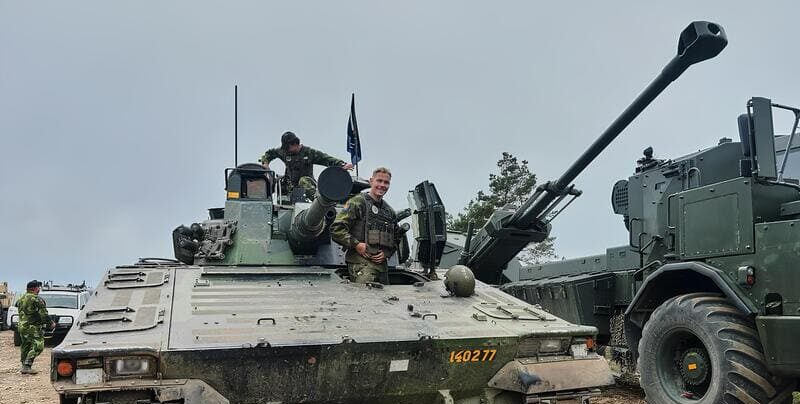
The NATO exercises in Gotland, Sweden, from April 27 to May 13, 2026, were revealing—not for what they demonstrated that was new, but for what they confirmed with uncomfortable clarity: Western armed forces are struggling to counter fast, low-cost drones. In fact, the Ukrainian FPV drone teams acting as the enemy forced NATO troops to halt three times due to their overwhelming tactics. One of the Ukrainians put it bluntly: in a real war, NATO positions would have been destroyed. The same had already happened during NATO’s REPMUS exercises in Portugal, where a multinational “red” team led by Ukraine defeated NATO’s “blue” forces, using advanced unmanned technology.
The war in Ukraine does not wait for procurement cycles, doctrinal reviews or assessment committees. It evolves daily, under real combat pressure, at a speed that most Western military structures were simply not designed to match. This is not a criticism. It is an observation.
The lessons are known and recur consistently: rear areas are no longer rear areas. Fixed positions attract fire. Electromagnetic signatures kill as surely as physical exposure. Dispersion saves forces. Deception protects capabilities. Adaptation is worth more than the plan. None of these observations are classified. Ukrainian operators, soldiers and commanders have shared them throughout the war — in briefings, in articles, in direct conversations with allies. The problem was never access to the lessons. The problem is that some of them require revising assumptions that many organisations prefer to consider permanent.
Ukraine has ceased to be a recipient of support. It is now one of the greatest sources of contemporary combat experience available to Europe. To treat it as anything less is not prudence. It is a strategic waste.
The third debate is the most difficult — because it requires abandoning a comforting illusion: that every conflict has a rational breaking point, a cost threshold beyond which the adversary concludes that continuing is not worth it.
That logic presupposes that all parties define success, failure and rationality in the same terms. Moscow suggests otherwise. For the Kremlin, strength, national prestige, political control and power projection are not instruments of foreign policy — they are the foundations of the regime’s legitimacy. What the West interprets as unsustainable cost, Moscow may interpret as proof of resilience. What appears to be strategic defeat can be reconfigured internally as resistance to encirclement. The grammar is different. And negotiating without understanding that is negotiating without understanding what the other side is actually saying.
From this follows something that hybrid operations, sabotage, cyber warfare and influence campaigns make evident: competition does not begin when war breaks out. It does not end when the fighting stops. It is continuous, structural and deliberate.
The conclusion is unavoidable: deterrence is not built with dialogue. It is built with capabilities that make dialogue credible — military, industrial, economic, political and social. Dialogue without capability is not diplomacy. It is hope. And hope is not a strategy.
These three debates are not independent. They converge on a single strategic question:
Is Europe prepared to become a full strategic actor — or will it continue to behave as a geopolitical space protected by external guarantees it considers permanent?
The answer does not lie in rejecting the transatlantic heritage, nor in replacing institutions that remain fundamental. It lies in building a Europe capable of being a stronger pillar of NATO while simultaneously being less vulnerable to the fragility that comes from depending on a single set of assumptions — assumptions that change with elections, with crises, with strategic redirections, and that sometimes change faster than institutions can follow.
Strategic resilience begins with an honesty that is costly: acknowledging that peace, victory, security and stability are not universal concepts. They are contested ones. And that those on the other side may be using the same words to mean something fundamentally different. Europe does not need to choose between optimism and pessimism. It needs to choose between complacency and preparedness. And that choice can no longer be deferred.
Author: Fernando Figueiredo – Retired Portuguese Army colonel and former NATO professional, who held various strategic leadership positions, currently serving as a defense consultant at Pulsar Development International. His work focuses primarily on defense requirements, offering expertise and a network of contacts that enable operational challenges to be overcome with effective, tailored solutions.
(The opinions expressed in this article belong only to the author and do not necessarily reflect the views of World Geostrategic Insights).
Image Credit: AP (Swedish servicemen participating in the NATO drills in Gotland, Sweden, in May , 2026.