



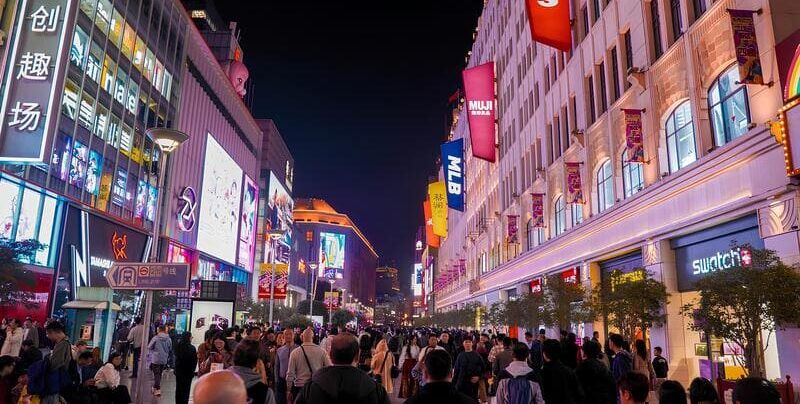
Beijing released its 15th Five-Year Plan for Expanding Consumption this week. For the first time in the history of China’s planning architecture, the State Council approved a dedicated five-year blueprint focused exclusively on domestic consumption as the central strategic priority of the 2026 to 2030 planning period.

The target is for total retail sales of consumer goods to reach 60 trillion yuan, roughly 8.85 trillion US dollars, by 2030. This decision to build a consumer market by 2030 marks a strategic rebalancing of the world’s second-largest economy. With retail sales already exceeding 50 trillion yuan, the new plan aims to add nearly 10 trillion yuan in annual consumer activity within five years, creating a market whose scale will influence global trade, investment and corporate strategy. Since retail sales crossed 50.1 trillion yuan in 2025, the target implies the addition of nearly 10 trillion yuan in annual consumer activity within five years. This is equivalent to creating a consumer market larger than the entire economies of many major countries. For international businesses still viewing China mainly as a manufacturing base, the message is clear. The country is rapidly becoming the most important source of consumer demand in the global economy.
The importance of the figure lies in the policy architecture behind it. By approving a dedicated plan for expanding consumption during the 15th Five-Year Plan period, China has placed household demand, services and consumption quality at the centre of its development strategy for 2026 to 2030. The plan contains 28 major measures covering service consumption, goods upgrading, new business models, household purchasing power, the consumer environment, and institutional reform. It shows that consumption is being treated as a long-term driver of development rather than a temporary response to slower external demand.
The implied pace of expansion is measured. Moving from 50.1 trillion yuan to 60 trillion yuan requires an average annual growth of about 3.7 percent. This is neither an overheated target nor a promise of growth at any cost. It reflects the broader shift in China’s economic policy from speed towards quality, resilience and sustainability.
The scale, however, is exceptional. China’s retail market is already about 80 percent of that of the United States in nominal terms and has surpassed it when measured by purchasing power, according to calculations cited by China’s commerce authorities. Reaching 60 trillion yuan would place China at the centre of the global consumer economy and could alter how multinational companies allocate investment, design products and organize supply chains.
For decades, international discussion viewed China primarily as the world’s factory. That description is increasingly incomplete. China remains a manufacturing power, but its future importance to the global economy will also be determined by the scale of what Chinese households purchase, experience, and demand.
This transition is already visible. Final consumption expenditure contributed an average of 58.8 percent to China’s economic growth during the 14th Five-Year Plan period, 10 percentage points higher than during the preceding five years. Online retail sales reached almost 16 trillion yuan in 2025, while online sales of physical goods accounted for more than a quarter of total retail sales. China is therefore expanding consumption from a base that is large, technologically sophisticated, and deeply integrated with digital commerce.
Yet the new plan also recognizes that market scale alone cannot unlock the full potential of domestic demand. Consumption depends on income, employment and confidence about the future. Households are more willing to spend when they feel secure about healthcare, education, pensions, childcare and elderly care. For this reason, the plan links consumption with higher-quality employment, income growth, stronger social protection and improved public services.
This is the central economic logic of the plan. Previous consumption programs often concentrated on subsidies, trade-in schemes, and incentives for purchasing cars, appliances, and electronics. Such measures can bring forward demand. Sustained consumption growth requires stronger foundations.
The new approach seeks to move from stimulating individual transactions to improving the conditions that shape household decisions. Stronger social security can reduce the need for precautionary savings. Stable employment can support long-term spending. Better public services can release household income for discretionary consumption. The plan therefore connects economic expansion with improved living standards rather than treating them as separate objectives.
A second major change concerns the composition of consumption. The next phase of China’s consumer development will increasingly be driven by services. The plan gives particular attention to elderly care, childcare, tourism, culture, healthcare, sports and education. It also promotes digital consumption, experiential retail, the debut economy and the integration of artificial intelligence into consumer products and services.
The global implications are considerable. At a time when protectionism is increasing and external demand is under pressure, China is seeking to use its domestic market as a source of shared growth. Restrictions on foreign investment in manufacturing have been removed nationwide, while further openings are being advanced in telecommunications, healthcare, education, biotechnology and other service industries. China has also pledged to improve national treatment for foreign enterprises and create fairer access to government procurement, trade-in program and market opportunities.
This creates new possibilities for businesses across both developed and developing economies. Agricultural exporters, healthcare providers, tourism companies, universities, cultural industries, technology firms and consumer brands can all benefit from the expansion of Chinese demand. China’s growing market can provide an important source of revenue at a time when growth in many established consumer economies is slowing.
The 60-trillion-yuan target is a statement about the future direction of China’s economy. It points towards a development model in which domestic demand provides greater stability, social improvement strengthens consumer confidence, innovation creates new forms of consumption, and a larger Chinese market generates opportunities for the wider world.
China’s next major contribution to global growth may come increasingly from the purchasing power of its people. The international business community should begin preparing for that future now.
Author: Muhammad Asif Noor – Founder Friends of BRI Forum, Advisor to Pakistan Research Center, Hebei Normal University.
(The views expressed in this article belong only to the author and do not necessarily reflect the views of World Geostrategic Insights).