



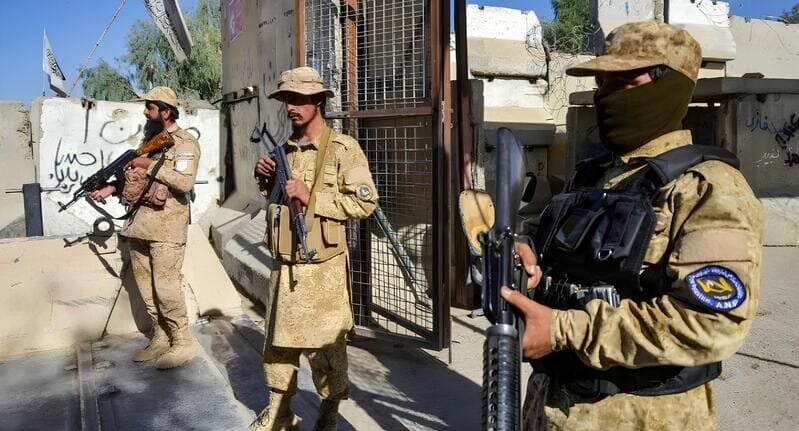
In the long shadow of the Durand Line, history rarely sleeps. It mutters through mountain passes, echoes in border posts, and now reverberates in the uneasy silence between Islamabad and Kabul.

The present tensions between Pakistan and Afghanistan are not the product of a single incident or a fleeting misunderstanding; they are the cumulative outcome of unfinished wars, unfulfilled commitments, and an increasingly dangerous ecosystem of cross-border militancy.
As the region recalibrates after the American withdrawal, Pakistan finds itself confronting a paradox. A neighbor bound by faith and geography, yet fractured by distrust and hardened by security imperatives. Islamabad’s position, articulated repeatedly by state officials and diplomatic channels, rests on a principle both simple and uncompromising: no sovereign nation can tolerate armed groups using a neighboring territory to wage violence against its people.
In recent days, this tension has not remained rhetorical. There have been fresh exchanges of fire along the border near Torkham and Tirah, with both Pakistani and Afghan forces accusing each other of initiating hostilities. Pakistani airstrikes inside eastern Afghanistan targeting suspected militant hideouts have further escalated tempers. Kabul has condemned these actions as violations of sovereignty, while Islamabad maintains they are defensive responses to cross-border terrorism.
Pakistan argues that elements of Tehreek-e-Taliban Pakistan (TTP) and factions linked to Islamic State Khorasan Province (ISKP) have found operational space inside Afghanistan since the fall of Kabul in August 2021. These groups, according to Pakistani security assessments, orchestrate cross-border attacks targeting civilians, security personnel, and infrastructure.
The Afghan Taliban administration denies providing sanctuary, yet the recurrence of high-intensity attacks and the recovery of sophisticated weaponry from militant hideouts keep the dispute alive and combustible. Pakistan frames its cross-border responses within the doctrine of self-defense under international law. For Islamabad, years of counterterrorism sacrifices cannot be undone by what it views as permissive space across the border.
The message to Kabul has been consistent, commitments must translate into measurable action against anti-Pakistan militant networks. In this context, Pakistan frequently references the assurances embedded in the Doha Agreement – the accord negotiated between the United States and the Afghan Taliban in 2020 which stipulated that Afghan soil would not be used against other states.
Islamabad’s argument is straightforward, if those commitments were central to international recognition and legitimacy, they must be honored in both letter and spirit. The diplomatic theatre has not been idle. Talks in Doha, hosted by the State of Qatar, have intermittently provided a channel for de-escalation and dialogue, even as trust remains thin.
Beyond Doha, regional actors have sought to prevent further deterioration. Turkiye, leveraging its historical ties and diplomatic credibility with both sides, has offered facilitation and quiet mediation efforts between Islamabad and Kabul. Ankara’s engagement reflects a broader regional understanding, instability along the Pakistan-Afghanistan frontier radiates outward, affecting Central Asia, the Gulf, and beyond.
While mediation has not resolved core disputes, it underscores the recognition that sustained hostility benefits no one. Overlaying these fragile efforts is the enduring impact of the U.S. withdrawal. When American forces exited Afghanistan under the presidency of Joe Biden, the rapid collapse of Afghan security institutions left behind a vast arsenal of military equipment originally supplied to Afghan forces.
Whether described as transferred, abandoned, or captured, the result is the same. Advanced weaponry now circulates in a volatile environment. Security assessments suggest that some of this equipment including night-vision devices and modern rifles has surfaced in militant operations beyond Afghanistan’s borders.
For Pakistan, this development amplifies the threat matrix, increasing both the sophistication and lethality of cross-border attacks. The proliferation of such arms symbolizes a broader dilemma. Military withdrawal ended a chapter of foreign intervention but did not end the war’s consequences.
Weapons outlive policies; militant networks adapt faster than diplomatic frameworks. In the absence of robust regional oversight, the aftershocks of America’s longest war continue to reverberate through South and Central Asia. Yet the crisis is not solely about arms or accusations; it is about governance and responsibility.
The Pakistan-Afghanistan border has historically been porous, shaped by tribal affiliations and economic interdependence. Militancy exploits precisely such ambiguities. Without a jointly managed border mechanism, intelligence-sharing protocols, and verifiable counterterrorism cooperation, every violent incident risks spiraling into a diplomatic rupture.
Both nations stand at a crossroads. Pakistan insists that peace with Afghanistan is its preference, but security is its obligation. Afghanistan, seeking legitimacy and stability, faces the critical test of demonstrating effective territorial control and compliance with international assurances. The space between these positions can either narrow through pragmatic engagement or widen through continued mistrust.
Constructive and positive momentum is still achievable. Firstly, institutionalized counterterrorism dialogue must replace episodic crisis management. Secondly, regional facilitators such as Turkiye, alongside platforms like Doha, should be empowered to transform ad-hoc mediation into sustained security architecture. Thirdly, the international community, particularly Washington, should acknowledge the unintended regional consequences of post-withdrawal arms proliferation and support mechanisms to monitor and restrict illicit transfers. Finally, economic interdependence and development initiatives should be reframed as instruments of stability rather than secondary considerations.
The mountains along the frontier have endured empires and ideologies alike. They will endure today’s tensions as well. What remains uncertain is whether leaders in Islamabad and Kabul will allow inherited grievances to define the future, or whether they will seize the fragile openings provided by diplomacy in Doha and mediation efforts from Ankara to craft a new compact of coexistence.
To put it mildly, a secure Pakistan and a stable Afghanistan are not competing ambitions; they are mutually reinforcing imperatives. In a region weary of war, wisdom lies not in the echo of artillery, but in the quiet persistence of dialogue backed by credible action.
Author: Mirza Abdul Aleem Baig – President of Strategic Science Advisory Council (SSAC) – Pakistan. He is an independent observer of global dynamics, with a deep interest in the intricate working of techno-geopolitics, exploring how science & technology, international relations, foreign policy and strategic alliances shape the emerging world order.
(The opinions expressed in this article are solely those of the author and do not necessarily reflect the views of World Geostrategic Insights).
Image Credit: AFP (Armed Taliban near the gate of the zero point border crossing between Afghanistan and Pakistan at Spin Boldak district in Kandahar province).