



By Jalal Ud Din Kakar and Aziza Mukhammedova
The United States of America completed its withdrawal from Afghanistan on 30 August 2021, finally pulling out after two decades of boots on the ground.

Four years later, President J. Donald Trump has stirred the hornet’s nest by signaling his strong intention to take back the Bagram Air Base, once the center of the U.S. military operations in Afghanistan.
Now, in 2025, President J. Donald Trump argues that Bagram airbase is important for countering China’s influence and monitoring its military activities in the region. For all that, the prospect of regaining control over the Bagram Airbase in Afghanistan remains highly unlikely given the Taliban resistance, Pakistan’s strategic role, and China’s growing foothold in Afghanistan.
Michael Waltz’s Influence
The idea of holding onto Bagram was not new. In 2021, Michael Waltz warned in the Military Times that “the Bagram Air Base in Afghanistan was too important to abandon.

He warned that “in addition to giving up the only airbase in the world located in a country that physically borders China and Russia’s southern border, the Biden administration will also give up a key strategic foothold along Iran’s eastern border, and along the Iran’s eastern flank, and along the nuclear-equipped and unstable Pakistan.” Accordingly, one may assert that his warning underscored the long-term strategic values of Bagram beyond the Afghan war. In light of this, I contend that someone planted this idea in Donald Trump’s mind, who later picked it up and ran with it, claiming that Bagram Airbase was near Chinese nuclear sites; his rhetoric exaggerated its proximity. Yet, it remains evident that his adoption of Waltz’s position indicates how concerns over great power competition continue to shape U.S. thinking.
The Bagram Air Base and Its Legacy
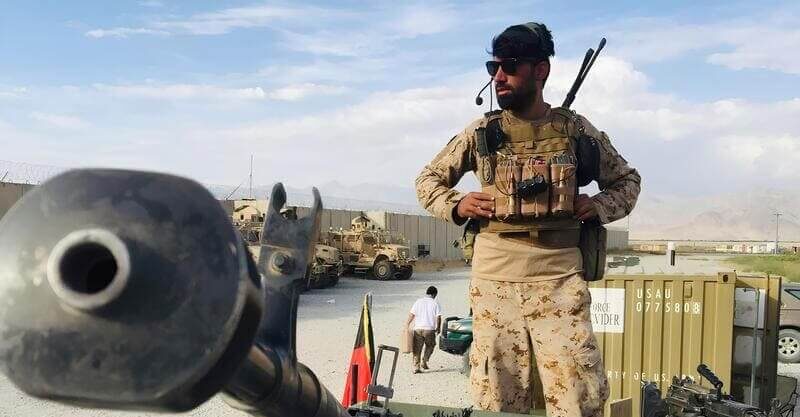
The Bagram Airbase in Afghanistan, located roughly 50km, around 30 miles north of Kabul, was originally built by the Soviets in the 1950s and later taken over by the U.S. into a mega operational hub. Further, the Bagram Airbase supported over 40,000 personnel, with dual runways and advanced facilities. When the U.S. forces pulled out of Bagram in July 2021, just days before Kabul fell, the Taliban swooped in and took control. In today’s geopolitical landscape, it is plausible to suggest that it remains a symbol of Taliban authority and a strong reminder of America’s hasty exit. During recent remarks, Trump said, “We gave it to [the Taliban] for nothing. We want that base back,” but the Taliban regime has categorically rejected the notion of foreign control over Afghan territory
The Taliban’s Calculus
The Taliban leadership has been explicit; Afghanistan’s territorial integrity is not up for grabs. Fasihuddin Fitrat, Afghan defense chief, declared that “ceding even an inch of our soil to anyone is out of the question and impossible.” Even amid this uncompromising posture, Afghanistan’s economic desperation could open avenues for backchannel diplomacy. UN reports say that since 2021, the UN has handed out $13 billion in aid, but funding was slashed by 50% in 2024, while 23 million Afghans now depend on humanitarian assistance to get by. World Bank reports say Afghanistan’s GDP shrank 20.7% in 2021 and kept sliding in 2022, even though aid continued to pour in.
By 2023, the economy was ~25% smaller than in 2020, with only 2.7% growth recorded last year. Taking these factors into account, one may conclude that potential incentives for the Taliban could include Humanitarian aid (food, medicine, education), release of $7 billion frozen Afghan assets, or lifting travel bans on their leaders, or even official recognition of the Taliban government. However, such concessions risk legitimizing a regime accused of systematic human rights abuses, including the suppression of women’s rights.
China’s Shadow Over Kabul
China has filled much of the vacuum left by the U.S., and its influence in Afghanistan cannot be swept under the rug. In 2023, China was the first country to build diplomatic relations, and became the first country to appoint the first ambassador to Taliban-controlled Afghanistan. One could assert that with its eyes on Afghanistan’s $1–3 trillion in untapped natural resources, Beijing views engagement as central to its high-tech ambitions, helping it power ahead in the global tech race. In fact, financial support and investment from China reduce the Taliban’s dependency on Western aid, limiting Washington’s leverage. Zakir Jalaly, a Taliban foreign ministry official, said that “military presence has never been accepted by Afghans throughout history, and this possibility was completely rejected during the Doha talks and agreement.” Still, they have left the door open for limited diplomatic engagement, further highlighting China’s advantage.
Pakistan’s role
Given the prevailing dynamics, Pakistan’s role in the equation remains indispensable. Its deep and longstanding ties both with China and the Taliban complicate the U.S. ambitions in the region. Even the American withdrawal from Afghanistan in 2021, was cheered on by the former Prime Minister of Pakistan, seeing it as a strategic victory. Against this backdrop, it is justifiable to argue that while Pakistan could, in theory, pressure the Taliban to consider the U.S. requests, doing so would risk undermining its relationship with Beijing and its influence in Kabul. Therefore, Pakistan has to tread carefully and stay on its toes, keeping its own national interest front and center while also not upsetting its own strategic balance. Therefore, keeping this scenario in mind, there’s no possibility that for Pakistan, balancing its security concerns and regional alliances makes supporting a U.S. return to Bagram highly improbable.
Conclusion
President Trump’s push to get Bagram back is a bold step, but it won’t be a walk in the park to accomplish. In fact, he highlights enduring U.S. anxieties about China’s rise and the loss of strategic footholds in South Asia. Despite this, it is justifiable to assert that the Taliban’s rejection, Pakistan’s alignment with both China and the Taliban, and China’s deepening influence in Kabul make such a move implausible. Therefore, it is reasonable to suggest that reclaiming Bagram would necessitate compromises with far-reaching political implications that could legitimize an internationally isolated regime, creating new political and ethical dilemmas for Washington. Thus, the tug-of-war over Bagram Airbase mirrors the broader chessboard of South Asian geopolitics, where the U.S. and China vie for influence.
Jalal Ud Din Kakar – Research Fellow at the Center for Security Strategy and Policy Research) and PhD International Relations scholar at the School of Integrated Social Sciences, University of Lahore, Pakistan.
Aziza Mukhammedova – Senior Research Fellow and PhD Student at the Institute for Advanced International Studies (IAIS) , Tashkent, Uzbekistan.
(The views expressed in this article belong only to the authors and do not necessarily reflect the views of World Geostrategic Insights).
Image Credit: Anadolu Agency) – An Afghan soldier stands on a military vehicle at Bagram Airfield. on July 5, 2021, after U.S. forces withdrew from the base,