



By Fawad Khan Afridi
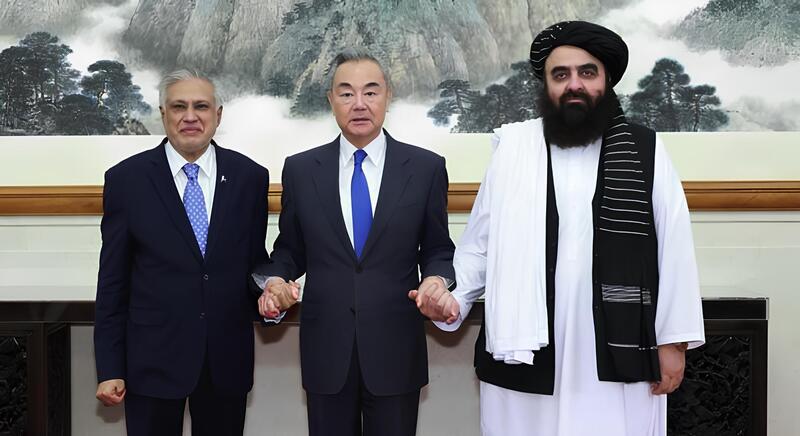
In May 2025, a handshake ceremony was held in Beijing between the foreign ministers of Pakistan, Ishaq Dar, China, Wang-Yi, and Afghanistan, Amir Khan Muttaqi, marking a quiet turning point in the geopolitics of South-Central Asia.
The trilateral dialogue has officially decided that Afghanistan will join the China-Pakistan Economic Corridor (CPEC), turning a long-discussed vision into a viable strategy. Although these efforts by China have been undertaken as an initiative to “promote regional connectivity in pursuit of mutual prosperity,” the truth behind the diplomatic terminology is closely linked to Beijing’s need to secure the stability of its western borders, an unstable area, and to maintain its role as guardian and power broker in South-Central Asia.
For Pakistan, the transfer will mean greater protection against Indian rhetoric of encirclement, as well as a viable way to entice Kabul to cooperate in the fight against terrorism. In the case of Afghanistan, the extension of the corridor promises a way out of the economic stranglehold caused by sanctions and the freezing of funds, at the cost of greater dependence on the China-centric system.
The trilateral statement outlined the first four points of a seven-point program focusing on “infrastructure connectivity, trade facilitation, counterterrorism cooperation, and energy cooperation.” Mao Ning, spokesperson for the Chinese Foreign Ministry, said, “Afghanistan’s involvement in CPEC projects will be realized based on China’s willingness to facilitate them.” For Beijing, expansion is not an act of charity, but rather a strategic necessity. The stability of Xinjiang is attributed to the territory of Afghanistan, where the ETIM (East Turkestan Islamic Movement) found refuge.
Following the agreement, Zabiullah Mujahid, a Taliban spokesman, said at a press conference on June 6, 2025, that “Afghanistan has assured China that it will not tolerate operations that threaten China’s security.” Such diplomatic comments are a response to China’s intense security needs and a warning about the transactional aspect of the connectivity project.
Economic interests are also very important. According to the US Geological Survey, Afghanistan’s rare earth, lithium, and copper mines are estimated to be worth between $1 trillion and $3 trillion and remain an untapped source of wealth that can be exploited thanks to Chinese investment. Chinese state-owned companies such as MCC and Xinjiang CAPEIC are already negotiating contracts for the exploitation of the Mes Aynak copper mines and for oil extraction in northern Afghanistan, and it is estimated that by 2026 crude oil extraction will reach 150 million per year.
As reported by the Afghan Ministry of Commerce, in 2024 China granted zero customs duties on 98% of Afghan products, increasing Afghan exports of pine nuts, saffron, and semi-precious stones, with Afghan exports to China increasing by 37% by the first quarter of 2025.
In the case of Pakistan, the inclusion of Afghanistan in the CPEC network is also based on security and economic considerations. Islamabad’s repeated allegations that Afghanistan is a safe haven for Tehrik-i-Taliban Pakistan for cross-border attacks have strained bilateral relations, culminating in attempts to close the border at Torkham in late 2024.
In light of the trilateral interaction in May 2025, the Pakistani Ministry of the Interior acknowledged a 14% reduction in cross-border activities by TTP factions, a minor but symbolically significant barometer showing that conditional economic cooperation could be enough to induce Kabul to take its foot off the accelerator of the extremist groups destabilizing Pakistan’s western frontier.
Economically, Afghanistan will benefit from the CPEC link, as it will have access to the port of Gilani in Pakistan, now completed following the opening of the new Gwadar International Airport in October 2024, built with a US$246 million Chinese grant and capable of accommodating A380 and 747 aircraft and connecting to a multimodal sea-air transport network with distribution channels in the interior of the country.
Due to delays, the ML-1 Karachi-Peshawar railway line modernization project is expected to resume at the end of 2025 with the refinancing of funds through a combination of Chinese concessional loans and a syndicated loan with Pakistani national banks, giving priority to the introduction of speeds of up to 160 km/h on the line.
Any extension northwards to Afghanistan depends on this backbone, and Pakistan Railways and China Railway Engineering Corporation have discussed the possibility of conducting a feasibility study on two random locations between Peshawar and Jalalabad and, ultimately, to Kabul, which could constitute an extension of phase II. With this in mind, the Khyber Pass Economic Corridor (KPEC), partly financed by the World Bank with a $483 million grant, is already under construction with the aim of modernizing the Peshawar-Torkham section, thus aligning the interests of the World Bank and China, as demonstrated by this important corridor connecting the world.
A planned section in Afghanistan involves the road from Torkham to Kabul and from Chaman to Spin Boldak in Kandahar, so that northern Afghanistan’s connections along the Wakhan Corridor to Chinese Xinjiang can be planned. However, the Wakhan fantasy, while logically unfeasible, is symbolically powerful, considering the harsh climate, dangerous terrain, and heavy militarization of China’s western borders. Meanwhile, China is interested in Afghanistan starting mining activities and creating a gateway to trade and transport linked to the infrastructure built in Pakistan, namely the CPEC, which will allow Afghanistan to access maritime trade and the distribution of minerals and goods in its supply chains.
There is also the issue of financial sustainability. The most important point is that Pakistan, with its tendency toward recurring current account deficits and debt servicing under IMF guidance, is facing internal attacks in terms of dependence on Chinese credit lines, as local industries fear that Chinese companies may drive them out of business. In June 2025, the National Assembly’s Public Accounts Committee presented a report on delays and cost overruns in several CPEC projects, such as the feasibility study for the Quetta public transport project, which raised doubts about the sustainability of debt-financed expansions.
In the case of Afghanistan, the possibility of joining the CPEC represents both an opportunity and the prospect of a rebirth under the rule of a single power at a time when the international community has not yet accepted the Taliban regime as the official government of Afghanistan. China’s unconditional commitment and strategic patience may provide respite from Afghanistan’s economic isolation, but the lack of a transparent financial system in Afghanistan could offer the local elite an opportunity to corrupt the benefits and even exacerbate economic inequalities instead of promoting economic development for the entire population.
In the future, the fate of the CPEC-Afghanistan corridor will depend on its transformation from diplomatic openness to real physical infrastructure capable of delivering economic dividends. This will require strong security measures, such as a “joint transit route monitoring system, risk insurance schemes for Chinese contractors, and credible guarantees against terrorism.”
On the financial side, Pakistan and Afghanistan need to negotiate gradual disbursement schedules, hybrid financing mechanisms, and institutional protection against excessive debt relative to the regular conduct of operations. Politically, China will have to contend with the complexities of doing business with an unrecognized government in Kabul while maintaining its international image and local goodwill.
References:
– Ministry of Foreign Affairs, China. (2025, May 22). China, Pakistan, Afghanistan hold trilateral dialogue, agree to extend CPEC.
– US Geological Survey (USGS). (2024). Afghanistan’s estimated mineral resources overview.
– UNAMA. (2025, June). Report on the security and human rights situation in Afghanistan. United Nations Assistance Mission in Afghanistan.
– World Bank. (2024). Khyber Pass Economic Corridor Project Overview.
– Pakistan Ministry of Commerce. (2025). Afghanistan-China bilateral trade update.
– Pakistan National Assembly, Public Accounts Committee. (2025, June). Annual report on CPEC project oversight.
Author: Fawad Khan Afridi– MPhil student at the National Defense University, Islamabad, Pakistan.
(The opinions expressed in this article are solely those of the author and do not necessarily reflect the views of World Geostrategic Insights).
Image Credit: Xinhua (Pakistan’s Foreign Minister Ishaq Dar, China’s Foreign Minister Wang Yi, and Afghanistan’s acting Foreign Minister Amir Khan Muttaqi, meeting on May 21 2025).