



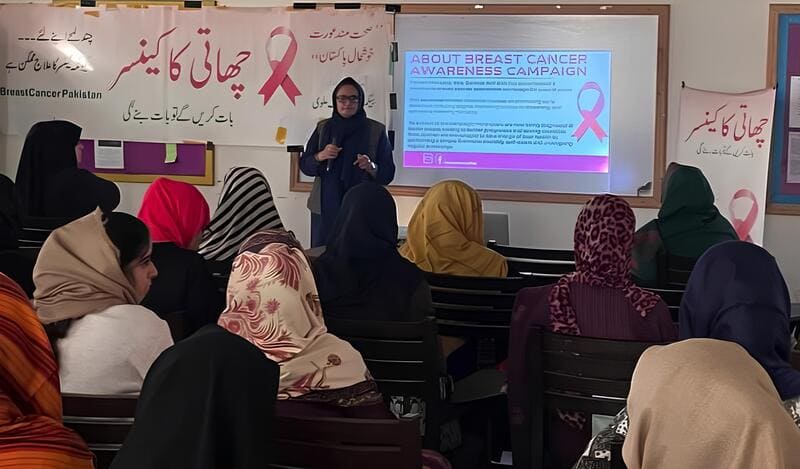
Policies regarding breast cancer have been discussed in Pakistan but evidence-based, promptly implemented solutions are not easily available. This letter outlines urgent actions for the government to take to address the widespread breast cancer crisis in Pakistan as it has the highest rates in Asia.

One out of every nine women is expected to be diagnosed with breast cancer during her lifetime; every year approximately ninety thousand new breast cancer cases are diagnosed and close to forty thousand women die of breast cancer. While breast cancer can occur in women under twenty, the risk of breast cancer increases with age.
Therefore, a large number of women diagnosed with breast cancer in Pakistan have been diagnosed remotely when they are in the advanced stage of the disease (stage III or IV) reducing their chances of survival. The high mortality rate of the disease is due in part to the lack of knowledge about breast health, the stigma associated with breast health amongst the population, the lack of breast health awareness, and hence the resulting delay in seeking medical consultation.
In addition, there is a dramatic lack of access to diagnostic tests and treatments, such as mammograms, which also causes delays in diagnosis. In addition, there is not enough infrastructure to support breast cancer care and treatment, mainly in rural areas, where shortages of oncologists and facilities provide treatment for many patients are severe.
Financial barriers hinder the continuity of care; due to the high cost of treatment (chemotherapy, surgery, and radiotherapy) people may interrupt or abandon their treatment due to the cost. The best way to promote survivorship is by detecting cases early. When cancer is detected early, survival rates are over 90%. Warning signs include breast lumps, breast size or shape changes, breast pain, dimpling of the breast skin, and breast milk discharge, etc. Breast self-examination (BSE) and routine screening are critical elements in improving the outcome of cancer treatment.
In Pakistan, the total burden of cancer is very high: More than 185,000 new cancer cases and approximately 125,000 deaths from cancer occur each year in Pakistan. Breast cancers account for 16.5% of all cancers; cancers of the lip and mouth (8.6%); and lung cancers (5.1%). Women are disproportionately affected by breast cancer (age-adjusted incidence rate = 34.2 per 100,000); men are more affected by oral cancers than by breast cancers. Studies that examine the overall burden of cancer in the large cities of Pakistan (Karachi, Lahore, Quetta, Peshawar) indicate an overall increase in incidence. More than 76% of female cancers in Karachi are due to breast cancer, and in Faisalabad, over 3,390 cases of breast cancer were recorded, with the greatest number of breast cancer cases among women aged 40–49.
There is an urgent need to take action through public health initiatives because globally, 1 out of every 6 people dies from cancer, with 75% of cancer deaths occurring in developing countries. There is a 30% chance of survival if you have been diagnosed with any form of cancer; therefore, there are over $1.16 trillion worth of economic losses each year, indicating an urgent need for developing countries to create comprehensive programs focusing on breast cancer awareness, early detection, and access to treatment. Breast Cancer is now at an alarmingly high level in Pakistan and poses not only a medical concern but a social and national crisis. The government must act immediately and enforce this action to protect women and prevent catastrophic consequences. In addition to immediate government action, the following policies must be put into place:
I – Mandatory Screening: The government should implement a system of mandatory quarterly breast cancer screenings for all women. All breast cancer screenings will take place at the tehsil, district, divisional, and provincial levels. All records will be integrated into government record systems. The compliance of mandatory screening will be ensured by creating an official warning system with an additional feature of temporary blocking of Computerized National Identity Cards (CNIC) or passports unless compliance is met. While this policy may seem draconian, it is necessary for protecting the national health security of Pakistan through early detection and protection.
II- Educational Institutions: All female students who are applying for any Educational Institution (School, College, University, or Vocational Training), need to submit a Medical Fitness Report including a Breast Examination Report, to that Institution. Institutions are required to verify these reports every month. If a student does not provide their report or is unable to keep up with the verification, that student will not be able to attend that institution. Having Health (Wellness) and Education connected will help create a culture of regular Screening, and to educate Family and establish a culture of Health Awareness in the Community.
III – Telecom Collaboration: The government should work with all the Cellular Carriers to create a network of Caller Tunes, Daily SMS and Weekly Recorded Voice Calls with Messages that promote Breast Cancer Awareness. Since the majority of people have Cell Phones and the majority of the American population have Cell Phones, this type of Public Awareness will serve to provide continuous reminders about the symptoms of breast cancer and where to get regular screenings.
IV- Public Advertising: Public Awareness messages need to be placed on Public Transportation, Public Transit Stations, Billboards, Roadside, and Digital Displays. Public transportation messages, using posters, banners and artwork, will help break down the Stigma associated with Breast Cancer and help create an open dialogue by providing Breast Cancer Awareness within our everyday public surroundings.
V – Institutional Workshops: All public and private Institutions should hold Monthly Seminars and Workshops promoting Breast Cancer Awareness. National and International Conferences will include Medical Experts, as Speakers and Survivors of Breast Cancer, as well. The attendance of Breast Cancer Survivors at Breast Cancer Awareness Events will bring a degree of Emotional Impact, which may facilitate Early Detection by the general public.
VI – Use digital or social media platforms to create awareness: The government, in conjunction with social media influencers, should create social media campaigns and make them a priority as part of their marketing strategy. All forms of media, such as TV, radio, printed newspapers, dramas, and talk shows, must also promote messages about breast cancer. Women will be able to gain knowledge about the disease that can help them throughout their lives by integrating a component of breast cancer awareness into an educational curriculum for schools and colleges.
VII – Public-Private Partnerships: Additionally, the government must endorse creating a Public/Private Partnership with Non-Governmental Organizations (NGOs), Laboratories, Pharmaceutical Companies, Media, and International Organizations, to support the development of an annual fundraising campaign to support Breast Cancer Screening and Awareness programs. A National Breast Cancer Awareness Day will become part of a National Holiday in Pakistan, which symbolizes a national commitment to create awareness about breast cancer.
Therefore, to maximize benefits from breast cancer awareness, all citizens of Pakistan must work together and prioritize breast cancer awareness and prevention as not just a medical issue but a national responsibility. By taking strict government actions and increasing breast cancer awareness through sustained and coordinated efforts of government and other public institutions, Pakistan can save countless women’s lives and ensure a healthier future for its women.
Author: Rana Danish Nisar – Independent international analyst of security, defense, military, contemporary warfare and digital-international relations.
(The views expressed in this article belong only to the author and do not necessarily reflect the views of World Geostrategic Insights).
Image Source: breastcancerpak (A Breast Cancer Awareness session held at Lahore Maktab school).