



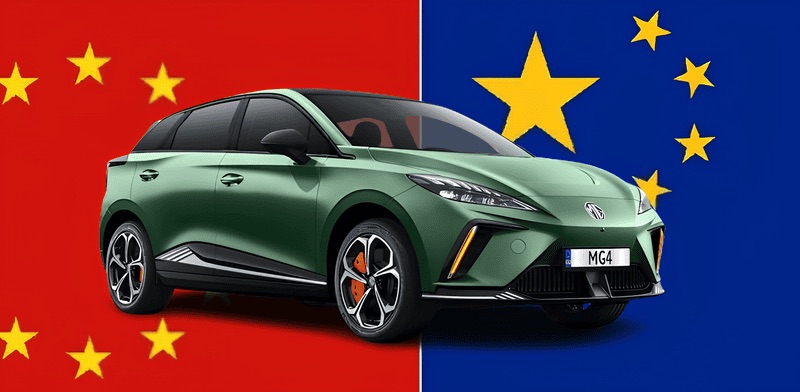
Europe’s argument with China over electric vehicles is often presented as a fight over subsidies. That framing is too small for the moment. The real contest is about industrial confidence. It asks whether Europe can protect its automotive base while giving its consumers affordable clean mobility. It also asks whether China can become a long-term industrial partner in Europe rather than a source of anxiety for its factories and policymakers.

The answer matters far beyond the showroom. The car has always carried economic meaning in Europe. It built regions, trained workers, created suppliers, financed research, and gave Europe a global industrial voice. The shift to electric vehicles has disturbed that old order. Engines, gearboxes, fuel systems, and mechanical refinement once gave European manufacturers a clear edge. In the electric age, batteries, software, scale, charging ecosystems, and cost discipline carry much of the weight. China prepared early for this shift. Europe moved with skill, yet with hesitation.
The numbers now speak with unusual clarity. China became the European Union’s largest source of imported vehicles in 2025. Imports rose by more than 30 percent and crossed one million units for the first time. Chinese own-brand electric vehicles expanded their share of the EU battery electric market from 2 percent in 2021 to 9 percent in 2025. During the same period, battery electric vehicles rose from 5.4 percent to 17.4 percent of the wider EU passenger car market. This is a structural movement in one of the world’s most politically sensitive industries.
Europe’s concern is understandable. The automotive sector remains tied to jobs, technology, taxes, and national pride. Capacity use among major Western automakers in Europe fell from 79 percent during 2000 to 2019 to 68 percent during 2020 to 2025. A plant running below strength carries political consequences. It means suppliers lose volume, workers face insecurity, and research budgets come under pressure. For Brussels, Berlin, Paris, and Rome, Chinese EVs are therefore more than imports. They have become a test of industrial survival.
Yet Europe’s current response carries its own risks. The EU’s anti-subsidy tariffs on Chinese-made battery electric vehicles changed company behaviour. They also showed the limits of defensive policy. Chinese manufacturers adjusted with speed. BYD pushed plug-in hybrids. SAIC used the MG platform to combine hybrid and fuel models with electric offerings. Chery, XPeng, GAC, BYD, and Leapmotor began preparing local production. The market continued to move.
BYD offers the clearest case. Its Seal U plug-in hybrid became Europe’s best-selling plug-in hybrid in 2025, with sales above 70,000 units. In Germany, the model starts at about 39,900 euros, while a comparable Volkswagen Tiguan plug-in hybrid starts near 50,000 euros. This gap explains more than any diplomatic statement. Consumers under pressure from high living costs will look at value. Climate policy built around expensive mobility will struggle for public support.
This is where Europe needs a more honest conversation with itself. Chinese EV competition is difficult because it combines price with speed. It is also difficult because it exposes weaknesses in Europe’s own transition. European manufacturers remain strong in engineering, safety, design, and premium branding. Their challenge lies in cost, battery supply, faster model cycles, and the mass market. Tariffs may provide time. They lose value when treated as a substitute for industrial renewal.
China also faces a serious choice. European success requires more than exports. A continent with deep automotive history will resist any model that appears to hollow out local industry. Chinese firms entering Europe need to act as local economic actors. They need factories, service networks, parts supply, financing, training programs, and visible investment in European skills. Selling cars is easy compared with building trust.
The proposed Industrial Accelerator Act shows where Europe is heading. Vehicles may qualify for public procurement or subsidies only if final assembly takes place inside the EU and a large share of non-battery vehicle cost comes from within the bloc. This policy direction sends a clear message. Market access will increasingly depend on local economic contribution. Chinese companies already understand this. Their movement toward European production indicates commercial pragmatism rather than retreat.
A reset in Europe-China economic relations should begin from this reality. Europe needs Chinese investment, but on terms that support local employment and technology upgrading. China needs Europe, but in a form that grants legitimacy and stability for its global brands. The common ground lies in localisation, standards cooperation, battery recycling, skills development, and transparent investment rules. A managed opening serves both sides better than a cycle of suspicion.
This reset should also recognise a basic fact of the green transition. Europe will struggle to meet its climate and mobility goals with premium EVs alone. It needs affordable electric and hybrid options for ordinary households. Chinese manufacturers have shown strength in this segment. European policy should channel that strength into local production rather than push it outside the gate. A Europe-built Chinese EV with European workers, European suppliers, and European safety standards creates a different political equation from a direct import competing with an underused factory.
For China, the lesson is equally direct. Europe is a demanding market. Consumers expect after-sales support, product adaptation, road-tested technology, and reliable financing. Some Chinese brands still sell in small volumes because they entered too fast with products designed for a different market. Europe rewards patience. It rewards service. It rewards credibility earned over years.
There is also a geopolitical layer. The United States has moved toward stronger barriers against Chinese EVs. Europe remains more open, yet more anxious. If Brussels turns the EV sector into a permanent battlefield, Beijing will deepen its search for other markets. If Beijing treats Europe mainly as an outlet for surplus capacity, Brussels will tighten further. The sensible path lies between these instincts.
The better course is clear. Europe should defend its industrial base through faster innovation and smarter localisation rules. China should prove its long-term seriousness through investment and responsibility in the European economy. Both sides should accept competition as permanent, while giving it rules that keep markets open and societies stable.
The EV debate is the first major test of a new economic era. Europe and China can pass it only by moving beyond fear and beyond triumphalism. The road ahead belongs to those who understand that green mobility is also an industrial strategy.
Author: Muhammad Asif Noor – Founder Friends of BRI Forum, Advisor to Pakistan Research Center, Hebei Normal University.
(The views expressed in this article belong only to the author and do not necessarily reflect the views of World Geostrategic Insights).