



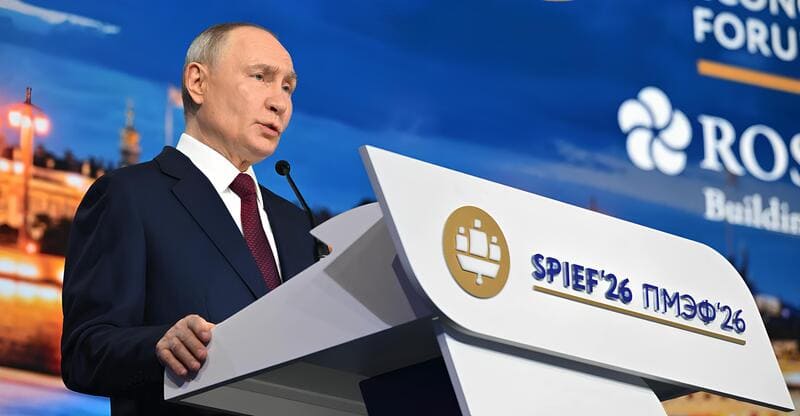
The 29th St. Petersburg International Economic Forum (SPIEF), held from June 3-6, concluded with results that underscore a definitive shift in global economic gravity.
Amidst a complex geopolitical landscape, the forum brought together representatives from 142 countries, signing over a thousand agreements worth a combined 6.642 trillion rubles (approximately $90.43 billion) .
Under the official theme “Pragmatic Dialogue: The Path to a Stable Future,” the event served as a barometer for the new world order, moving beyond rhetoric to concrete project announcements. From a historic Russia-Saudi energy alliance to joint oncology ventures with Cuba, the message was clear: global business is pivoting toward new centers of power.
Record-Breaking Statistics & The Saudi Pivot
The sheer scale of this year’s forum was notable. Key statistical highlights include:
- Total Agreements: 1,084 contracts signed .
- Participation: Over 24,500 participants from 142 countries, including the first official US delegation in a decade .
- Guest Country: Saudi Arabia, marking 100 years of diplomatic relations.
The partnership with Riyadh was a dominant theme. Saudi Energy Minister Prince Abdulaziz bin Salman Al Saud announced the signing of 30 cooperation agreements with Russia, spanning energy, education, and tourism . This solidifies the OPEC+ partnership into a broader economic alliance, signaling mutual intent to regulate energy markets while diversifying bilateral trade.
Strategic Healthcare: The Russia-Cuba Oncology Alliance
In a significant move for global health sovereignty, Russia and Cuba signed a memorandum for the joint development of cancer vaccines .
- The Russian Partner: While a specific “Russian company” was not named, the initiative is driven at the intergovernmental level. Deputy Prime Minister Dmitry Chernyshenko highlighted the cooperation, noting Russia’s prior supply of 6 tons of pharmaceutical substances to Cuba .
- The Cuban Asset: Cuba has a renowned biotechnology sector. The joint work focuses on developing a biosimilar of the monoclonal antibody Pembrolizumab, with Cuban experts already testing its effectiveness against melanomas and lymphomas in collaboration with St. Petersburg’s N.P. Napalkov Research Center .
This agreement represents a strategic move toward technological sovereignty in the pharmaceutical sector, bypassing Western patent frameworks to secure access to critical oncological treatments.
The Vision: Tunnel to Alaska & The Trump Factor
Perhaps the most headline-grabbing announcement came from Kirill Dmitriev, Head of RDIF and Special Presidential Representative. He confirmed active plans to proceed with a railroad tunnel connecting Russia (Chukotka) to Alaska (USA) .
- The Project: A transport artery under the Bering Strait, estimated to cost between $8 billion (using innovative boring technologies) to $65 billion (using traditional methods) .
- The Timeline: Dmitriev stated that the project could be completed in less than eight years, with a specific agreement to continue the design work signed at SPIEF .
- Political Will: The President of USA Donald Trump has reportedly called the idea “interesting.” However, Russian Foreign Ministry spokeswoman Maria Zakharova noted that construction is “impossible without political will” and the lifting of sanctions .
While highly ambitious, the proposal serves a political purpose: signaling openness to major infrastructure cooperation, even as Russia deepens its ties with the Global South.
Expert Analysis: The New Growth Formula
In the plenary session, President Vladimir Putin emphasized that global economic growth now relies on “new, alternative centers of power,” highlighting the rapidly growing significance of BRICS . He stressed the need for predictable investment climates, support for small and medium-sized businesses, and technological sovereignty, particularly regarding Artificial Intelligence (AI) and intellectual property regulation.
For stakeholders navigating the current environment, three key takeaways emerge from SPIEF 2026:
- Infrastructure is King: From the Bering Strait tunnel to the modernization of the Northern Sea Route, massive infrastructure projects are the new frontier for investment. These offer high-risk, high-reward opportunities for engineering and logistics firms.
- Healthcare as Geopolitics: The Russia-Cuba oncology deal exemplifies how nations are using healthcare to achieve strategic independence. International pharma companies may face increased competition from state-backed “localized” biologic production in emerging markets.
- The Fragmented West & The Consolidating East: The return of a US delegation—even a cautious one—suggests a pragmatic “cold peace” is emerging. However, the record deals with Saudi Arabia and deepening ties with BRICS members demonstrate that the global economy is no longer unipolar.
SPIEF 2026 proved that while the West deliberates on decoupling, the rest of the world is building new roads, bridges, and vaccines. For international business, the opportunity now lies in following this new axis of growth.
Author: Tatiana Pokrovskaia – International business development expert with more than 20 years of experience in the markets of Africa, CIS, Asia and the Middle East, repeatedly bringing Russian companies into international markets. Based in St. Petersburg, Russia, her work focuses on strategic partnerships, market expansion, and the promotion of innovation through the development of winning marketing strategies, essential for driving international business growth.
(The opinions expressed in this article are solely those of the author and do not necessarily reflect the views of World Geostrategic Insights).