



World Geostrategic Insights interview with Ilai Saltzman on the feasibility of the “fragmentation of fronts” doctrine pursued by Tel Aviv, the limits of regional deterrence, the weight of international constraints and the complex interactions between Israel’s internal stability and its strategic projection options, the long-term sustainability of Israel’s Grand Strategy, and the prospects for a transition from a purely kinetic-military approach to a dimension of diplomatic and economic stabilization.

Dr. Ilai Saltzman is Director of the Gildenhorn Institute for Israel Studies and an Associate Research Professor at the University of Maryland, United States, as well as a member of the board of directors of Mitvim – The Israeli Institute for Regional Foreign Policies. He is one of the world’s leading experts on the security and foreign policy of Israel and the United States, and on the geopolitical dynamics of the Middle East. He earned his Ph.D. from the University of Haifa and completed a postdoctoral fellowship at the Harvard Kennedy School. He is the author of the book “Securitizing Balance of Power Theory: A Polymorphic Reconceptualization”, and other essays on international relations theories and global security. His analyses appear regularly in the “Los Angeles Times”, “Haaretz”, “The Jerusalem Post”, and other major media outlets.
Q1 – Prime Minister Benjamin Netanyahu has sought to isolate the various fronts of the conflict (Gaza, Lebanon, and Iran) to ensure greater freedom of maneuver for Israel. In this context, the issue of Hezbollah is mainly a local border security problem, distinct from the stalemate over Tehran’s nuclear program and regional influence. What is your opinion on such a strategy? Is it possible to separate Beirut’s stability from the Islamic Republic’s regional ambitions? How realistic is the complete demilitarization of Hezbollah in Lebanon?
A1 – It is true that the Israeli Prime Minister wanted to delink the Iranian question from the Lebanese one but he was confronted by two issues. First, the Iranians were vigorously creating a linkage between these two theatres, Tehran is very much concerned about the survivability of Hezbollah, its Shiite proxy in Lebanon. If Israel had a free hand to militarily attempt to further degrade and possibly destroy Hezbollah (which is quite debatable), Iran may lose a major regional ally that was instrumental part of what was known as the Axis of Resistance. Second, it seems like US president Donald Trump agreed to create the linkage between both theatres of conflict when he called Netanyahu and essentially ordered him to stop the plans to attack Hezbollah targets in Beirut’s Dahia suburb, a stronghold of the organization and a place where many members of its leadership reside.
The approach advocated by Netanyahu has recently been echoed in statements by the Lebanese president, who accused Tehran of “using Lebanon as a bargaining chip in its negotiations” and added: “this is unacceptable. It’s not your country, it’s our country.” The demilitarization is something that neither Israel nor the Lebanese governments can do on their own. This will require several stakeholders to cooperate and will certainly include a comprehensive diplomatic arrangement to single out and possibly marginalize Hezbollah’s role in Lebanon until it no longer plays such a critical role in the country’s politics and military affairs.
Q2 – The conflict between Israel and Iran has evolved from a proxy war to direct military attacks. In light of your research on political psychology and strategic blind spots, how has this direct confrontation altered the deterrence calculus for both Tel Aviv and Tehran?
A2 – The transition to a direct confrontation means that both parties assume that such interactions are no longer inconceivable. In other words, once the Rubicon was crossed, this will become the scenario that both countries prepare for in the future. Barring a long-term and sustainable diplomatic solution, the Israelis will have to focus on keeping Iran’s airspace vulnerable and porous so they can attack strategic sites related to Iran’s nuclear program and/or ballistic missiles if needed. In this scenario, Iran on the other hand, will certainly seek to develop nuclear weapons to perform the role of the ultimate deterrence against Israeli or American attacks in the future. They may develop a more flexible response posture that would entail the usage of the same capabilities we’ve seen in the past (e,g, April 2024): ballistic missiles, cruise missiles and drones.
Q3 – Given the current situation, Israeli leaders could still consider a large-scale preemptive strike against Iran’s nuclear facilities to be a viable and effective option?
A3 – There are two aspects to this question: first the technical feasibility or necessity and the political-diplomatic context. First, it is not clear to what extent were Iran’s nuclear sites destroyed and whether the Iranians were able to either safeguard some sites or rehabilitate the others. We know that Tehran was quicker in salvaging many of its launchers but it is still not clear about the nuclear program other than the +400 kg of enriched uranium that is buried in several nuclear sites.
Second, it does not seem to be the case that Trump is interested and able to resume the war against Iran. Between the financial constraints caused by the closing of the Hormuz Strait to the domestic political opposition to the war, he himself said that he’s bored with the entire affair. On the other hand, he also made comments that suggested he may resume the attack should Tehran fail to accept his terms for the agreement. The fact that these talks are indirect and the Iranian Supreme leader is unable to communicate directly with the mediators suggest the exploration of the terms and possibly an agreement is still far away. But it’s difficult to say given the lack of credible information.
Q4 – Several analysts point out that winning the information war on social media is now as crucial as dominance on the battlefield. Furthermore, Iran uses its influence over the Strait of Hormuz as a strategic counterweight. In this highly unstable context, how should Israel balance its conventional military power with these asymmetric geopolitical vulnerabilities?
A4 – I think that the main challenge for Israel is the inability to convert military successes into long-term diplomatic or political gains both in Iran and in Lebanon. What is missing is a cohesive strategy that is coordinated with the Americans and seeks to consolidate the end-means of both conflicts. It seems like Israel is lacking a tangible strategic objective or vision in both theatres of war as well as in Gaza. They are conflating wishful thinking with what is pragmatically attainable and fail to articulate a big picture that the military can then translate into actionable goals to achieve. In part, this was the result of misjudging the ability of Iran and Hezbollah to sustain the initial blows and then to retaliate. In the Persian Gulf, the closing of Hormuz proved to be far more lethal than perhaps anticipated and in Lebanon Hezbollah was able to survive massive losses to target the northern part of Israel repeatedly.
Q5 – The Trump administration is pursuing complex parallel diplomatic channels with Tehran. Does the Netanyahu government’s immediate security agenda risk conflicting with the White House’s overall diplomatic strategy for the Middle East?
A5 – The divergence of interests between Israel and the US is quite clear, both in Iran and in Lebanon. The Americans share Israel’s position on the Iranian ability to acquire nuclear weapons in principle, but for Washington it is not an existential threat. Thus, they are not willing to pay the price that Israeli leaders are willing to pay, nor do they wish to extend this conflict in perpetuity which is something that the Israeli can certainly think is necessary.
This conflict has manifested itself several times so far, from the time that Trump ordered Netanyahu to call back an aerial attack against Iranian targets back in June 2025. As noted, Trump also called off an Israeli aerial attack against Hezbollah targets a few days ago. In other words, Netanyahu is so dependable on Trump’s military and diplomatic support that he essentially outsources Israel’s decision-making to the White House. And this applies to both Iran and Lebanon where Trump hold unprecedented sway over Netanyahu and, therefore, Israeli military operations
Q6 – You have noted that the potential deterioration of the U.S.-Israel relations poses a greater existential threat to Israel than regional proxy forces. To what extent has Jerusalem underestimated Washington’s long-term bipartisan patience?
A6 – I think that losing American support, both political and in public opinion, is a strategic threat that undermines Israeli national security. The US plays such a critical role in maintaining Israel’s qualitative military edge but also in terms of international forums such as the UN and its Security Council, that without such support Israel’s security will undoubtedly be compromised in the long term.
There is another angle to this threat and that is the way such trends will be seen by Israel’s regional adversaries, first and foremost the Iranians. Tehran was effectively playing the Israeli card to attack Trump’s policies and reluctance to negotiate an end to the war, as the Iranians see it. In fact, they were overtly blaming Netanyahu for this inability which causes, among other things, the rise in gas prices in the US. The loss of bipartisan support seems like one of the most dangerous side effects of Netanyahu’s policies since he took office in 2009.
Q7 – Moderate Arab states, particularly the United Arab Emirates and Saudi Arabia, are approaching this direct confrontation between the United States, Israel and Iran with extreme caution. Is this high-stakes geopolitical volatility accelerating the creation of an integrated Arab-Israeli security architecture, or is it pushing Gulf monarchies to seek autonomous avenues of de-escalation with Tehran to avoid finding themselves in the line of fire?
A7 – I think that given the geostrategic positioning of the Gulf countries in such proximity to Iran, and given the asymmetries of power, they have no choice but to hedge their risks, certainly in the short-term as the war is still ongoing. This play by Iran proved to be very effective in driving a wedge between the Gulf countries and the US. Although they supported the attack against Iran, the failure to achieve the war’s goals left them vulnerable and concerned about the American ability to protect them in the future. It was possible to see the strengthening of the ties between Israel and the UAE, for example the deployment of an Iron Dome defense system after Iran fired more than 500 ballistic and cruise missiles and more than 2,000 drones at the UAE.
On the other hand, the Saudis have implemented a multidirectional hedging strategy aimed at protecting its vulnerable oil infrastructure, maintaining a tenuous cease-fire with the Iran-backed Houthis in Yemen. Iran’s regional adversaries are watching how the conflict ends and what would be the terms of its conclusion before they make a decisive move one way or another.
Q8 – Regarding the early general elections in Israel, scheduled for fall 2026, do you believe the electorate will vote primarily driven by trauma and demands for accountability regarding the security breakdown during the events of October 7, 2023, or will patriotic consolidation around the current leadership prevail following recent regional military successes?
A8 – Elections in Israel have always been determined by questions pertaining to security, or war and peace. In this case, the accumulative effect of the last three years is very difficult to ignore, but the question is what will be the composition of the political landscape and which parties will run. In addition, it is very important to wait and see if Israel will remain in a state of war by the time the general elections take place. Politically, Netanyahu will prefer to have a conflict brewing somewhere (Iran, Lebanon, or Gaza) because that may trigger a rally ’round the flag effect with his base, but that scenario will be far less appealing to voters who oppose him and his policies.
Q9 – We have recently witnessed the emergence of significant momentum in opposition to the Netanyahu government, such as the electoral merger between former Prime Minister Naftali Bennett and centrist Yair Lapid. However, historically, national unity governments in Israel have exhibited significant inherent instability. From a political psychology perspective, what makes this new alliance structurally different or more resilient than past attempts to oust Benjamin Netanyahu?
A9 – First of all, the merger between Yair Lapid and Naftalie Bennet is not proving itself in the polling so far. In fact, the benefactor is actually Gadi Eisenkot who has positioned himself as a more capable and electable alternative. Still, we’re still far from the elections so things can change, but it seems like that move has not paid off. I think that, from a political psychology perspective, one of the most intriguing questions pertains to the role of the Arab parties in the coming elections. While Lapid and Bennet openly rejected the possibility of forming a coalition government with the Arabs, Eisenkot was much more cryptic and merely said that if the Arab parties accept the government’s principles he does not see why they should not be included in the coalition.
Yair Golan, the leader of the Democrats, is the most vocal political leader on the left who unequivocally endorsed the possibility of collaborating with the Arab parties. The composition of such a coalition may be very difficult to attain given it will probably stretch from parties on the right such as Avigdor Lieberman’s Israel Beytenu (Israel Our Home) to the Democrats, but it was done between 2021-22. The main difference now is that all these opposition parties know what happens if they fail to cooperate—Netanyahu wins and remains in power.
Q10 – In 2024, Israel’s Supreme Court ended military exemptions for the ultra-Orthodox community. In your view, could this issue represent a breaking point for the Likud-led right-wing bloc, or will Netanyahu manage to find yet another compromise to maintain the support of the religious parties?
A10 – Netanyahu will do everything in his power to preserve the alliance he formed with the Ultra-Orthodox parties, or what he called his “natural partners”. This keeps him in power and leaves him out of jail for the moment. There is tremendous opposition to his policies from within his own political base but his insistence on staying in power at all costs forces him to find all kinds of ways to placate the Ultra-Orthodox parties.
Recently, when they threatened to vote with the opposition in favor of establishing a national inquiry commission for the attacks of October 7, 2023, unless Netanyahu reinstates some social benefits that were removed as a result of the Supreme Court’s ruling, Netanyahu did not hesitate and gave them what they wanted. Still, Netanyahu needs the Ultra-Orthodox parties to determine the date of the general elections, and he may choose to distance himself from them once that is achieved, at least in the short-term. However, in the long-term, he has no viable alternative.
Q11 – The opposition often accuses the current government of being able to win tactical battles but of “lacking strategic vision” to translate successes on the ground into stable political victories. If the center-left or centrist blocs were to win a majority of the 120 seats in the Knesset, what would be their alternative strategy?
A11 – I think that the opposition’s model is the 2021-2022 government where the entire DNA of the coalition was transformed compared to Netanyahu’s coalitions before and after. Despite the ideological and political divergence they would focus on stabilizing the political landscape, avoid controversial and divisive legislation and attempt to heal some of the social schisms that reached their zenith during Netanyahu’s term in office. This may be another effort to introduce what they called at the time “sensible” or “common sense” policies. They would certainly stop the judicial reform/overhaul launched by Netanyahu’s Justice Minister Yariv Levin in January 2023 and would probably try to rollback many of the laws and initiatives that were passed by the coalition in the past 3 years. I think that the main effort will be to reinstate decency and integrity in the Israeli political system and beyond.
Q12 – You often warn that Israel is trapped in a vicious cycle of “endless wars and victories without peace.” In your view, what are the fundamental elements that an Israeli Grand Strategy must include today to move beyond short-term military responses?
A12 – As I noted, such an approach must reject the fundamental argument that conflicts must be resolved through the use of military force, and military force alone. Many of Israel’s security challenges have no pure military solutions, and would require a more holistic approach that integrates diplomacy, economics and the use of military force but as a last resort. I think that one of the key problems preventing Israeli leaders from effectively converting war into peace, or coming up with a grand strategy that would facilitate such transformations, is their inability to articulate a vision for Israel in 10, 15, or 20 years. Far too often we see Israeli leaders whose time horizon is dominated by short-term political considerations.
What Israel needs are leaders with a pragmatic and positive vision for the future, statespeople who will be less concerned about their seat and more eager to better their country’s future prospects. Israel is located in a very challenging environment, no doubt, but being able to seize on opportunities rather than miss them is crucial. One does not have to be naive to believe that positive change is feasible.
I like the quote from William Arthur Ward “The pessimist complains about the wind; the optimist expects it to change; the realist adjusts the sails.” Israelis have been pessimists for far too long, sometimes justly so, and some were overly optimistic about regional developments over the years, and that did not work for them. Still, Israelis can and should be realists and create the conditions that would infuse some optimism in their sails. Pessimism is just too paralyzing for a country that achieved so much in such a short time and can do even better if the appropriate conditions emerge.
Dr. Ilai Saltzman – Director of the Gildenhorn Institute for Israel Studies and Associate Research Professor at the University of Maryland, United States.
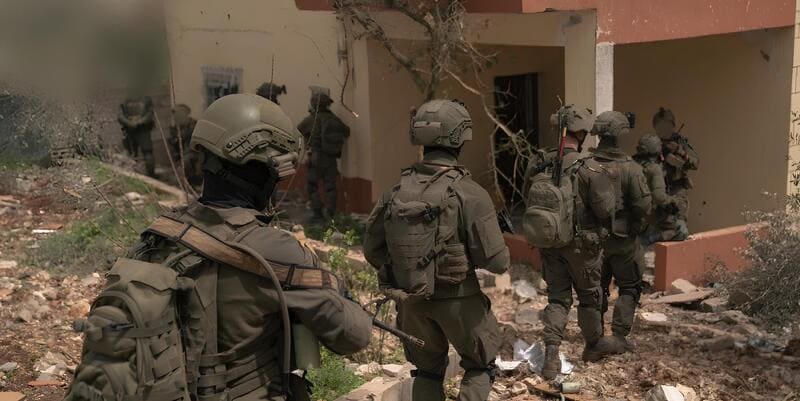
Image Credit: Israel Defense Forces (IDF soldiers operating in Southern Lebanon against the Iranian proxy group Hezbollah, April 2026).