



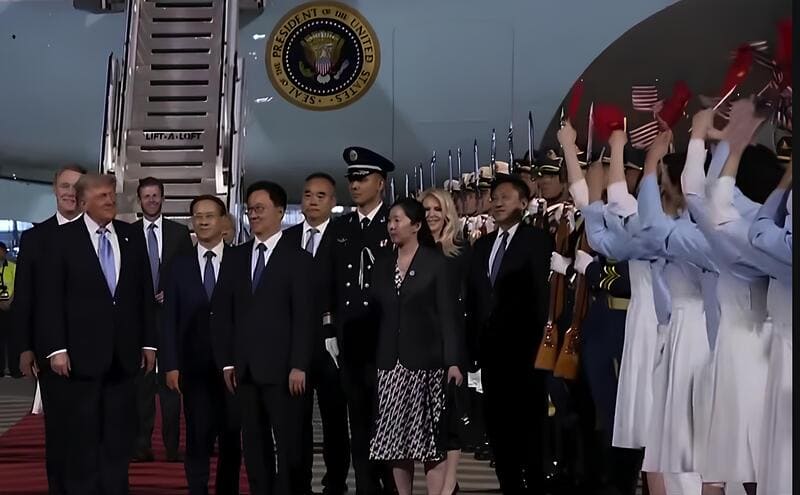
The visit of President Donald Trump to China from May 13 to 15, 2026, is not merely another diplomatic engagement between Washington and Beijing. It is a strategic encounter taking place at a historical inflection point where the global order itself is under reconstruction.

Beneath the ceremonial handshakes, red carpets, and carefully choreographed lies a far deeper reality; the world is entering an age where military power, technological supremacy, economic resilience, energy corridors, artificial intelligence, and techno-geopolitical influence are converging into a single grand strategic contest.
This visit comes at a moment when the international system is exhausted by continuous crises. The Russia-Ukraine war has fundamentally altered European security architecture. The Middle East remains volatile after the Iran-Israel-U.S. confrontation.
Global trade routes are increasingly militarized. Energy markets remain vulnerable to disruptions in the Strait of Hormuz and the Red Sea. NATO is under stress. The Indo-Pacific is becoming heavily militarized. Meanwhile, artificial intelligence, quantum computing and semiconductor competition are reshaping the foundations of national power itself.
Against this backdrop, Trump’s Beijing visit represents something much larger than bilateral diplomacy. It is effectively an attempt to redefine the rules of engagement between the two most powerful states in the international system before strategic competition enters an uncontrollable phase.
The symbolism alone is extraordinary. Donald Trump returns to Beijing not as the leader of a confident unipolar superpower, but as the president of a United States facing strategic overstretch, economic fragmentation, domestic polarization, mounting debt pressures, alliance fatigue, and growing questions about the sustainability of American global primacy.
At the same time, Xi Jinping is receiving Trump not as the cautious leader of a rising power seeking accommodation within the Western-led order, but as the architect of an increasingly assertive China determined to shape an alternative geopolitical and geo-economic system.
Beijing understands this reality clearly. In fact, Chinese strategic planners may increasingly believe that the Iran-Israel-U.S. war has accelerated the redistribution of geopolitical momentum away from Washington and toward Beijing.
This is classic geopolitical war-gaming logic. Great powers rarely collapse because of one decisive defeat. They weaken gradually through cumulative strategic overextension. China’s leadership studies history deeply. Chinese strategists understand how prolonged overseas commitments exhausted previous empires economically, militarily, and politically.
Beijing may therefore view the Iran crisis not simply as a regional disturbance, but as a strategic diversion accelerating long-term American overstretch. This is the hidden geopolitical layer behind Trump’s visit. The Middle East war fundamentally altered the strategic environment.
The Iran-Israel-U.S. confrontation was not merely a regional conflict. It exposed the vulnerability of globalization itself. Oil markets reacted violently, shipping routes became insecure, insurance premiums surged, maritime security deteriorated, and the Strait of Hormuz emerged as the world’s most dangerous economic chokepoint.
For decades, Washington believed economic integration would eventually liberalize China politically and bind Beijing permanently into a U.S.-led international system. Instead, the opposite occurred. China used globalization to build industrial depth, technological capability, military modernization, infrastructure connectivity, and financial leverage at a scale unprecedented in modern history.
Today, Beijing is no longer merely competing within the existing system; it is quietly constructing parallel systems. The expansion of BRICS+, the strengthening of the Shanghai Cooperation Organization, alternative payment mechanisms, de-dollarization initiatives, digital currency experimentation, and strategic infrastructure financing collectively indicate a long-term strategy aimed at reducing Western structural dominance.
Washington understands this clearly now. That realization explains why the U.S.-China rivalry has evolved from trade disputes into a full-spectrum strategic competition involving semiconductors, AI, quantum computing, cyber warfare, rare earth minerals, maritime dominance, satellite systems, biotechnology, and supply-chain control.
Increasingly unstable, the coming decade may not resemble the Cold War of the twentieth century. It may instead become a far more complex hybrid contest where economies remain interconnected while militaries simultaneously prepare for conflict.
Strategically, this is precisely why Trump’s China visit matters. The visit is not designed to create friendship, but to prevent catastrophic escalation while both powers continue preparing for long-term rivalry. In strategic war-gaming terms, the United States currently faces three simultaneous pressure theaters.
First is the European theater, where Russia’s confrontation with NATO continues draining Western military stockpiles and financial resources. Second is the Middle Eastern theater, where instability involving Iran threatens energy security and maritime chokepoints. Third is the Indo-Pacific Theater, where China’s military rise increasingly challenges U.S. naval supremacy and alliance structures.
Beijing acutely understands this historical vulnerability. Chinese strategists increasingly calculate that the United States is entering a period of strategic exhaustion similar to late-stage imperial overstretch experienced historically by other dominant powers. Rising debt, political polarization, internal institutional distrust, and endless military commitments have created vulnerabilities that adversaries carefully monitor.
Beijing’s strategic doctrine appears increasingly centered on time advantage. Chinese planners believe that demographic scale, manufacturing dominance, technological catch-up, infrastructure connectivity, and Global South partnerships gradually favor China over the long term. Their objective is not necessarily immediate confrontation with the United States, but rather the slow erosion of American structural advantages.
Trump’s visit therefore becomes strategically important because Washington seeks to slow or stabilize this transition before the balance changes irreversibly. The most dangerous issue beneath the visit will undoubtedly be Taiwan. Public discussions may emphasize trade, tariffs, investment, and economic cooperation, but the real geopolitical fault line remains the Taiwan Strait.
For Beijing, Taiwan is not merely a territorial issue; it is tied directly to regime legitimacy, national rejuvenation, and the unfinished legacy of Chinese history. For Washington, Taiwan represents the frontline of Indo-Pacific containment architecture and the credibility of U.S. security guarantees.
Fundamentally, this creates an exceptionally dangerous equation. If Beijing concludes that American deterrence credibility is weakening due to Middle Eastern distractions, domestic divisions, or alliance fatigue, Chinese strategic calculations could become more assertive.
Conversely, if Washington interprets Chinese military modernization as preparation for forced reunification, the United States may accelerate regional military deployments, alliance integration, and technological containment.
Inadvertent danger is not necessarily deliberate war, the danger is miscalculation. History repeatedly demonstrates that major conflicts often emerge not from intentional decisions alone, but from escalation spirals, strategic ambiguity, nationalist pressures, alliance entanglements, and misreading adversary intentions.
Behind closed doors, this is why the visit may quietly focus on substantial and discreet crisis-management mechanisms, military communication channels, cyber protocols, AI governance discussions, and operational technicalities far more than public statements reveal.
Artificial intelligence itself is becoming a new strategic frontier. For the first time in modern history, great powers are competing simultaneously over military superiority and algorithmic supremacy. AI-driven warfare, autonomous systems, cyber sabotage, disinformation operations, predictive surveillance, and quantum-enhanced intelligence capabilities could fundamentally alter the future battlefield.
In this emerging environment, semiconductor supply chains may become as strategically important as oil fields once were. Taiwan’s centrality to advanced chip manufacturing therefore transforms it from a regional dispute into a global systemic risk. Should conflict erupt around Taiwan, the consequences would extend far beyond East Asia.
Thus, Trump’s Beijing visit is partially an exercise in strategic damage control. Yet there is another dimension often overlooked in Western analysis. The Global South is carefully observing this visit not emotionally, but pragmatically.
Countries across Asia, Africa, the Middle East, and Latin America increasingly seek strategic flexibility rather than rigid bloc politics. Many states now pursue multi-vector diplomacy; engaging China economically, maintaining security relations with Washington, and simultaneously expanding regional partnerships.
For countries like Pakistan, the implications are profound. Pakistan stands geographically positioned near the intersection of Middle Eastern instability, Central Asian connectivity, Chinese strategic expansion, and Indo-Pacific competition. The future trajectory of U.S.-China relations will directly shape regional economic corridors, security alignments, technological investments, and strategic partnerships across South Asia.
This is where strategic clarity becomes essential. The emerging world order is no longer being shaped solely by military alliances. It is increasingly being shaped by technology access, supply-chain positioning, energy transit routes, digital infrastructure, financial systems, AI ecosystems, and strategic geography.
The Trump-Xi meeting therefore symbolizes something historic – the opening phase of negotiations over the rules governing twenty-first century competition. Not peace! Not partnership! But, managed rivalry between two civilizations-scale powers attempting simultaneously to avoid direct war while preparing for prolonged geopolitical contestation.
The coming years may determine whether humanity enters a period of controlled multipolar balance or descends into fragmented techno-economic blocs defined by sanctions, proxy conflicts, cyber warfare, and militarized trade routes.
That is the real shadow hanging over Beijing. That is why the world is watching Beijing. The old world order is weakening, but the new order has not yet stabilized. That transitional vacuum is where danger grows – that is precisely where the world stands today.
At this juncture, the Dragon and the Eagle are no longer negotiating partnership. They are negotiating the terms of coexistence within an increasingly fragmented world system shaped by wars in the Middle East, energy insecurity, technological rivalry, and geo-economic disorder.
Looking beneath the surface – behind the smiles and handshakes, diplomatic language and photographs, lies a far deeper question: “Can the Dragon and the Eagle coexist within the same century without dragging the world into systemic confrontation?” “Can the Dragon and the Eagle negotiate the future of world order while the Crescent burns beneath them?” The answers to these questions will shape the future of emerging world order.
Author: Mirza Abdul Aleem Baig – President of Strategic Science Advisory Council (SSAC) – Pakistan. He is an independent observer of global dynamics, with a deep interest in the intricate working of techno-geopolitics, exploring how science & technology, international relations, foreign policy and strategic alliances shape the emerging world order.
(The opinions expressed in this article are solely those of the author and do not necessarily reflect the views of World Geostrategic Insights).
Image Source: Sky News (President Trump touching down in Beijing on May 13, 2026).