



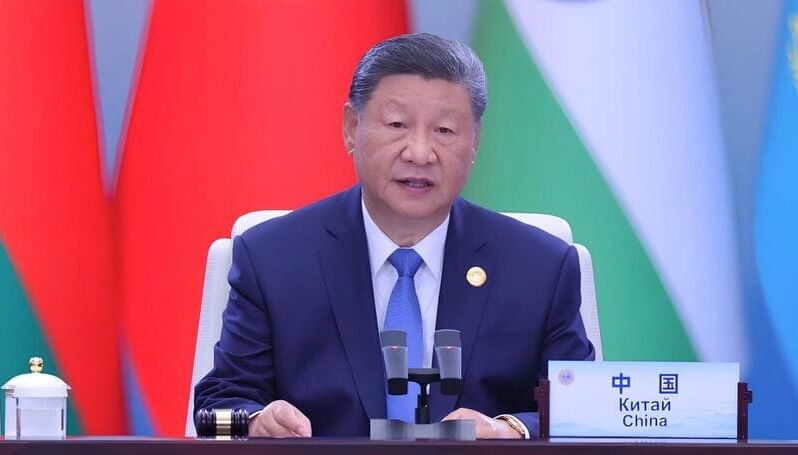
President Xi Jinping proposed a new reformative initiative for equitable global governance at SCO Tianjin Summit 2025. This agenda, Global Governance Initiative (GGI), will potentially take the world towards shared development, multilateralism and sustainable peace.
President Xi announced GGI at the Heads of State SCO Plus Summit with a five-point agenda. He calls for sovereign equality, respect for the rule of international law, multilateralism, people centric development agendas and taking real actions instead of talking.
President Xi opened the summit with his presidential address. Its significance lies in its SCO Plus format which means extended participation of SCO observers and dialogue partners along with core members in the summit. It is the first time in the history of SCO that China took a bold step to invite over 20 heads of states or governments along with leaders of international organizations at Heads of State Summit. The diversity of audience made SCO Plus truly an international highlight ahead of the UN General Assembly session.
Moreover, President Xi announced the Global Development Initiative at the 76th UN General Assembly session but opted to announce the Global Governance Initiative at SCO Plus summit in China. It is significant in terms of time and place reflecting the broader foreign policy of China on global governance. It simply means the UN needs reforms or the world needs a new governance model. It is one step further implying that the UN often fails to address development and security needs of the Global South.
The Global Governance Initiative is not just a five-point blueprint of global governance but it is a first real milestone towards shaping the new norms in the international system. The concerns over rich states getting richer in Global North with reverse impacts in Global South are the hallmark of this initiative. Because development and security are intertwined for President Xi.
In short, President Xi advocated for orderly, equitable and multipolar world order with no space for unilateralism and exceptionalism. It is a call for the system that is just, fair and transparent. A systematic shift that equally respects the sovereignty of every state, promotes economic globalization, and creates space for shared development.
This is not a vision of President Xi alone but it is a shared decision to make the international system more equitable where consultation is preferred over confrontation.
If SCO member states stay committed to Shanghai Spirit and organization’s founding mission, no power on earth can stop SCO from achieving result-driven and sustainable economic development with solid resolve. Having a strong, interdependent and functioning economy is the only way to contribute to global peace and stability for SCO members.
In manner, SCO member states need to take responsibility for open cooperation across the globe. They can leverage their rich energy resources, bigger markets, better connectivity, and internal driving forces to fast-track their local development. But President Xi advises non-confrontation, non-alignment in global power politics, and non-unilateralism. Because this could go against the essence of the Shanghai Spirit. This is the way SCO can remain a force for stability in the volatile world.
The SCO institutions like SCO Universal Center for Countering Security Challenges and Threats, SCO Anti-Drug Center and SCO Regional Anti-Terrorist Structure are the foundational pillars of security for SCO. Such institutions guarantee common security in the SCO region. If SCO is able to increase its contribution towards the global economy, its security needs will also increase in proportion. This is why, President Xi, upheld that all SCO members should combine their forces to address various threats and challenges.
President Xi gives a vision, provides an agenda, and suggests a clear direction with visible goals. But the execution requires resources. President Xi filled this gap by announcing market access in China, sharing its knowledge economy, centers for technological innovation, scientific research labs, higher and vocational education. China will set up more than 10 million kW renewable energy capacity in SCO Plus states and share its Beidou satellite navigation system for diverse applications.
Since the world has entered into a phase of disturbing transition, resilience through shared development and common security is the only reliable option to seek equitable global governance. This inclusive approach is the ticket for smaller states to secure a voice at larger platforms to protect their sovereign interests. The underlying motive is to promote multilateralism and consensus-based decision making in the international system. In this context, the Global Governance Initiative is a very timely intervention for democratic world order.
Author: Muhammad Asif Noor – Secretary General Pakistan-Shanghai Cooperation Organisation Friendship Forum.
(The views expressed in this article belong only to the author and do not necessarily reflect the views of World Geostrategic Insights).
Image Source: Xinhua