



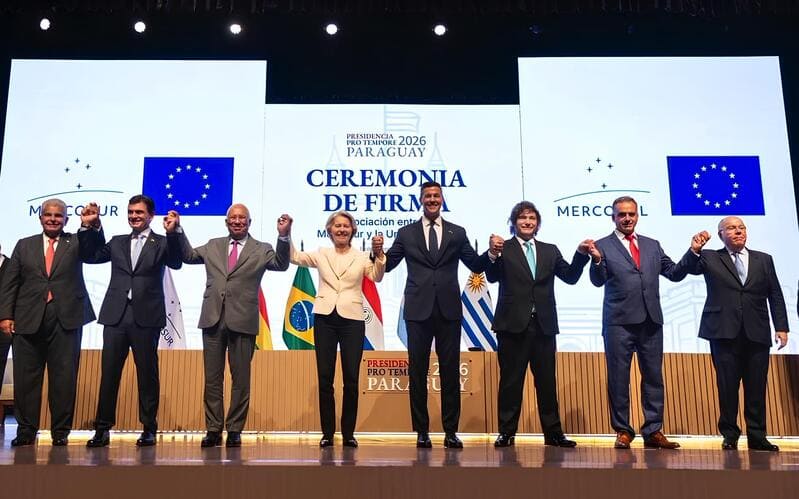
Although it has been overshadowed by higher profile events on the international scene, the recent conclusion of a free trade agreement between the European Union and Mercosur on January 17 has special significance, coming as it does at a time when the geopolitical status of the Western Hemisphere is in flux.

While the agreement, almost three decades in gestation, may have only limited economic significance for the near future, it marks an alternative approach to this region from that of the United States which is seeking to reassert its predominance in the crudest possible terms.
Ironically, under the banner of “open regionalism,” the United States too once championed free trade agreements like this one in its relations with Latin America and elsewhere. In contrast, it now seeks to tie the region’s countries to it through pressure tactics—imposing high tariffs and subsequently only providing partial relief to individual countries on a bilateral basis.
And of course, Latin America is absorbing the impact of the operation which removed Venezuelan head Nicolas Maduro while, at least for the present, leaving the rest of his regime intact so long as it diverts its oil trade towards the United States. And Europe itself is facing unprecedented tensions with the United States on issues ranging from trade to Ukraine to Greenland.
Mercosur’s Dreams Deferred
It is in this unsettled environment that the European Union and Mercosur have finally come together on an agreement—an achievement which is all the more surprising for taking place at a moment when the construction of multilateral architecture has appeared to be a relic of a more optimistic time. To understand this agreement, one must look back first to the early 1990s, and the creation of the Southern Common Market—Mercosur.
Mercosur itself emerged as a project of the political and economic elites of Brazil and Argentina (together with those of far smaller Uruguay and Paraguay) as their countries transitioned away from military rule and sought to recover from the “lost decade” of economic stagnation brought on by the debt crisis of the 1980s. Integration was seen as a vehicle for creating sustained economic growth, while provisions formalized in a 1998 protocol which stressed the democratic nature of the participant countries underscored its potential role in locking in their return to civilian rule.
Mercosur was structured not only as a free trade area in which barriers to the flow of goods and services among the members were to be progressively eliminated, but also as a single economic bloc with a common external tariff, following the model of the European Union. The treaty establishing Mercosur was signed in 1991, and indeed the accord initially provided its members with a strong impetus for economic growth.
However, it has suffered from limitations which have prevented it from fulfilling its potential. It lacks the centralized, empowered bureaucracy like that of the European Commission, with competence over trade issues, and key issues are often resolved only through diplomatic negotiation at semi-annual summits. Thus, the relative weight of Brazil, and with it, its ability to impose its will, which is often protectionist, has left other members, such as Uruguay, and more recently Argentina, frustrated.
A Long and Winding Road
The recent accord may have a positive effect in reviving Mercosur as an engine of growth while also helping Europe’s economy. But the path to agreement has been tortuous, ever since negotiations began in 2000. The fundamental problem has been the very complementarity between the two blocs’ economies which makes the effort at reaching agreement worthwhile.
Mercosur is efficient producer of agricultural products, leading to fears in Europe that that its exports will prejudice the latter’s farmers—a concern felt particularly strongly in France, which, while theoretically supportive of an agreement, has long opposed any text which is actually negotiated, and has sought allies both from other European countries with vulnerable agricultural sectors and from European environmentalists concerned about Amazon deforestation in an effort to halt the conclusion of an agreement.
The mirror image of this has been fear that Mercosur’s industries, particularly automobile production, would be crushed by European imports. After the seemingly endless back-and-forth, including a five year-long period in which negotiations were suspended, a deal was finally reached, which was approved at the level of the European Council, representing the governments of the EU’s member states, with France and other opponents unable to muster the votes for a blocking minority.
We have, however, seen a successful effort at the directly elected European Parliament to refer the agreement to the European Court of Justice, and the final outcome may not be known for up to two years. The European Council, however, retains the option of putting the agreement into effect provisionally while the court case proceeds, although it is not clear that it will be willing to take such a politically fraught decision.
The final agreement includes the usual elements that are included to make trade agreements palatable, such as slow phase-ins, including for free trade in automobiles, (calming Mercosur fears) and safeguard provisions to stop unwelcome import surges (a sop to European agricultural producers). Also, the EU will create a new fund for subsidies to affected interests (another measure to placate European farmers). It has been suggested that the agreement could increase EU GDP by 0.1 percent and Mercosur GDP by 0.1 to 0.7 percent, respectable but hardly earth-shattering amounts.
Open Regionalism—European and U.S. Style
The EU-Mercosur agreement was first proposed at a moment in which “open regionalism” was in vogue. Under this thinking, trading areas, even as they pursued internal integration, would do so in ways that did not discriminate against non-member states, while in parallel the World Trade Organization’s efforts at global trade liberalization continued.
Negotiations with Mercosur began after the European Union had consolidated itself under the 1992 Maastricht agreement, granting its central institutions greater powers vis-à-vis individual member states. It then expanded eastward to the former Soviet-dominated states, and signed trade-expanding agreements (some more comprehensive than others) with a range of countries throughout the world.
Parallel to this, the United States was pursuing its own efforts at regional trade integration, focusing on the Western Hemisphere. This began with the 1989 U.S.-Canada Free Trade Agreement which in 1994 was expanded to include Mexico in the North American Free Trade Agreement (NAFTA).
This was followed by a wave of such agreements in the Western Hemisphere: Chile (signed in 2003), five Central American states—Costa Rica, El Salvador, Honduras, Nicaragua and Guatemala—plus the Dominican Republic (2004), Peru (2006), Colombia (2006) and Panama (2007). Outside of the Western Hemisphere, the United States concluded agreements with Israel, Jordan, Australia, South Korea, Oman and Morocco.
The United States sought to extend its free trade agreements within the Hemisphere to include the Mercosur countries, and in 1994 proposed consolidating them into a single Free Trade Area of the Americas (FTAA). However, the Mercosur countries showed limited interest for multiple reasons including fear that U.S. agricultural subsidies would impact their own producers, concern that their own industrial sectors, already facing competition from China, could not compete, and broader suspicions of U.S. leadership on the part of leftists Luiz Inácio Lula da Silva in Brazil and Nestor Kirchner in Argentina during their presidencies.
America Walks Away
The FTAA initiative fell by the wayside; at the same time the negotiation of new free trade agreements lost political viability within the United States. Barack Obama worked with a range of Asia-Pacific countries on the ambitious Trans Pacific Partnership (signed in 2016), seeing it as a counterweight to China, but ratification by the U.S. Congress proved impossible, and Vice President Hilary Clinton, running for the presidency in 2016, felt compelled to disavow the agreement, which was also opposed by the winner in the race, Donald Trump. (A variant ultimately went forward without U.S. participation.)
In his first term Trump left the network of free trade agreements in the Western Hemisphere and beyond intact, with the important exception of NAFTA. (He did impose a number of sector-specific tariffs that affected some of these countries.) After he initially threatened to simply abandon NAFTA, rancorous negotiations produced a revised agreement in 2019. It weakened investment protection provisions, enhanced enforcement of labor standards and stiffened the rules of origin in the automotive sector—all with the aim of returning industrial production to the United States.
The four year interregnum of President Joseph Biden was one largely of stagnation on trade. His administration’s one regional trade initiative, the Americas Partnership for Economic Prosperity (2022), was a mere framework for policy coordination, without providing any genuine new market access, and was received without enthusiasm in the region.
Trump Prefers to Twist Arms
In his second term, however. Trump took a much more high pressure approach towards the region. While the free trade agreement with Canada and Mexico remains largely intact at least for the time being, goods not covered by it have been subjected to new tariffs, and automobile, aluminum and steel imports have been hit with sector-specific tariffs. (The atmosphere with Canada was further poisoned by Trump’s bizarre insistence that Canada only had a future as the fifty-first U.S. state.) And tariffs, starting from a baseline of ten percent, have been imposed throughout Latin America, despite the provisions of multiple free trade agreements.
Trump has also used tariffs and other forms of pressure in support of political goals. He threatened to impose high tariffs on Colombia when its president, Gustavo Petro refused to accept flights of repatriated illegal immigrants. (Petro caved.) He threatened to use economic or even military force against Panama if it did not oust Chinese-owned firms from commercial facilities adjacent to the Canal. (Unwinding the Chinese presence remains a work in progress.) And most dramatically, he seized Venezuelan dictator Nicolas Maduro to face trial in the United States on narcotics charges, while using naval power to require the Venezuelan regime to sell its petroleum as the United States will direct.
Politics seems to figure heavily in U.S. economic policies towards the two largest Mercosur member states, Brazil and Argentina. Argentina, under the leadership of Javier Milei, who has cultivated both a personal relationship with Trump and alignment with his policies, has not been spared the baseline ten percent tariff. However, the Trump administration has gone out of its way to be helpful as Milei seeks to reform Argentina’s economy, with the Treasury Department supporting the peso when it weakened as a result of internal political turbulence. Also, as Americans faced rising beef prices, Argentina’s tariff-rate quota for exports to the United States was raised.
Initially at least, Brazil, led by left-leaning, Trump-skeptical Lula, was hit particularly hard, first receiving the baseline 10 percent tariff, which was followed by an additional tariff of 40 percent, principally as a result of Lula’s refusal to halt criminal proceedings against right-wing, pro-Trump former President Jair Bolsonaro for his involvement in coup plotting following his loss to Lula in the 2022 Presidential race. However, since then, Trump’s interest in Bolsonaro’s fate has waned while concern over the inflationary impact of the tariffs within the United States has increased; the additional tariffs on products such as coffee, beef, and cocoa have been removed while negotiations continue.
A Better Way?
What is the significance of the EU-Mercosur agreement in the current regional and global environment? Under Trump, U.S. policy is to eschew multilateral negotiations and deal with individual countries in the region on a bilateral basis in which it has overwhelming superiority. It ties market access to compliance on specific issues (accepting immigrants being repatriated to Colombia, ousting China from Panama, etc.). And the market access which the United States is prepared to offer in exchange for this compliant behavior is less than that of the status quo ante.
Given the hardening U.S. approach to the region, the EU-Mercosur agreement has geopolitical significance which extends beyond its limited potential economic impact. The United States, at least under its current leadership, views the Western Hemisphere as an area of “American preeminence,” as stated in its November 2025 National Security Strategy. While this stance may be directed principally against China, the EU-Mercosur agreement, in principle at least, stands in opposition to any possible effort to exclude (or at least limit) the European presence in the Hemisphere. Given that Brazil and Argentina have important oil and gas resources as well as vast mineral deposits, this may prove to be relevant in the future.
In any event, the approach that the EU-Mercosur agreement embodies harkens back to the more optimistic days of open regionalism. It has its limits, particularly the slow phase-in periods and the uncertainty created by efforts still underway within Europe to derail it. However, it may have a demonstration effect that should not be overlooked. The mere fact that this agreement which had been given up for dead for so long is finally coming to a conclusion shows that the idea of global economic growth through trade expansion still has some prospects. (The same may be said for a recently announced trade agreement which the European Union has reached with India.)
The agreement with Mercosur also shows that there is an alternative to the approach which the United States is now taking to Latin America—one of high tariffs to be turned up or down at its convenience and of bluster and threats used as everyday tools of diplomacy. It may be that the approach of the EU-Mercosur agreement—patient negotiation, compromises on both sides—will ultimately prove more fruitful; a future American administration may want to return to it, even to the point of reviving the bold thinking which led to ideas such as the Free Trade Area of the Americas.
Author: Richard M. Sanders – Senior Fellow, Western Hemisphere at the Center for the National Interest in Washington D.C. A former member of the Senior Foreign Service of the U.S. Department of State, he served in embassies throughout Latin America as well as in Spain and Canada. His Washington assignments include service as Director of the State Department’s Office of Brazilian and Southern Cone Affairs, 2010-13.
(The opinions expressed in this article belong only to the author and do not necessarily reflect the views of World Geostrategic Insights).
Source of the image: MERCOSUR