



World Geostrategic Insights interview with Péter Siklósi on the likely outcome of the conflict in Ukraine, the risks to European stability arising from Ukraine becoming a member of the EU, the prospects for a common European defense, and Hungary’s role in European security.
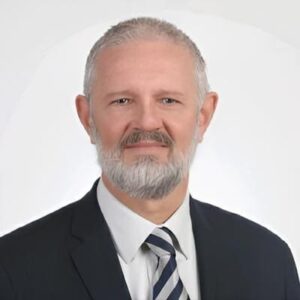
Péter Siklósi is a Hungarian expert on geopolitics and security, with a long career in defense policy and international diplomacy. He currently serves as a senior researcher at the Magyar Külügyi Intézet (MKI) – the Hungarian Institute of International Affairs. Siklósi has served for over two decades within Hungarian government institutions. At the Ministry of Defense, he has held several senior positions, including Undersecretary of State for Defense Policy and Planning (from July 2010 to July 2018). He also served two terms at the Permanent Representation of Hungary to NATO in Brussels as defense advisor (2007–2010 and 2018–2022).
Q1 – In a policy brief released in October 2025 by the Hungarian Institute for International Affairs, written by you, Gergely Fejérdy, and Csaba Stefán, entitled “Who Can Move What in the Grand Chess Game”, you analyzed the conflict in Ukraine as a grand chess game. Currently, of the actors involved, who is in control of the game? Or could the game end in a stalemate?
A1 – There are more influential players and less influential players in this game, but noone is in absolute control. Of the warring parties Russia is stronger and Ukraine is weaker, so obviously Russia has more options and time, which is why they are not in a hurry. Ukraine’s options are very limited and they are totally reliant on Western support. Of the Western powers the US is much stronger than the EU or the Europeans in a wider sense, no wonder that the US is much more influential on what’s happening and the Europeans are running after the events. The US wants peace, we can safely state that, but so far hasn’t used its full leverage on the warring parties to achieve it. I am confident that the time will come sooner rather than later when they will pressurise the parties, Ukraine first and foremost, to sign the peace deal. The most probable outcome is a kind of stalemate indeed, in a sense that there won’t be a clear winner and a clear loser. Both parties will have to accept a result which is less than their original, maximalist goals.
Q2 – You have described the current situation as almost hopeless for Ukraine due to the depletion of human resources. Could the “war fatigue” of Ukrainian society force the government to make territorial concessions that it has so far rejected?
A2 – Time is against Ukraine. The longer this war lasts the more they lose, in terms of human and financial resources for sure, but also in territory. President Zelensky has to choose between losing the uncompromising war-hero status in case he signs a peace deal and slowly but surely losing public support in case he doesn’t and the war goes on without the realistic hope of winning it. Russia’s relentless campaign to destroy Ukraine’s power and heating infrastructure in the middle of winter intends to strengthen the war fatigue in the Ukrainian population. There are no signs of general and widespread discontent yet, but here again, time is not on Ukraine’s side.
Q3 – Despite sanctions and pressure on the budget, Putin does not seem willing to back down on his demands. Can Russia afford to continue the conflict for a long time?
A3 – Noone can afford to wage a major war indefinitely and Russia is no exception, but they don’t have to. The calculation in Moscow is that they can last longer than Ukraine can and that’s enough for them. They learned to live with the sanctions, which are by no means airtight and in some cases more damaging for Europe than for them. Ukraine’s hope is in European financial and American military support. The problem is that Russia also has supporters, China first and foremost and the Europeans also lose a lot as long as the war lasts in economic terms.
Q4 – You have described Western policy support for Ukraine as “extremely cynical,” consisting of low-cost gestures and obsolete weapons, an approach deliberately aimed at weakening Russia “through Ukrainian blood” rather than ensuring a decisive victory for Kyiv. What should the West have done differently in the face of Russia’s military attack on Ukraine?
A4 – They should have realised in the summer of 2023 during the failed Ukrainian counteroffensive at the latest that reclaiming the lost territories is hopeless. From that moment on it was obvious that the longer the war lasted the more territory Ukraine would lose. The ethical policy would have been to convince them to accept a compromise. Instead the Europeans chose to buy time for themselves to strengthen their military capabilities against Russia (which may or may not want to test NATO) through financial support to Ukraine to continue the war. Europe only loses money on this, but Ukraine loses hundreds of thousands of people as well.
Q5 – You have pointed out that Ukraine’s accession to the EU could turn into a “financial black hole” due to corruption and the lack of a clear reconstruction plan in Ukraine. What concrete guarantees should Europe demand before granting full economic integration and membership to Ukraine?
A5 – Ukraine should follow the same meticulous integration process that every candidate country has had to follow. This process was designed precisely to provide such guarantees. Ukraine is further from meeting the criteria than any other candidate country, but many in Brussels still aim to bring it into the EU by 2027.
Disregarding the due process would not only be unfair to the others, but also very dangerous for the EU. In the worst case this could destroy the EU itself. No wonder Putin does not oppose Ukraine’s EU accession.
Q6 – Apart from the economic aspect, what do you think are the main security challenges that the European Union should be prepared to face if Ukraine joins?
A6 – Ukraine’s accession would almost automatically make the EU member states warring parties. The EU’s „mutual assistance clause” (Article 42(7) TEU) would give the right to Ukraine to activate it and why wouldn’t they do it? In this case all other member states would have to provide assistance in response. If they do it in a substantial way, they become warring parties, if they only help in words, the clause and the EU loses its credibility.
Q7 – The Hungarian government is making Ukraine’s possible integration into NATO and the EU conditional on the restoration of pre-2015 minority legislation in Transcarpathia. Do you believe that Ukrainian leadership is really willing to return to that legislative framework or that the stalemate will continue indefinitely?
A7 – Together with many other allies Hungary does not support Ukraine’s NATO integration, because it would bring NATO into war with Russia. Ukraine’s NATO membership is off the table for the foreseeable future, so in this regard the issue of the Hungarian minority legislation is currently not relevant. In terms of EU accession it is only one of the many criteria, although an important one for Hungary. We are sceptical of Ukraine’s willingness to solve the issue.
Q8 – Having served two terms at the Hungarian representation to NATO, how do you view Hungary’s current contribution to the defense of the “eastern flank”?
A8 – Hungary is doing its part. We spend on defence as agreed, our defence capability development plans are in line and closely coordinated with NATO plans. Hungary is one of the „eastern flank” countries with our own contingency plans, multinational NATO forces and HQ, led by Hungary, but integrated into NATO’s force structure. This is our main effort on the eastern flank”, but we also regularly participate in NATO exercises elsewhere and the Baltic Air Policing mission.
Q9 – How do you assess the EU’s ReArm Europe/Readiness 2030 plan and the prospect of a European common defense less dependent on the United States?
A9 – Europe has to do more in defence, that’s clear. It has to overcome decades of underinvestment. It has to spend more and acquire military capabilities which were either lost or are brand new. NATO’s new spending target of 3.5+1.5=5.0% is a good thing, the work should concentrate on actually acquiring real military capabilities from it. While doing so Europe should also strengthen its defence industrial base, both in terms of innovation and production capacity. But we shouldn’t confuse the roles. Defence is a matter of the nations or the alliance of nations, i.e. NATO.
NATO has the proper political and military decision making and command capabilities for the job and most importantly it has the indispensable leading power, the US, which the EU lacks. Although the EU has some consultative and coordination roles in defence, it shouldn’t aim to duplicate or overtake the role of NATO. It can and should be less dependent on the US in terms of capabilities and be able to perform missions where the US is not interested, but shouldn’t aim to push out the US from the European security architecture. The EU’s most important task should not be common defence, but common defence industrial policy. Aiming for a proper common defence, not only in slogans, but in the true meaning of the word, would inevitably lead to the idea of a federal Europe, which will cause immense conflicts in Europe. We shouldn’t go down this path.
Q10 – What role do you see for Hungary in the future European security architecture once the conflict in Ukraine has stabilized? Will Hungary maintain an “outsider” position or will it have to align itself more closely with the EU’s common defense strategies?
A10 – Hungary has no problems with the EU’s agreed defence strategies, so in this respect Hungary is not in an outsider position. There are two ideas on which we disagree, but these are not agreed common defense strategies. One idea that we strongly disagree with is that Ukraine’s defence equals Europe’s defence, in other words that Ukraine’s war is Europe’s war. Europeans can help Ukraine, but Europe shouldn’t tie its fate to Ukraine. Hopefully an American brokered peace agreement will take this idea off the table. The second idea is the already mentioned push by some towards a federalised European common defence. That’s why Hungary will always oppose the introduction of the QMV voting system into the areas of foreign and defence policies. This is a matter of sovereignty for us. Luckily we are not alone on this issue.
Péter Siklósi – Senior researcher at the Hungarian Institute of International Affairs.