



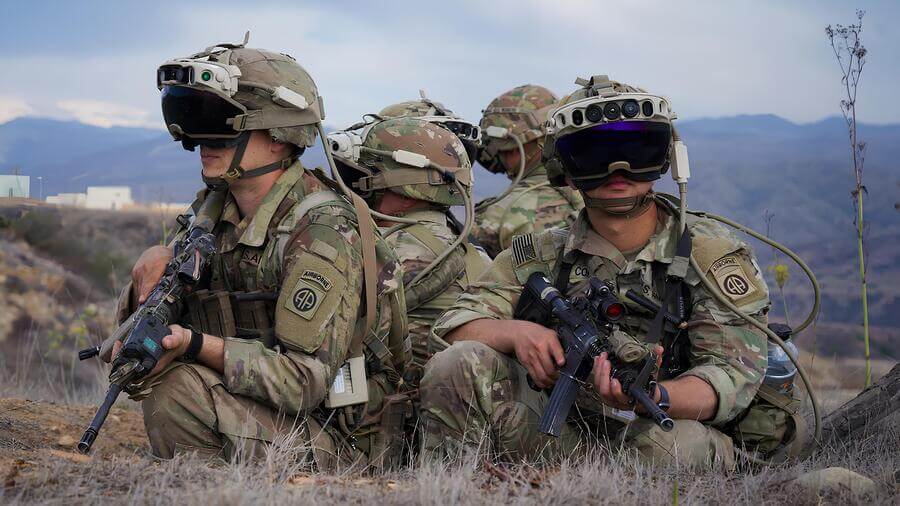
World Geostrategic Insights interview with Joseph Núñez on the current military and power projection capabilities of the United States, as well as the challenges to its global military superiority and prospects of its alliances.

Joseph Núñez Ph.D. is a former US Army colonel who also served in Iraq as an advisor to the US State Department. Dr. Núñez has taught political science at the United States Military Academy (West Point) and the Army War College. His research/consulting on counter-insurgency, reconstruction, and conflict prevention have influenced government policy and international politics. His articles have been published in the New York Times and the Financial Times. Dr. Núñez is currently president of Nunez Properties.
Q1 – The United States continues to possess a superior military and an extensive network of allies, but this advantage is threatened by the growing military capabilities of its adversaries and by technological advances that are changing the nature of threats and rendering obsolete traditional U.S. notions of security based on geographic isolation. In addition, the U.S. military is downsizing, with budget cuts that could affect its capabilities, while China continues to increase its military investments and make significant advances in several areas, including its naval and air forces. Is the U.S. military advantage at risk?
A1 – It is true that China has made rapid advances in the size and capabilities of its military forces. On the other hand, the U.S. military is not really downsizing, especially when it comes to actual fighting units. Headquarters are being consolidated to ensure that lethality is favored over bureaucracy and advisory units are being reduced. In actual funding, the defense budget has not been cut, but it is a slight reduction when inflation is taken into consideration.
As China has expanded and developed its naval and air forces, the United States has struggled, particularly in the ability to manufacture ships and aircraft. This critical shortfall can be explained by a deficient defense industrial base (that atrophied in the post Cold War era), rampant cost overruns (defense industry profiteering and military contracting snafus), more than a few examples of poor design and rapid obsolescence, and the underinvestment that came from two long wars that resulted in strategic losses (including blood and treasure).
On the positive side of defense, the United States continues to lead in the technology realm (with important collaboration with allies) and is making rapid advances, though it is fair to say that China has made significant advances in defense technology. The Chinese continue to make progress through technological innovation, along with lots of replication of Western military weapons through various forms of industrial theft. It should also be noted that China has little combat experience compared to the United States, and their military does not have competent non-commissioned officers to lead soldiers on the battlefield.
My own sense is that the U.S. military advantage is somewhat at risk if not protected and rapidly advanced through public-private scientific research in defense technology. At present, the greater concern is quantity over quality, particularly when it comes to ship building. There are significant opportunities to partner with allied shipbuilding companies that have a far superior production record than those in the United States.
Q2 – Under the current presidency of Donald Trump, the U.S. military is undergoing significant changes characterized by budget cuts affecting logistics, troop training, and research in critical areas; a change in the military hierarchy with a purge of senior officers; and the dismantling of diversity initiatives and support programs that could undermine long-term military competitiveness. Are concerns about the future of national defense and U.S. military effectiveness justified?
A2 – This is not an easy or simple question to answer, but it is an important one that should be discussed, even if there are challenging political equities involved with perception and assessment. Let me preface my answer by stating that the policy pendulum often swings too far in each direction, particularly when it comes to personnel initiatives and decisions.
On the whole, budget cuts were not draconian. Some of the reductions may actually improve readiness and efficiency because they came in areas such as consulting contracts awarded to various private sector firms, an enterprise cloud IT services contract awarded to a software reseller, a Navy contract for business process consulting, and some Army drone programs that were deemed outdated. Needless to say, the U.S. defense budget is large and there is always room to trim superfluous bits from service tally sheets.
As for leadership purges and diversity policy changes, the ultimate proof as to their negative or positive impact should be reflected in the overall force – both for unit readiness and combat effectiveness, and also in the attitudes and opinions of the public towards the military, which has a major impact on enlistment and retention. It is worth noting that in 2024 almost all of the services were well under enlistment goals. Only the Marines were making their quotas. In 2025, the services are making their recruiting goals.
As for public opinion, I can say that numerous anecdotal observations prior to this current administration were not positive. In talking with numerous people who were veterans or family members of service oriented families, I found that a large majority of these people were telling their children, nieces, nephews, grandchildren, etc. not to join the military. Pressed further, they expressed frustration about the disastrous exit from Afghanistan, lack of confidence in Pentagon leadership, and resentment toward the changing military personnel policies that were often diametrically or largely opposed to their values and beliefs. When I wrote about this subject online, the response was overwhelming and consistent with my anecdotal findings.
Though it is too soon to make a definitive statement, it appears that the military is increasing its wartime focus, and setting aside the previous policies that were seen as diminishing fairness, teamwork, fitness, and focus on combat effectiveness.
Q3 – A recent internal document of the U.S Department of Defence, entitled “Interim National Defense Strategy,” circulated in mid-March and signed by Secretary of Defense Pete Hegseth, redefines the priorities of the U.S. armed forces. It calls for a withdrawal of U.S. troops from Europe, essentially shifting the responsibility for countering Russian threats to European allies, marking a significant departure from the Biden administration’s strategy, which emphasized political and military alliance with European countries. What is your view on this expected U.S. disengagement from European security?
A3 – While the previous administration may have emphasized political and military alliance with European countries, such as pulling together for support of Ukraine in its defense against Russia’s invasion and war for territorial expansion, there may have been lots of smiling faces around the NATO table in Brussels and elsewhere (European Union capital cities), but the happiness was somewhat superficial. The cold reality was that too many countries, including some wealthy G-7 members, were not pulling their weight on defense.
The new administration has not been so gentle. Washington has become much more transactional. When a European country asked if the United States would come to their aid under NATO if they did not pay their fair share (it was 2% of GDP then, now bumped up to 5%), they were sorely dismayed with the answer they received.
Reality is hard to accept long after the post Cold War peace dividend that led to false assumptions about international relations and the likelihood of war within the state system, especially on the European Continent. Russia is now seen as not satisfied with its current war on Ukraine, and may test other borders in the Baltics, Scandinavia, or another part of Eastern Europe.
It would be very unwise for the United States to withdraw all forces from Europe. This idea that Europe can fend for itself against Russia today while the United States concentrates military forces in the Asia Pacific region creates numerous negative unintended consequences. First, it would be an abandonment of NATO. American leadership within NATO has kept the herd of cats together and focused on defense as a team. Second, trying to extricate our American forces from Europe (and pull back from the support of Ukraine) is unwise because China is strongly invested in Russia’s war. Third, Beijing is watching to see if we relent, which will affect their thinking about Taiwan and other allies in the Indo-Pacific region.
My sense is that Washington is changing its perspective on Russia and Ukraine. Moscow (Putin) has been sweet talking Washington (Trump), but it has not made any effort toward a ceasefire, and has actually increased its attacks on mostly civilian targets in Ukraine. The United States will likely increase support to Kiev and ramp up economic sanctions on Moscow. The Pentagon should be encouraged that many European countries – Germany led the way – are now pledging to spend 5% of GDP on defense.
Q4 – As emphasized by Defense Secretary Pete Hegseth, China remains the primary threat, and the U.S. military is prioritizing a potential conflict over Taiwan. However, traditional U.S. allies in the Indo-Pacific, including Australia, Japan, South Korea, and Taiwan, fear that Trump could undermine the Biden administration’s efforts to create a cohesive regional security framework, with particular implications for initiatives such as AUKUS and QUAD. The stability of U.S. alliances in the region could become uncertain due to Trump’s unpredictable approach to foreign policy, while China-Russia cooperation and North Korea’s involvement in global conflicts could pose significant new challenges to regional security dynamics. What prospects do you see for alliances and multilateral cooperation in the Indo-Pacific to counter China in the new Trump era?
A4 – China does remain the primary threat. But in the calculations of strategy for this great power competition, we need to make sure that Washington does not forget that our allies are important, particularly those who call the region home and are well informed. Moreover, there are out of region allies with strong historical and current ties.
Frankly, just as was the case in Europe, there were friendly smiles but not a strong and functional regional security framework under the last administration, but there was constructive discussion on what could be formed. Clearly, there was a significant lack of U.S. forces deployed within the region. Likewise, there was not much in the way of concrete action to deter China from intimidation and expansion. I see all of this changing and it is long overdue.
However, strong allied cohesion should not be assumed or taken for granted. Whether we look at tariff talk and threats or how we engage allies, there are potential storm clouds on the horizon. If tariff negotiations can be quickly settled in a fair manner and there is positive change on our bluster about the sovereignty of various allies, that would be very beneficial for building comity, mutual respect, and a sense of teamwork.
There is nothing wrong with realism as an approach to strategy, especially if it is well grounded in history, facts, and complexity. Frankly, you cannot just focus on China and ignore Russia or their ties to Iran and North Korea. That said, realism sometimes undervalues those outside of the great powers (such as some allies), and that is a potential vulnerability.
Joseph Núñez Ph.D. – Former US Army colonel, President of Nunez Properties.
Image Credit: U.S. Army photo by Sgt. Thiem Huynh