



As Russia continues making tactical gains in southeastern Ukraine, the United States seems to be pressuring Kyiv to agree to the framework of the recently leaked 28-point peace proposal. The document – perhaps the most credible initiative yet – appears at first glance to require both sides to make significant concessions. What would happen if Russian and Ukrainian leaders accepted the plan?

Following the “historic” summit between US President Donald Trump and Russian leader Vladimir Putin in Anchorage on August 15, the idea that the Ukraine war should be ended at the negotiation table rather than on the battlefield has become more relevant than ever. Trump likely aims to freeze the conflict and once again portray himself as a “peacemaker.” But the problem for him is that neither the Kremlin nor Kyiv seem to be particularly eager to accept his peace proposal.
In Ukrainian society, any territorial concessions to Russia are widely seen as “capitulation.” The 28-point peace plan states that Ukrainian forces would have to withdraw from the part of Donetsk oblast they currently control, which would become a “neutral demilitarized buffer zone.” From Kyiv’s perspective, such a move would mean voluntarily giving up part of its territory – something that no politician in Ukraine could easily agree to.
What also worries Ukrainian leaders is that, according to Trump’s peace proposal, Kyiv would have to agree to enshrine in its constitution that it will not join NATO. Given that the document also states that the Alliance would agree not to deploy troops in Ukraine, Kyiv fears that, in the event of a renewed Russian invasion, it would again be on its own. It is, therefore, no surprise that Khrystyna Hayovyshyn, Ukraine’s Deputy Permanent Representative to the United Nations, has clearly declared that Kyiv “will not cross any red lines on sovereignty or territory in negotiations with Russia.”
Although the Kremlin remains quiet over Trump’s peace initiative, accepting some of its points would be very difficult to present to the Russian people as a “victory.” For instance, the plan proposes that a significant amount of the frozen Russian assets be invested in the reconstruction of Ukraine. Historically, it is the defeated party that pays war reparations, which the victors use to rebuild their own country. By agreeing to pay Ukraine de facto war reparations, Moscow would have to invest hundreds of billions of dollars into the economy of its adversary rather than into Russian development. In the long-term, such an outcome could trigger a serious economic crisis in Russia, especially since the peace proposal does not specify when the West’s sanctions on Moscow would be lifted, nor when Russia would be reintegrated into the global economy.
At the same time, the Kremlin would have to place the Zaporizhzhia Nuclear Power Plant, now under Russian control, under the International Atomic Energy Agency (IAEA) supervision, and allocate 50% of the generated electricity to Ukraine. Given that energy has traditionally played a key role in Russia’s foreign policy, accepting this point of Trump’s peace initiative would mean ceding a substantial portion of Moscow’s energy leverage.
Territorially, Russia would have to abandon its ambitions to capture the remaining parts of Kherson and Zaporizhzhia regions, even though it annexed them back in 2022. More importantly, even if Crimea, Luhansk, and Donetsk were recognized de facto as Russian, from the perspective of the West and Kyiv they would still be considered de jure Ukrainian. Thus, if Ukraine eventually attempts to recapture the territories, its action would be unlikely to be interpreted as an invasion of Russia. This aspect is crucial, as point 10 states that “if Ukraine invades Russia, it will lose the US security guarantee.” Additionally, it specifies that if Ukraine, without cause, launches a missile at Moscow or Saint Petersburg, the security guarantee will be considered invalid. Does this mean that if Russian forces violate the ceasefire anywhere along the line of demarcation, Ukraine would then have just cause to strike the two cities?
Also, Trump’s peace proposal does not permit Russian forces to enter the demilitarized zone in the Donbass, which could create a security vacuum in cities such as Sloviansk, Kramatorsk, and Druzhkivka. Besides territorial issues, the political aspects of Trump’s peace plan could be problematic for Russia. Even if Ukraine adopts what the document defines as “EU rules on religious tolerance and protection of linguistic minorities,” that still does not mean that the Russian language will receive the same status as Ukrainian, which is reportedly one of the key goals of Russia’s so-called special military operation in Ukraine.
Finally, although Trump’s initiative calls for a full and comprehensive non-aggression agreement between Russia, Ukraine, and Europe, this does not necessarily mean that peace will prevail, since such an agreement is not the same as a formal peace treaty. Therefore, if Moscow and Kyiv agree to sign the deal, it would most likely only freeze the conflict, allowing both sides – as well as European countries – to prepare for an even bloodier war in the not-too-distant future.
“This is not peace. It is an armistice for twenty years,” French Marshal Ferdinand Foch said, after the Treaty of Versailles was signed in 1919. Trump’s peace proposal could lead to the same outcome, unless, in the meantime, faced with internal power struggles and economic hardships, Russia weakens to the point that it is no longer able to fight another war. If that happens, Ukraine might have the opportunity to recapture roughly 20% of its territory, similar to how Azerbaijan regained control over Nagorno-Karabakh and surrounding regions in 2020 and 2023.
One thing is for sure: under the current circumstances, when the Russian military has the initiative and is capturing territory, though at high cost, if the Kremlin accepts Trump’s proposal, it would allow the Ukrainian Armed Forces to regroup and consolidate. Given that the deal’s implementation would be “monitored and guaranteed by a Peace Council headed by President Trump,” any potential ceasefire is likely to hold only until the end of his term.
Author: Nikola Mikovic – Journalist, researcher and analyst based in Serbia.
(The views expressed in this article belong only to the author and do not necessarily reflect the editorial policy or views of World Geostrategic Insights).
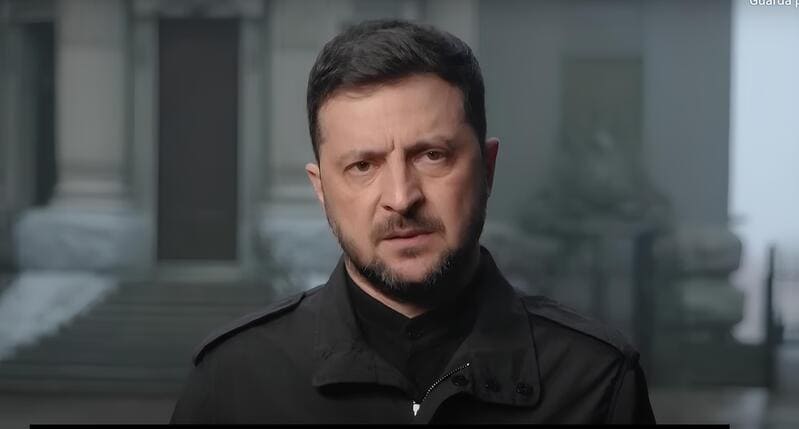
Image Source: Times News (Zelensky Addresses Nation Saying Ukraine Is Facing Its “Most Difficult Moment” In History).