



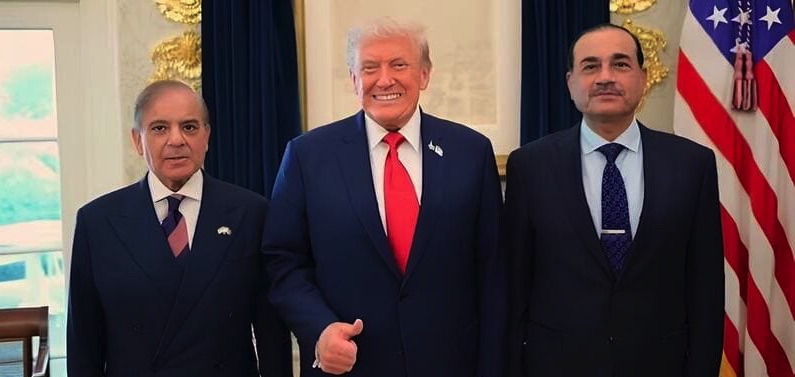
In a season marked by global volatility and recalibrations of old alliances, the calculated diplomatic warmth between Washington and Islamabad stands out not merely for its symbolism, but for its strategic implications. After years of being relegated to the periphery of U.S. foreign policy, Pakistan is once again making its way to the White House, the Pentagon, and the boardrooms of American investors.

Whether this rekindled relationship becomes a durable strategic partnership or fades into the familiar pattern of transactional cooperation will depend less on the pageantry of state visits, and more on the political will, policy follow-through, and regional balancing that both sides are now testing.
Recently, Pakistani Prime Minister Shehbaz Sharif and Field Marshal Asim Munir were received at the White House with uncommon courtesy. Field Marshal’s back-to-back meetings with President Donald Trump – who, despite the legal tumult of the past few years, remains a dominant force in Republican foreign policy circles – signaled a shift in tone.
Heretofore, Field Marshal Asim Munir was accorded a formal lunch at the White House was especially notable; it was the first such engagement of its kind since the Cold War era and a gesture laden with subtext. For the U.S., this marked a willingness to re-engage Pakistan’s military establishment as a key node of influence. For Pakistan, it was a calculated demonstration of institutional unity and geopolitical ambition.
But the significance of these visits goes beyond optics. They reflect a deliberate Pakistani strategy to reposition itself in a rapidly evolving global order – one in which economic partnerships and mineral diplomacy are beginning to rival military alliances in geopolitical currency.
At the core of this recalibration is Islamabad’s ambition to rebrand itself not as a dependent recipient of military aid or an unstable frontline state in the war on terror, but as a geoeconomic partner with untapped value. To this end, Pakistan has pitched itself to American investors as a gateway to South-Central Asia’s energy and mineral corridors, offering access to rare earths and critical materials in Balochistan.
In Washington, this narrative found some resonance. Preliminary agreements have been signed to facilitate U.S. investment in Pakistan’s oil and mining sectors. There are talks of tariff reductions to boost Pakistani exports. Just as significantly, the U.S. State Department recently designated the Balochistan Liberation Army (BLA) as a Foreign Terrorist Organization, aligning American policy with one of Pakistan’s long-standing security concerns and signaling a deeper convergence on internal threats.
This shift toward economic diplomacy marks a notable departure from the traditional framework of U.S.-Pakistan relations, which has historically swung between military patronage and post-crisis disillusionment. In that old model, Pakistan was often treated as a strategic utility – useful in Afghanistan, disposable afterward. What Islamabad is now proposing is a partnership built on interdependence, not mere convenience.
Yet this new trajectory is not without risks. Pakistan’s appeal to the United States as an investment destination is complicated by its existing commitments to China. Since 2015, Beijing has poured more than $60 billion into the China-Pakistan Economic Corridor (CPEC), anchoring its Belt and Road Initiative in South Asia and giving it privileged access to Pakistan’s infrastructure, ports, and mineral assets.
Chinese firms already dominate many of the same sectors – energy, transportation, and mining – that Pakistan now wishes to open to American investors. This puts Islamabad in a delicate position. On one hand, it seeks to attract U.S. capital and strategic goodwill. On the other, it cannot afford to alienate Beijing, whose economic leverage and strategic patience have long underwritten Pakistan’s developmental and military agendas.
A miscalculation here could provoke a backlash from China, or worse, spark competitive extraction projects in politically sensitive regions like Balochistan, where nationalist resistance is already simmering. The United States, too, must navigate this triangle carefully. A direct contest with China for influence in Pakistan could force Islamabad into a corner, undermining the very strategic autonomy it is now trying to exercise.
If Washington genuinely seeks to engage Pakistan as a partner, rather than as a wedge in its China containment strategy, it must allow for a more nuanced balancing act. The history of U.S.-Pakistan relations is littered with resets that never quite took. In the 1980s, it was the anti-Soviet alliance in Afghanistan; in the 2000s, the counterterrorism pact post-9/11; in the 2010s, the chaotic disengagement from Kabul.
Each phase was followed by a period of mistrust, policy fatigue, and strategic drift. The current moment feels different, but only slightly. The most promising shift is the inclusion of economic interdependence as a pillar of engagement. If U.S. investment actually flows into Pakistan’s mineral sector, and if trade reforms materialize into increased exports and tariff relief, the relationship could take on a degree of resilience that has historically been lacking.
There are also signs of a quiet reactivation of defense cooperation. Joint counterterrorism working groups are reportedly being formed. The ISI and U.S. intelligence agencies are once again in active dialogue. Military-to-military channels, dormant since the chaotic U.S. withdrawal from Afghanistan, are being cautiously reestablished. These are not headlines – but they matter.
Still, the structural weaknesses remain daunting. Pakistan’s domestic political instability, its fragile economy, and its unresolved tensions with India could all derail the current momentum. On the American side, the temptation to use Pakistan as a counterweight to China or to once again reduce the relationship to tactical security coordination could reproduce the very dynamics that derailed past partnerships.
If the U.S. fails to deliver on economic incentives, and Pakistan falls short on governance and institutional reforms or security commitments, this moment will fade into yet another cycle of disappointment. Conversely, if both sides act with strategic patience and policy discipline, they may yet build a partnership suited to a multipolar world.
Pakistan’s wager on the U.S. is a bold one. It is betting that Washington is ready to look at it not as a crisis-prone problem, but as a potential partner – flawed, yes, but geopolitically vital. The U.S., for its part, must decide whether it can move beyond the ghosts of Abbottabad, Kabul, and Kargil – and engage Islamabad with the complexity and nuance that today’s world demands. Anything less would be a missed opportunity for America’s standing in South Asia.
Author: Mirza Abdul Aleem Baig – President of Strategic Science Advisory Council (SSAC) – Pakistan. He is an independent observer of global dynamics, with a deep interest in the intricate working of techno-geopolitics, exploring how science & technology, international relations, foreign policy and strategic alliances shape the emerging world order.
(The views expressed in this article belong only to the author and do not necessarily reflect the views of World Geostrategic Insights).