



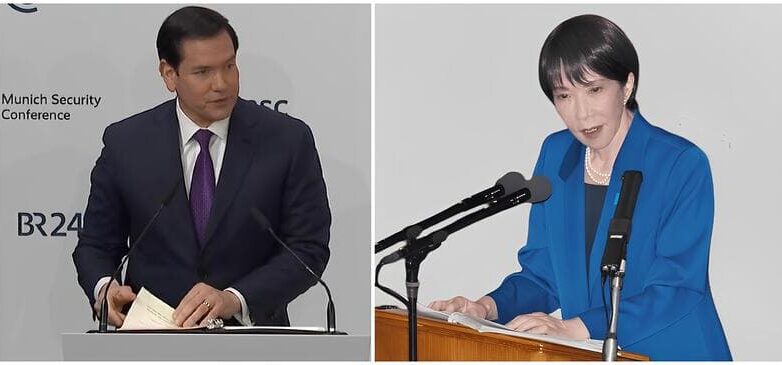
Introduction: The End of the “Bavarian Consensus”
For nearly three decades, the Munich Security Conference served as the high church of the liberal international order. It was a place where trans-Atlantic elites gathered to reaffirm a specific catechism: that economic interdependence prevents war, that nationalism is the precursor to conflict, and that the arc of history bends inevitably toward liberal democracy.

The proceedings of February 2026, however, will be remembered by historians as the moment the “Bavarian Consensus” finally collapsed. It was replaced not by chaos, but by a colder, harder logic. The speech delivered by U.S. Secretary of State Marco Rubio did not speak the language of universal values or aspirational globalism. He spoke the language of structural realism, industrial capacity, and sovereign limits.
To the untrained ear, the alignment of Rubio’s “Pragmatic Realism” and Takaichi’s “Japan First” conservatism seems contradictory. How can an administration in Washington committed to prioritizing domestic renewal find common cause with a Prime Minister in Tokyo committed to having a normal military capacity in name and function? Conventional wisdom suggests that a more nationalist United States would abandon its allies, leaving Japan exposed.
This view is structurally flawed. It relies on an outdated understanding of alliance dynamics. The 2026 National Defense Strategy (NDS), released just days before the conference, reveals the truth: we are witnessing a “Realist Convergence.” This convergence acknowledges that the liberal project of engaging China has failed due to the immutable “institutional genes” of the Chinese Communist Party (CCP). Consequently, the only remaining path to peace is a strategy of “Denial Defense,” built not on the shifting sands of shared values, but on the concrete foundation of a shared industrial base and what Rushi Doshi and Kurt Campbell articulated as “scale” in their Foreign Affairs article “Underestimating China: Why America Needs a New Strategy of Allied Scale to Offset Beijing’s Enduring Advantages.”
The paradox of the Indo-Pacific in 2026 is this: to save the international order, Washington and Tokyo had to return to the nation-state.
The Diagnosis: Institutional Genes and the Failure of Engagement
To understand the solution proposed by Secretary Rubio, one must first accept the diagnosis of the problem. For a generation, Western policy toward China was guided by the “Modernization Theory”, the belief that as China grew richer, it would inevitably become more democratic, or at least a “responsible stakeholder” in the global system.
The 2026 NDS explicitly abandons this hope, drawing heavily on the theoretical framework of economist Chenggang Xu. Xu’s concept of “Institutional Genes” argues that the CCP is not merely an authoritarian government but a totalitarian structure with a specific, self-replicating DNA. This DNA, characterized by Regional Decentralized Authoritarianism (RDA), is fundamentally incompatible with liberal norms. Xu posits that a totalitarian institution cannot “evolve” into a liberal partner without first collapsing; its primary directive is always the preservation of the Party’s monopoly on power.
Rubio, who spent his Senate career highlighting the structural abuses of the CCP (from the Uyghur Forced Labor Prevention Act to capital markets sanctions), has long implicitly accepted Xu’s premise. In Munich, he made it explicit. If China were merely a competitor state, diplomacy and trade could manage the friction. But if the CCP is an expansionist organism driven by its institutional genes, then “engagement” is not just ineffective; it is dangerous. It feeds the organism without altering its behavior.
The Rubio-Takaichi alignment accepts that the CCP’s behavior in the South China Sea, the Taiwan Strait, and the Senkaku Islands is not a temporary aberration but a structural necessity of the regime’s survival. Therefore, the objective of the alliance shifts. The goal is no longer to “shape” China’s rise, but to build a “Sovereign Shield”, a hard military and industrial barrier that denies the CCP the ability to replicate its institutional gene beyond its borders.
The Strategic Pivot: The Architecture of Denial
If the diagnosis is the “Institutional Gene,” the prescription is the “Strategy of Denial.” This concept, championed by former Deputy Assistant Secretary of Defense Elbridge Colby and fully adopted in the 2026 NDS, represents a fundamental shift in American military doctrine.
For years, U.S. deterrence relied on “Cost Imposition”, the threat that if China attacked Taiwan or Japan, the U.S. would eventually retaliate with devastating sanctions and long-range strikes, strangling the Chinese economy. The 2026 framework argues that this is insufficient. A totalitarian regime, willing to absorb immense economic pain for political glory (as demonstrated by Russia in the 2020s), cannot be deterred by the threat of future punishment. It can only be deterred by the certainty of immediate failure.
“Denial Defense” means physically preventing the People’s Liberation Army (PLA) from seizing territory in the first place. It requires a forward-deployed force capable of sinking an invasion fleet within the first 72 hours of conflict.
This is where the “Realist Convergence” becomes essential. The United States, facing a “simultaneity problem” with threats in Europe, the Middle East, and the Indo-Pacific, can no longer execute a Denial Strategy alone. It cannot maintain a dominant posture in three theaters at once.
Enter PM Sanae Takaichi. Often caricatured in the Western press as a dangerous revisionist, Takaichi is, in realist terms, the ideal partner for a constrained superpower. Her position of wanting to comprehensively strengthen Japan and her willingness to reinterpret Article 9 of the Japanese Constitution are not acts of aggression; they are acts of “internal balancing.” By doubling Japan’s defense spending and acquiring counter-strike capabilities (Tomahawks and indigenous hypersonics), Takaichi is transforming Japan from a “shield” (protected by the U.S. “spear”) into a spear in its own right.
This aligns with the Rubio doctrine. As Jennifer Kavaugh writes for the Carnegie Endowment for International Peace, US administrations, regardless of their political stripes do not want a dependent protectorate; they want a capable ally. They understand that a Japan capable of defending itself is a Japan that frees up American assets for the highest-end contingencies. The 2026 alliance is not a charity; it is a division of labor. Japan holds the First Island Chain; America provides the nuclear umbrella and the space-based reconnaissance.
The Industrial Engine: Beyond the Jones Act
However, strategy without industry is hallucination. The most stinging critique of U.S. foreign policy in the early 2020s was that it was all teeth and no tail. The U.S. possessed the world’s most advanced missiles but lacked the shipyards to launch them.
The statistics facing the alliance in 2026 are stark. According to unclassified Office of Naval Intelligence (ONI) data from 2023, China’s shipbuilding capacity is over 232 times that of the United States. In a protracted conflict or even in the “short war” envisioned by Denial Defense attrition is inevitable. Ships will be damaged. If the U.S. Navy has to tow a destroyer from the Taiwan Strait to San Diego for repairs, that ship is out of the fight for months.
This logistical nightmare is the catalyst for the most radical proposal in the 2026 NDS: the creation of the Allied Maritime Security Zone (AMSZ).
Historically, the U.S. maritime industry has been protected by the Jones Act (Section 27 of the Merchant Marine Act of 1920), which requires ships moving between U.S. ports to be U.S.-built and crewed. While intended to protect American industry, it effectively allowed the U.S. commercial shipbuilding base to wither, leaving the Navy dependent on a handful of overworked, inefficient yards.
The Japan-U.S. “Realist Convergence” cuts this Gordian knot. The AMSZ proposes a grand bargain: The U.S. provides Japan with privileged access to aerospace and cyber technology (breaking down barriers like ITAR), and in exchange, Japan opens its massive shipyards from Mitsubishi Heavy Industries and Kawasaki Shipbuilding to the U.S. Navy for forward-deployed repair and maintenance (MRO).
This is the “Arsenal of Democracy” modernized for the 21st century. It envisions U.S. destroyers being repaired, maintained, and eventually co-produced in Yokohama and Kobe. It leverages Japan’s industrial surplus to cover America’s industrial deficit.
This move requires immense political capital. It angers U.S. labor unions and Japanese pacifists alike. But Takaichi and Rubio argue that the alternative is losing a war. They are prioritizing the “sovereign right to survive” over the protectionist impulses of domestic lobbies. It is a recognition that in a war of attrition against the world’s factory (China), the Alliance cannot fight with boutique supply chains.
The Political Theory: Why Nationalism Strengthens Alliances
Critics of the Trump-Takaichi alignment often fall into the trap of viewing “Nationalism” and “Internationalism” as a zero-sum game. They argue that “America First” and “Japan First” must inevitably lead to a clash.
Neoclassical Realism offers a more sophisticated view. Scholars like Gideon Rose have long argued that foreign policy is filtered through domestic politics. An alliance built on the shaky foundation of elite consensus while the domestic populations feel ignored or exploited is brittle. It cracks under pressure.
The “Sovereign Shield” is robust precisely because it is built on nationalist self-interest. Takaichi is not striving to normalize Japan’s self-defense forces as a military to please Washington; she is doing it to restore Japanese greatness and sovereignty. The Trump administration is not pivoting to Asia to be the “world’s policeman”; they are doing it to protect American supply chains and prosperity.
This is the concept of “Alliance Binding via Internal Balancing.” When an ally increases its own strength (internal balancing), it becomes less dependent on the hegemon’s caprice, but simultaneously more valuable to the hegemon’s strategy.
By demanding that Japan stand on its own two feet, the U.S. is actually showing Japan more respect than previous administrations, which treated Tokyo as a junior partner to be managed. This creates a sticky alliance. It transforms the relationship from a landlord-tenant arrangement (where the U.S. provides security in exchange for basing rights) into a partnership of shareholders. Both nations have skin in the game.
Furthermore, this nationalist approach solves the abandonment/entrapment dilemma. For decades, Japan feared abandonment (the U.S. leaving) or entrapment (being dragged into U.S. wars). Under the new architecture, Japan’s independent capability reduces the fear of abandonment, while the specific focus on defense of the home islands (Denial) mitigates the risk of entrapment in foreign adventures.
The Trap: The Predatory Hegemon
Despite the strategic logic, this convergence is not without peril. The greatest threat to the 2026 architecture comes from what Stephen Walt describes as the behavior of a “Predatory Hegemon.”
Realism dictates that great powers will seek to maximize their relative gains, even at the expense of their allies. There is a danger that the United States, under the guise of integration, will attempt to extract economic rent from Japan. We saw echoes of this in the 2024 controversy over Nippon Steel’s acquisition of U.S. Steel, where economic nationalism clashed with strategic necessity.
If the Sovereign Shield becomes a mechanism for the U.S. to force Japan to buy overpriced American hardware while blocking Japanese exports to the U.S. market, the political coalition supporting Takaichi will fracture. Japanese nationalists are, after all, nationalists. They will not accept vassalage disguised as partnership.
To avoid this trap, the U.S. must exercise strategic restraint. It must accept that industrial integration is a two-way street. If Japanese shipyards are to repair American warships, then Japanese steel must be welcomed in American markets. If Japan is to host long-range missiles, it must have a say in their targeting.
The risk is that the transactional nature of Trump’s worldview overrides the strategic imperative. If every interaction is treated as a business deal to be won, the trust required for high-level military integration will evaporate. The “Institutional Gene” of the U.S. political system is that it is prone to short-termism and protectionist outbursts which is the biggest internal threat to the alliance.
Conclusion: The New Iron Logic
As the delegates depart Munich in February 2026, the mood is somber but clarified. The era of optimistic globalism is dead, buried under the realities of Chinese tonnage and American retrenchment.
In its place stands the Sovereign Shield. It is an architecture born of necessity, welded together by two leaders who understand that the world is a dangerous place. It draws on the deep insights of Chenggang Xu to recognize the enemy, the strategic discipline of Elbridge Colby to define the mission, and the industrial might of the Japanese archipelago to forge the weapons.
The convergence of Tokyo and Washington proves that nationalism need not be the enemy of order. In the face of a totalitarian superpower, the sovereign nation-state remains the only entity capable of mobilizing the will and the resources to resist. The “Realist Convergence” is not a retreat from the world; it is a decision to face the world as it is, not as we wished it to be. The shield is heavy, and the cost is high, but for the first time in a decade, the architecture of the Indo-Pacific is solid enough to hold the line.
Author: Stephen R. Nagy – Professor of politics and international studies at the International Christian University. Concurrently, he holds appointments as a senior fellow and China project lead at the Macdonald-Laurier Institute and a visiting fellow at the Japan Institute for International Affairs. The titles of his forthcoming books are “Japan as an Adapter Middle Power State: Navigating Ideological and Systemic Divides” and “Get Over it and Move On: How to run a global business in the emerging world order.”
(The opinions expressed in this article belong only to the author and do not necessarily reflect the views of World Geostrategic Insights).