



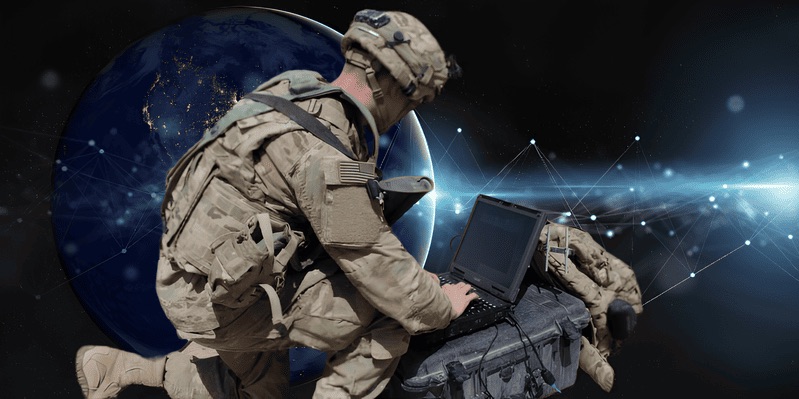
World Geostrategic Insights Interview with Georgios Koukakis on his theory of “Hyperland”, which redefines geopolitics, emphasizing control of cyberspace, space, and information over the traditional domains of land and sea; the intricate relationship between national security and armed conflict; and the prospect for a common European defense.

Georgios Koukakis is the Secretary General & Senior Researcher at KEDISA, Center for International Strategic Analysis, and a PhD Candidate at the Department of Mediterranean Studies of the University of the Aegean, focusing on the Defence Diplomacy & National Security of Greece. A former Lieutenant Colonel, he has served for 22 years as a Leader and Staff officer in several Special Forces and Infantry Units and Division Headquarters, and as an Instructor of the Hellenic Army Airborne School and the Hellenic Army Infantry School. He is the co-author of the book “National Security: Myths and Reality”, published in April 2023 (in Greek), and the author of the book “Armed Conflict & National Security in the 21st Century”, published in January 2025 (in Greek).
Q1 – You are the author of a new geopolitical theory entitled “Hyperland,” which aims to understand the actions of key international actors in the evolving geopolitical landscape. It emphasizes the strategic importance of technological superiority in space, cyberspace, and the information space, departing from traditional theories focused on land and sea power and instead highlighting the priority given by major powers to technological advances to secure national interests and dominance. Can you briefly explain your theory here?
A1 – First of all, I would like to thank you for providing me the opportunity to explain the basic points of my geopolitical theory, as it is a new theory that was published in early 2025 in the international peer-review scientific journal “HAPSc Policy Briefs Series” of the Hellenic Association of Political Scientists. I would also like to express my gratitude to Dr. Piotr Pietrzak, as he endorsed my theory and included an extended version of it as a Chapter in his book entitled “Strengthening International Relations Through Transformative Theory and Practice” that was released in June 2025 from IGI Scientific Publishing. Hyperland is an “out-of-the-box” theory of geopolitics that builds upon Mackinder’s theory of “Heartland” and Spykman’s theory of ”Rimland” that were developed in the past century.
Mackinder emphasised on the land domain, arguing that whoever controls the central part of Eurasia –in fact he called Eurasia the “World Island”– can control the entire world. A few decades later, Spykman argued that the control of the World Island could be achieved through sea power, by taking control of the periphery of Eurasia instead of its central part. Throughout my research on several major actors’ strategic documents though, I noticed that the contemporary strategic competition had shifted its focus from the domains of land and sea, to the ones of cyberspace, space and the information space. As the two main geopolitical theories could not interpret this behaviour, I realised that a new theory needed to be conceived, and a new concept gradually began to develop in my mind.
At first, I wondered how this behaviour could be related to past geopolitical theories, as it did not involve actual “earth space” (land or sea) –the main component of every geopolitical theory since “geo” comes from the Greek word “γη” which means “earth”–, but then it stroke me! Geopolitics is all about the interaction between “politics” and “space”, not necessarily the traditional domains of land or sea. Thus, this “out-of-the-box” approach led me eventually to the conception of my geopolitics theory, which argues that “Hyperland” consists of the imaginary geopolitical space of cyberspace, space and the information space, and whoever controls it, controls the entire world.
At this point I need to highlight the vital role that technology plays in strategic competition, as the former facilitates the development of new instruments of hard power through which states can impose their will on other actors. I would also like to clarify that even though the possession or control of land, sea and air remains a vital factor of strategic competition, it can nowadays be achieved more easily by an actor by gaining dominance in cyberspace, space and the information space, and in fact achieve much more.
To be more precise: (i) dominance in cyberspace allows a state to control or deny access to the vast majority of another states’ assets, facilities, functions and infrastructure, as most of them are digitalized relying on cyberspace to function properly, (ii) dominance in space provides a state with the ability to control communications, navigation systems, weapons trajectory systems and intelligence, thus affect a large number of policy fields, and finally (iii) dominance in the information space can greatly affect the decision-making procedures of a state’s leadership, its citizens’ trust in good governance and democratic values, leading to civil unrest and violent demonstrations, even change the outcome of elections.
As you can understand, the control of “Hyperland” provides a huge advantage, which is the main cause that most actors have developed policies and strategies related to these three strategic domains or set relative objectives in their national security strategies. I also believe that the mass disinformation campaigns –either as a part of modern warfare or as a general pattern of behaviour– we are witnessing, the cases of several media platforms banning is some states, the new “Space Race” and “AI Race” that is going on between major geopolitical actors, and the rising number of cyberattacks all over the world is a clear evidence that confirms my theory.
Q2 – Your new book (in Greek), published in 2025 and titled “Armed Conflicts and National Security in the 21st Century,” explores the complex relationship between national security and armed conflicts through an interdisciplinary lens, analyzing contemporary conflicts and emphasizing the vital importance of security for the prosperity of society. How does the use or threat of the use of arms influence international relations and the resolution of disputes between states? What is the relationship between national security and armed conflicts?
A2 – The relationship between national security and armed conflict lies in the fact that –since according to Clausewitz, war is the continuation of politics by other means– and that the essence of national security is to protect a state’s national interests, an armed conflict–taking into consideration the negative consequences for both sides– is conducted by a state in order to safeguard its national interests, thus protect (or in some cases enhance) its national security. In my interdisciplinary approach, I examine the use and the threat of the use of armed violence through the following five different lenses:
(i) the 1st one is the international relations theories that have been developed through time through which I mostly highlight the root causes of conflict,
(ii) the 2nd lens is strategy through which I analyse several grand strategy documents of major actors such as the National Security Strategy and the National Defence Strategy of the United States and Russia, the Military Strategy of the China, the National Strategic Review of the France, and the Integrated Review Refresh of the United Kingdom,
(iii) the 3rd one is military science, through which I examine the way –in terms of (traditional and modern) principles, levels, tactics, methods and functions– of conducting war,
(iv) the 4th one is international law, through which I note the relative limitations that have been imposed by the International Community to the use or threat of use of armed violence by several conventions, treaties and standards and the institutions –such as the International Court of Justice (ICJ) and the International Criminal Court (ICC)– that have been founded to deal with relevant issues, and finally
(v) the last lens through which I examine armed conflicts is national security (a more specialised approach of international relations that falls in the category of Security Studies), stressing that when a state resorts to the use of armed violence it does so only to serve a national security purpose, mostly to address a perceived national security threat or accomplish a national security interest.
In my book, I also note that even though the use or threat of use of armed violence affects international relations in a negative way –as it usually escalates existing disputes between states into crises and war– it also promotes bilateral and multilateral cooperation in the defence sector, in the form of alliances and bilateral agreements that provide for collective defence and mutual defence respectively and cooperation in the defence industry. Therefore, armed violence has also a “positive” let’s say side that promotes dialogue between actors –what is known as defence diplomacy– as far as military issues are concerned, minimizes the likelihood of war, and even enhances a state’s economy.
Q3 – Some European leaders are calling for the creation of a European army, mainly with the aim of improving military preparedness against possible Russian aggression, while others express their reluctance, emphasizing that military defense is a national prerogative. However, most agree that Europe would need significant military resources and increased defense spending, especially in view of a possible disengagement of the United States from European security. You were an officer in the Greek armed forces for 22 years, including 15 years in various special forces units. What is your opinion? How do you see a common European defense? Would a unified European army be conceivable? Or would it be more realistic to focus on greater interoperability and military coordination at the European level?
A3 – When considering European Defence, someone must understand that defence remains –at least for the time being– a national responsibility. This means that a state’s armed forces are the only forces responsible for protecting its territorial integrity and national independence against any military threat. Thus, in order for a European Army –in terms of a multinational force that will be responsible for defending the European territory– to be created, the EU has to be transformed into some kind of Federation and its member-states to cede their sovereignty to it. In addition to that, there are a lot of Command & Control (C2) issues that need to be resolved too, such as who will command this force, who will decide for its deployment, etc. In my opinion this is an unlikely scenario, as I believe that most states are still not ready for such a change.
On the other hand, the existing European Union Rapid Deployment Capacity (EURDC) is the closest thing to a European Army, being different inter alia in the way that it is not a standing military force and that it operates outside the European Union territory. As far as defence spending is concerned, Russia’s invasion of Ukraine in 2022 has already led most European states to increase their defence expenditures, also leading the EU to proceed to several initiatives in the S&D sector such as the creation of a Commissioner for Defence and Space, the publication of the White Paper for European Defence, the endorsement of a European Defence Industry Strategy (EDIS), and the signing of several Security & Defence Partnerships (SDPs) with a large number of states.
As far as the establishment of a common European defence is concerned, I strongly believe that it can be mainly achieved through the integration of the EU member-states’ national air-defence systems, an action that will allow the exchange of information establishing a holistic European situational awareness nexus, and the creation of a European Air-Defence Umbrella to address every aerial threat. In this case, interoperability is a key function that will facilitate military coordination and cooperation, ensuring the effectiveness of joint action.
Regarding the disengagement of the United States from the European security architecture, it needs to be stressed that the initial European concerns that the United States will suddenly abandon Europe have gradually been replaced by a more rational perception and the realization that the EU must finally assume greater responsibility as far as its defence is concerned. Besides, Josep Borrell –EU’s former High Representative & Vice President (HR/VP)– had stressed long before President Trump’s re-election that “Europe must learn quickly to speak the language of power”, while NATO’s latest Strategic Concept that was adopted by its member-states during the 2022 Madrid Summit stated that:
“NATO recognises the value of a stronger and more capable European defence that contributes positively to transatlantic and global security and is complementary to, and interoperable with NATO”.
To conclude, I would like to stress a phrase of Robert Schuman –one of the pioneers of the European Union– that I believe is one of the fundamental “truths” of the European Union related to every crisis that needs to be overcome and every major reform that has to be implemented, and that both policy-makers and scholars must keep in mind, which is:
“Europe will not be made all at once, or according to a single plan. It will be built through concrete achievements which first create a de facto solidarity”.
Georgios Koukakis – Secretary General & Senior Researcher at KEDISA, Center for International Strategic Analysis,