



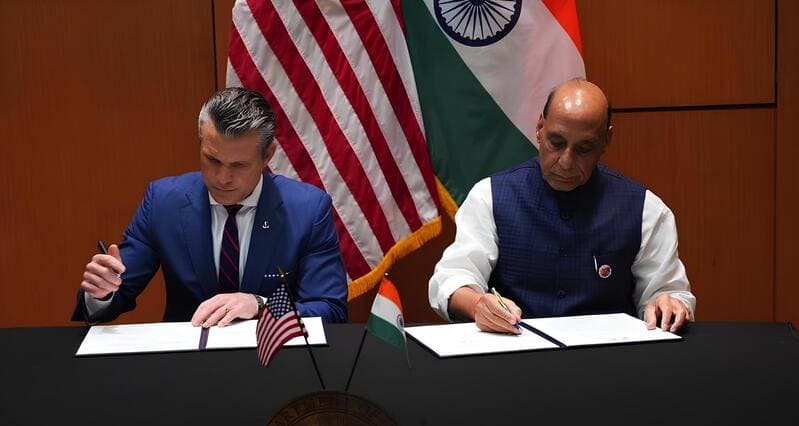
The recently signed ten-year defense pact between the United States and India has redrawn the strategic map of South Asia. It is not just another bilateral military agreement, but it is a structural commitment designed to define Washington’s long-term presence in the Indo-Pacific and its influence over the power dynamics of the subcontinent.

By locking itself into a decade-long framework of military cooperation, technology transfer, and intelligence coordination with New Delhi, the U.S. has effectively declared India its principal regional anchor while retaining tactical leverage over Pakistan and Afghanistan. The move, cloaked in the language of partnership and stability, introduces both opportunities and vulnerabilities that will reverberate across the region.
The new defense framework expands joint exercises, defense-industrial collaboration, and information-sharing, giving India access to advanced American systems and boosting interoperability. This enhanced capacity is meant to modernize India’s deterrence posture, but it also alters the conventional balance in South Asia.
Islamabad will inevitably read it as a tilt that constrains its strategic space, compelling it to deepen ties with China, explore new defense linkages with Turkey and Gulf partners, and strengthen asymmetric capabilities. Such moves risk intensifying the militarization of an already volatile region, where miscalculations can quickly spiral into crises.
Washington’s logic is clear, by bolstering India; it aims to reinforce Indo-Pacific architecture capable of countering Beijing’s expanding influence. Yet this geopolitical calculus is far from straightforward. The U.S. cannot entirely sideline Pakistan, whose geography remains central to American counterterrorism and regional stability goals.
Thus, while Washington cements a long-term defense partnership with India, it quietly maintains transactional engagement with Pakistan, especially over Afghanistan’s evolving landscape. This dual-track approach, “playing both sides”, gives Washington flexibility, but also fuels mistrust. India fears the U.S. might use Pakistan as leverage when convenient; Pakistan suspects Washington’s promises of partnership come with conditional strings attached.
Afghanistan, meanwhile, has re-emerged as the critical third vector in this triangular equation. Despite its 2021 withdrawal, the U.S. has shown renewed interest in Afghanistan, driven by concerns over the resurgence of ISIS-K, narcotics trafficking, and the Taliban’s uneven governance. American intelligence and defense circles have revisited discussions about limited operational access in the region, including potential over-the-horizon capabilities and the symbolic utility of former hubs like the Bagram Air Base.
For Washington, Afghanistan remains unfinished business, a space too strategically located to be abandoned, yet too unstable to reoccupy. Its approach is one of selective engagement, relying on Pakistan’s corridors for intelligence and logistics while pressuring the Taliban regime diplomatically.
In this evolving equation, Pakistan’s own diplomacy with the Taliban government takes on new significance. Recent peace and border management talks between Islamabad and Kabul aim to address cross-border militancy, trade facilitation, and TTP activity. These negotiations serve both domestic and regional objectives, stabilizing Pakistan’s western frontier while offering the U.S. an indirect channel to monitor and influence developments inside Afghanistan.
The convergence of U.S. security interests and Pakistan’s border imperatives has reopened limited cooperation, echoing earlier eras when strategic necessity compelled pragmatic alignment despite mutual mistrust. This layered reality; U.S.-India strategic embrace, U.S.-Pakistan tactical dialogue, and Afghanistan’s volatile center creates a chessboard of intersecting interests.
India, buoyed by American technology and political support, gains confidence to assert its regional leadership. Pakistan, squeezed between an emboldened India on the east and an unpredictable Taliban regime on the west, faces mounting pressure to recalibrate.
For Islamabad, balancing between Beijing, Washington, and Kabul will be a delicate act, leaning too far toward China could risk isolation from Western capital and influence, leaning toward Washington could strain its strategic ties with Beijing; the anchor of its economic future.
The U.S., for its part, is not merely deepening an alliance; it is re-establishing a regional presence. By tying India into a long-term defense framework and re-engaging Pakistan through selective security channels, Washington ensures that it retains oversight of South Asia’s two nuclear powers while keeping an operational foothold in Afghanistan without the political cost of boots on the ground.
It is a strategy of distributed influence, India as the permanent partner, Pakistan as the conditional collaborator, and Afghanistan as the manageable frontier. However, the risks of this approach are substantial. The U.S.-India pact may embolden hardline elements within India to adopt a more assertive stance toward Pakistan, confident of American backing. This could shorten crisis decision times and elevate the danger of escalation in a future border confrontation or Kashmir-related standoff.
Conversely, Islamabad’s reliance on asymmetric tools to offset conventional disadvantages could intensify low-level conflicts that draw both powers into dangerous posturing. The U.S., while seeking stability, may find itself managing crises it inadvertently encouraged. Without parallel investments in diplomacy, transparency, and crisis-avoidance mechanisms, South Asia could slide toward a more brittle balance of deterrence.
Beyond military logic, Washington’s renewed presence also reflects broader ambitions. Control over strategic supply chains, influence in the connectivity corridors linking Central and South Asia, and access to critical earth minerals in Afghanistan and northern Pakistan all feature in its recalibrated regional interest.
The U.S. views these as economic levers within its global competition with China. By aligning with India on technology and defense, and keeping selective cooperation open with Pakistan, Washington positions itself to influence both the infrastructure and the intelligence dimensions of regional development. As this pact is less about defense and more about direction, the direction of power in a region where every corridor, from the Arabian Sea to the Himalayas, now carries geopolitical weight.
For India, it is a moment of opportunity to rise as a regional counterweight to China. For Pakistan, it is a moment of reckoning that demands strategic agility and renewed focus on diplomacy, economic stability, and balanced engagements. And for the United States, it is the resumption of a long game that never truly ended, “a new Great Game”, where bases are replaced by partnerships, and influence travels not through armies but through technology, intelligence, and alignment.
South Asia today stands at a fragile intersection where old competitions are being reframed through new strategic compacts. The U.S.-India defense pact may promise stability, but without inclusive diplomacy and crisis management, it risks becoming another instrument of imbalance. The region’s peace will depend not on how power is distributed, but on whether wisdom tempers its use.
Author: Mirza Abdul Aleem Baig – President of Strategic Science Advisory Council (SSAC) – Pakistan. He is an independent observer of global dynamics, with a deep interest in the intricate working of techno-geopolitics, exploring how science & technology, international relations, foreign policy and strategic alliances shape the emerging world order.
(The views expressed in this article belong only to the author and do not necessarily reflect the views of World Geostrategic Insights).
Image Source: Hegseth /X (US Defence Secretary Pete Hegseth and his Indian counterpart Rajnath Singh on October 31, 2025, in Kuala Lumpur).