



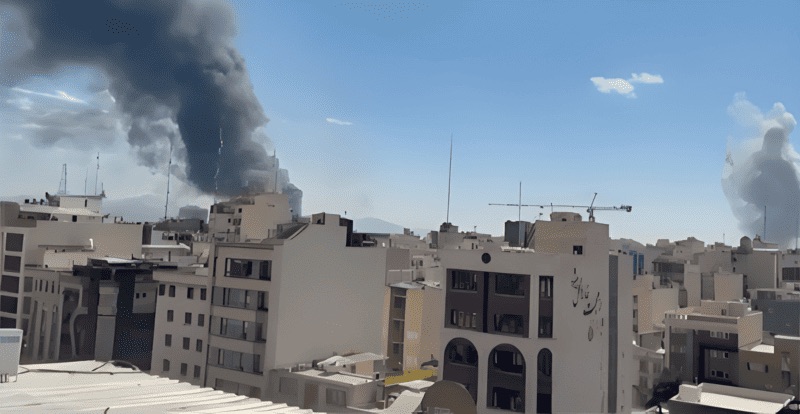
The joint U.S.-Israeli military operation “Operation Epic Fury” that eliminated Iran’s Supreme Leader, Ayatollah Ali Hosseini Khamenei (1939-2026), will be remembered not simply as a military strike, but as a geopolitical rupture. It is the kind of moment that divides eras. In Washington and Jerusalem, it may be framed as the removal of a persistent strategic adversary, the culmination of a long campaign to blunt Iran’s ideological and paramilitary reach.

Yet in the Middle East, where history breathes through memory and grievance alike, the meaning will not be confined to tactical success. It will be absorbed into a deeper narrative about sovereignty, humiliation, resistance, and power.
Modern Middle Eastern geopolitics has never rested on stable foundations. Since the collapse of the Ottoman Empire, the region’s order has been constructed upon a precarious equilibrium among states, sects, and ideologies. The mandates and borders that followed World War I (1914-1918) did not erase older loyalties; they merely overlaid them with fragile nation-states.
Arab nationalism rose under figures such as Gamal Abdel Nasser (1918-1970), promising dignity against colonial tutelage. Monarchies entrenched themselves through patronage and Western security guarantees. Military republics oscillated between socialism and authoritarianism. Beneath these political forms, the Sunni-Shia divide remained largely dormant in statecraft until the shock of 1979.
The Iranian Revolution transformed that dormant divide into a strategic axis. It introduced a governing doctrine that fused clerical authority with republican institutions and projected itself outward as a vanguard of Islamic resistance. Tehran’s model was Shia in jurisprudence but universalist in aspiration. It sought not merely to rule Iran but to inspire movements beyond its borders.
Over time, this vision hardened into an “axis of resistance” that linked Iran with Hezbollah in Lebanon, with Shia militias in Iraq, and with aligned actors elsewhere. The rivalry between Iran and Saudi Arabia became the organizing principle of multiple proxy conflicts, from Syria to Yemen.
For the time being, Turkey sought to balance its NATO commitments with neo-Ottoman regional ambitions, and Israel recalibrated its diplomacy through the Abraham Accords, drawing Gulf States into open cooperation. This was not a harmonious order, but it was a recognizable one. Each actor understood the boundaries of escalation. Each rivalry operated within a known grammar of deterrence.
The removal of Iran’s supreme leader disrupts that grammar. It introduces uncertainty into a system that has long functioned through calibrated hostility. History offers caution. The decapitation of a leader rarely dissolves the structure he led. When the United States invaded Iraq in 2003 and dismantled its ruling apparatus, the vacuum did not yield liberal democracy; it unleashed forces that reshaped the region for a generation and, paradoxically, expanded Iranian influence.
When Iranian General Qasem Soleimani (1957-2020) was assassinated in 2020, predictions of fragmentation gave way instead to nationalist consolidation. External blows often compress internal fractures rather than widen them. The Islamic Republic was never a one-man enterprise. Its institutional core, particularly the Islamic Revolutionary Guard Corps, is deeply embedded in the state’s economic and military infrastructure.
In moments of existential threat, such structures tend to centralize authority rather than relinquish it. Even factions that resent clerical dominance may hesitate to challenge the system while foreign missiles still define the horizon. The immediate effect of this operation may therefore be not collapse but cohesion.
Yet beyond Iran’s borders, the symbolism reverberates more widely. Pan-Islamism has always been more aspiration than reality. Sultan Abdul Hamid II (1842-1918) invoked Islamic unity to resist European encroachment. The Muslim Brotherhood articulated a transnational revivalist project in the 20th century. But nationalism repeatedly trumped religious solidarity; the Iran-Iraq War demonstrated that Muslim-majority states would wage brutal conflict against one another despite shared faith.
What makes the present moment distinct is not doctrinal convergence but narrative convergence. A strike that eliminates the symbolic head of a major Muslim state can be framed, across sectarian lines, as an assault on sovereignty itself. Sunni movements that distrust Shia theology may nonetheless recognize a common grievance in perceived Western overreach.
In a digital age where images and interpretations circulate instantly, such a narrative can travel from Beirut to Jakarta in hours. It need not produce a unified caliphate to alter geopolitics. It needs only to produce a shared discourse of resistance.
This is where the regional and global orders intersect. The Middle East has long functioned as both an arena and catalyst for wider transformations. The 1956 Suez Crisis signaled the decline of British and French imperial dominance. The 1973 oil embargo revealed the leverage of resource-rich states over Western economies. The Iraq War destabilized a fragile equilibrium and reshaped great-power calculations.
Today, the elimination of Iran’s supreme leader marks a similar inflection. Energy markets remain sensitive to disruption in the Persian Gulf. Any sustained instability threatens not only regional actors but global supply chains already strained by geopolitical competition.
Russia and China, both deepening ties with Tehran in recent years, will interpret regime decapitation through the prism of strategic encirclement. In much of the Global South, where memories of colonial subordination remain vivid, the precedent of targeting sovereign leadership risks reinforcing perceptions of an unequal international order.
Such perceptions can accelerate alternative alignments, from expanded BRICS+ cooperation to non-dollar trade arrangements and new security frameworks that dilute Western primacy. Perhaps the most consequential shift lies in norms. If major powers normalize leadership elimination as a legitimate instrument of policy, the threshold for similar actions elsewhere lowers.
The international system, already strained by great-power rivalry, becomes less predictable and more combustible. For Washington, the question is not whether the operation succeeded tactically but whether it clarifies or complicates America’s long-term position.
The United States has oscillated between deep intervention and strategic retrenchment in the Middle East for decades. Each decisive act has generated second-order effects that outlived the initial rationale. The region’s political architecture – balanced precariously among revolutionary fervor, monarchic stability, sectarian identity, and pragmatic statecraft – does not easily absorb shock.
The removal of Ali Khamenei may weaken a symbol, but symbols have a way of regenerating when embedded in grievance. If this moment catalyzes a broader pan-Islamic consciousness defined less by theology than by opposition to perceived Western coercion, then the strategic consequences will extend far beyond Tehran.
The Middle East will not simply adjust; it will reconfigure. And when the Middle East reconfigures, the global order seldom remains untouched. History’s lesson is sobering. When external powers redraw the political lines of this region, they rarely control the aftershocks. When empires redraw the map of the Middle East, the aftershocks rarely remain regional. They reshape the world.
To put it succinctly, the present rupture may promise clarity. It is more likely to inaugurate an era of uncertainty in which new coalitions form, old rivalries harden, and the language of resistance acquires renewed force. In that uncertainty lies the true turning point – not only for the Middle East, but for the world. The world now watches not just a Middle East transformed, but a global order challenged.
Author: Mirza Abdul Aleem Baig – President of Strategic Science Advisory Council (SSAC) – Pakistan. He is an independent observer of global dynamics, with a deep interest in the intricate working of techno-geopolitics, exploring how science & technology, international relations, foreign policy and strategic alliances shape the emerging world order.
(The opinions expressed in this article are solely those of the author and do not necessarily reflect the views of World Geostrategic Insights).