



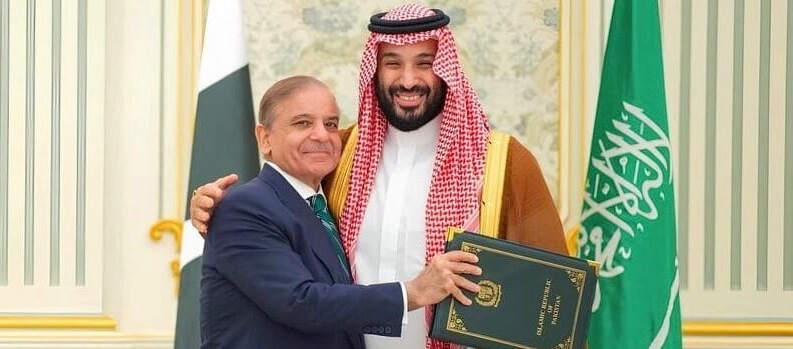
In an era of shifting global alliances and increasingly multipolar geopolitics, the recent Pakistan-Saudi Arabia defense agreement stands out as a bold and consequential move. More than a conventional military pact, this Strategic Mutual Defense Agreement has stirred interest and concern across capitals from Washington to Tel Aviv to New Delhi.
 At its core lies an implicit understanding that both nations will treat an act of aggression against one as an attack on both. But layered within this otherwise standard phrasing is a provocative and largely unprecedented element; the veiled extension of Pakistan’s nuclear deterrent to the Kingdom of Saudi Arabia.
This is not merely a matter of symbolism or diplomatic theatre. Pakistan’s Defense Minister explicitly stated that the country’s nuclear capabilities would be “absolutely available” under the terms of the pact, should circumstances demand it. Though the specifics of how, when, or under what command structure such an extension would be operationalized remain deliberately vague, the message is clear enough.
Saudi Arabia, long suspected of seeking a nuclear security guarantee, may now have one – at least rhetorically. The question is not whether this is legal; technically, both nations remain within the framework of the Non-Proliferation Treaty. Nor is it about legitimacy; sovereign states may form defense arrangements of their choosing.
The question is whether this move advances the strategic interests of Pakistan or risks entangling it in conflicts far beyond its borders and bandwidth. Pakistan has long played a quiet yet essential role in Gulf security. Its military officers have trained Saudi forces, and its troops have, at various times, been stationed in the Kingdom.
But this agreement marks a turning point. For the first time, Islamabad has tied itself to the explicit defense of Saudi Arabia under formalized mutual obligations. In doing so, it steps beyond traditional military cooperation into the realm of strategic alliance with all the responsibilities, risks, and consequences that such an alliance entails.
Proponents of the pact argue that this is Pakistan’s moment to assert itself as a regional power of consequence. Economically challenged at home and often diplomatically sidelined, Islamabad sees in this agreement an opportunity to restore strategic relevance. Riyadh, for its part, gets what it has always sought: a strong, ideologically aligned, and combat-tested Muslim partner willing to back its defense posture.
In a time when American security guarantees no longer carry the certainty they once did, Saudi Arabia is hedging its bets and Pakistan is happy to provide the hedge. But this is where ambition must be tempered with realism. The notion of strategic depth, so often invoked in Pakistan’s regional calculus, was originally conceived as a defensive concept gaining breathing room in case of a two-front war, securing fallback options in crisis.
Yet in this case, what is being pursued may be less about depth and more about extension. Strategic extension into the Gulf – a region rife with volatility and great-power competition – may yield influence, but it also carries the potential for overstretch.
Pakistan must ask itself; does it truly possess the capacity – economic, military, and political – to uphold a binding defense pact in a region where threats are more complex, ambiguous, and asymmetrical than in South Asia? Can it credibly offer deterrence, let alone defense, in a region that may draw it into proxy conflicts, ideological rivalries, or inter-state tensions that are not of its own making?
The greatest risk is not military defeat or direct confrontation, but the slow erosion of autonomy. What begins as mutual defense may, over time, evolve into asymmetric dependence. Riyadh’s expectations may rise in proportion to Pakistan’s promises. Should conflict erupt, will Islamabad be in a position to say “no,” or will it find itself pulled into decisions shaped more by Saudi priorities than Pakistani national interest?
What’s more, such entanglement may complicate Islamabad’s relations with key global actors. While China may welcome the agreement as a sign of growing Islamic cohesion and U.S. retrenchment, Washington may see it as a challenge to its traditional sphere of influence. If the U.S. reacts sharply through financial levers, diplomatic rebukes, or by tightening its grip on multilateral institutions like the IMF – Pakistan could find itself squeezed from multiple directions. Its attempt to gain stature might inadvertently lead to new vulnerabilities.
Yet one must also acknowledge the compelling logic that binds the two nations. This is not a marriage of convenience. It is a convergence rooted in shared religious identity, overlapping security concerns, and historical precedent. Both nations view themselves as defenders of the Muslim world, albeit in different ways.
Pakistan-Saudi Arabia relationship has weathered decades of shifting politics, leadership changes, and global transformations. This pact is the natural evolution of that bond, shaped by new realities. But the heart of the matter lies not in shared brotherhood, but in the tension between solidarity and strategic calculation.
Brotherhood, as an emotional and cultural construct, lends moral force to the pact. But realpolitik, the cold arithmetic of interests, will ultimately shape its outcomes. If the agreement is managed prudently – kept within a framework of clear rules, limited obligations, and constant communication – it may indeed become the cornerstone of new Muslim security architecture.
If allowed to drift into ambiguity, or worse, if it is weaponized rhetorically without strategic clarity, it may create more instability than security. The challenge before Islamabad and Riyadh is to ensure that sentiment does not outpace strategy. They must be mindful that alliances formed in the spirit of solidarity still require institutional structure, diplomatic foresight, and political restraint. Without these, even the noblest intentions can devolve into dangerous miscalculations.
In a world defined by complex alignments and fluid loyalties, the Pakistan-Saudi defense pact is both an opportunity and a gamble. It could redefine Muslim security cooperation or it could become a case study in strategic overreach. Only time, and the discipline of both parties, will tell which path history records.
Author: Mirza Abdul Aleem Baig – President of Strategic Science Advisory Council (SSAC) – Pakistan. He is an independent observer of global dynamics, with a deep interest in the intricate working of techno-geopolitics, exploring how science & technology, international relations, foreign policy and strategic alliances shape the emerging world order.
(The views expressed in this article belong only to the author and do not necessarily reflect the views of World Geostrategic Insights).
Image Source: Saudi Press Agency/AP