



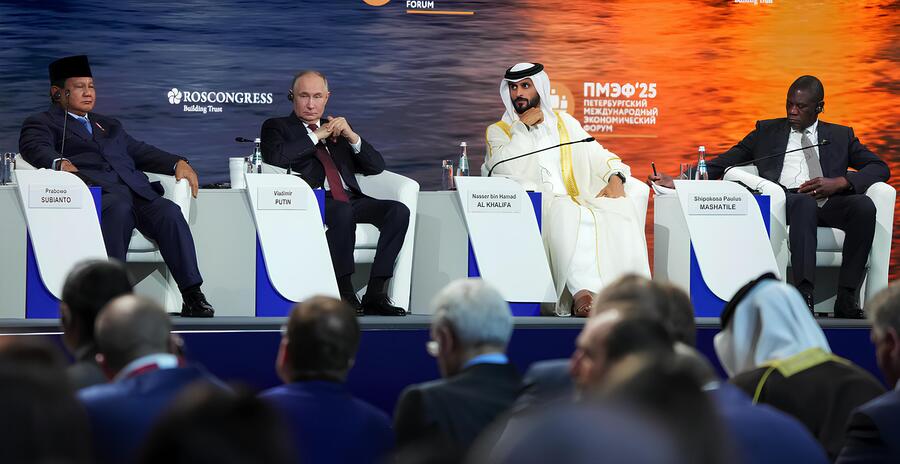
World Geostrategic Insights interview with Tatiana Pokrovskaia on the outcomes of the 28th St. Petersburg International Economic Forum (SPIEF) and 17th BRICS summit, and changing dynamics in international economic relations.
Tatiana Pokrovskaia is an international business development professional with more than 20 years of experience in the markets of Africa, CIS, Asia and the Middle East, repeatedly bringing Russian companies into international markets. She is based in St. Petersburg, Russia.

Q1 – The 28th St. Petersburg International Economic Forum (SPIEF) was held from June 18 to 21. The Forum is considered Russia’s main annual diplomatic and economic event, demonstrating the country’s openness to global engagement. Focusing on the theme “Common Values: Foundation for Growth in a Multipolar World,” the forum featured over 200 discussions on key topics such as artificial intelligence, cybersecurity and environmental issues, global growth, Russian economy, future technologies, and current geopolitical challenges. However, SPIEF 2025 appears to differ significantly from previous forums held before the conflict in Ukraine began in 2022, reflecting a changed international landscape, minimal Western participation, and a possible slowdown in the Russian economy. The forum essentially prioritized bilateral dialogues between Russia and its strategic partners: Vietnam, China, India, Brazil, Iran, Turkey, the United Arab Emirates, as well as representatives from Africa, Latin America, and ASEAN. What is your opinion on the impact and outcome of the 2025 Forum? In the past, Saint Petersburg was considered Russia’s window on Europe. Can we now say that it has become a window on the Global South?
A1 – The XXVIII St. Petersburg International Economic Forum, which was held on June 18-21, 2025 in St. Petersburg, Russia has completed its work.
The Forum was attended by more than 24,200 participants and media representatives from 144 countries and territories, including Russia. This year, the Honorary status of the Forum’s guest country was granted to Bahrain.
As you correctly noted, the Forum was held under the slogan “Common values are the basis for growth in a multipolar world.” Forum participants noted the importance of real sovereignty – political, economic, technological, as well as value-cultural. These principles will help countries go through a difficult period of transformation.
Since the beginning of the Special Military Operation in Ukraine, the Forum has undergone significant changes. In recent years, there has been a change in focus on the domestic market and partner countries. expanding its presence in the Asian, African and Latin American directions.
The Russian President also noted that the Russian Federation ranks first in Europe in terms of economy, and in terms of GDP, Russia is ahead of all European countries, which is an important indicator of the country’s power. In the first 4 months of 2025, Russia’s GDP grew by 1.5%.
As a result of the Forum, 1,084 agreements were signed for a total of 6 trillion 480 billion 869 million rubles, only agreements that were not a commercial secret were announced.
Russia and the USSR had centuries-old economic ties with the West. Russia’s focus on the West was realized through various concepts and strategies. After the annexation of Crimea to Russia, hope for economic, social and cultural ties with the West disappeared. But any country cannot just be on its own, it has to cooperate with someone. The concept of Russian foreign policy for 2023 finally stated that the West had moved to last place. The development of the West has slowed down significantly, maintaining a certain level, but there are no longer any leaps forward and, most likely, there will not be any. At the same time other developing countries have quite rapid growth rates, naturally, the future belongs to them. The reorientation of Russian regions to economic cooperation with the countries of the Global South is already underway and will increase every year. Noting the primary economic significance of the Forum, it is logical that more attention was paid to agreements and business negotiations with partner countries.
Q2 – Russian and US business leaders discussed the possibility of restoring relations during a working breakfast organized by the American Chamber of Commerce in Russia (AmCham) at the St. Petersburg International Economic Forum. According to Kirill Dmitriev, head of the Russian Direct Investment Fund (RDIF), the meeting focused on how to address and remove restrictions that hinder trade and export activities between the two countries, to promote the expansion of US companies in Russia, the pursuit of joint technological initiatives, and the restoration of direct air links. In your opinion, what are the prospects for economic and trade cooperation between the United States and Russia?
A2 – The SPIEF 2025 hosted the Russia-USA Session, which became a space for constructive dialogue aimed at overcoming barriers and developing partnerships in various areas, such as investment, industry, energy, technology, transport and infrastructure. Of particular importance is cooperation in joint projects in the field of space development and Artificial Intelligence.
The organizers of the Russia-USA meeting were the American Chamber of Commerce in Russia and the Agency for Strategic Initiatives (ASI). The session was attended by more than 150 representatives of Russian and international companies.
The prospects for the return of American companies to Russia and the establishment of long-term cooperation were discussed. A major obstacle to business cooperation is sanctions from the United States and the ambiguity of the political situation.
However, joint projects can become a catalyst for sustainable economic growth in both countries.
According to Robert Agee, CEO of the American Chamber of Commerce in Russia, they are convinced that the best way to resolve conflicts is to develop business and exchange opinions, this will create opportunities for both countries.
The American side is also interested in restoring air communication with Russia, which was interrupted more than 3 years ago. At the moment, direct pragmatic discussions are underway. It is quite possible that by the end of 2025 this issue will be resolved positively.
Q3 – The 17th annual BRICS summit was held in Rio de Janeiro, Brazil, on July 6-7, 2025, with approximately 4,000 participants from 37 countries, focusing on the theme “Strengthening Global Cooperation of the South for More Inclusive and Sustainable Governance.” The summit addressed crucial issues such as global health cooperation, trade, investment, finance, climate change, artificial intelligence, governance, multilateral peace, and security architecture. Leaders, particularly Brazilian President Lula da Silva, emphasized the need for reform of international governance and the United Nations Security Council to better reflect the realities of a multipolar world and address global crises. BRICS now comprises eleven members, including new partners such as Belarus, Bolivia, and Vietnam, representing approximately 56% of the world’s population and 44% of global GDP. However, the expansion of BRICS has introduced complexity in reaching consensus on geopolitical issues, struggling to translate ambition into action. raising concerns about the bloc’s cohesion and effectiveness in becoming a significant player in global affairs. Some analysts even believe that the bloc is doomed to irrelevance. What is your opinion on the summit’s results and the future trajectory of BRICS?
A3 – The 17th BRICS Summit was held on July 6 and 7 in Rio de Janeiro for the first time in an expanded format. Among the main results of the Summit were initiatives aimed at strengthening the bloc’s position on the world stage through innovative approaches to economics and trade. The main points are:
– Increasing the use of national currencies in mutual settlements;
– Increasing investment volumes to stimulate economic growth;
– Strengthening BRICS institutions. It was noted that the organization plays an important role in changing the existing financial system of the world.
Particular attention was paid to cooperation in the field of culture (the importance of returning cultural values and heritage to their countries of origin) and education, healthcare, concerns about unilateral sanctions, the governance of AI , hot spots in global politics and others. The issue of the prospects for UN reform in the context of today’s realities, restructuring the world to multipolarity was also raised. The agenda of the BRICS Summit for 2026 was determined, where the chairmanship will be transferred to India.
The BRICS Summit 2025 confirmed its role as a platform for developing solutions that influence international politics and economics for a balanced future for the world community. At the same time, it emphasized the potential of soft power and cultural diplomacy.
Q4 – The BRICS countries have recently stepped up efforts to reduce their dependence on the dollar by promoting trade in local currencies among members. As an example, on the sidelines of the St Petersburg International Economic Forum, Vladimir Putin met with Dilma Rousseff, President of the New Development Bank established by BRICS countries, emphasizing the need for further efforts for the expansion of the possibility of settlements in national currencies, and to create a digital platform for settlements and investments. However, it seems that there is no real alternative to the dollar in international trade. What is your opinion?
A4 – The BRICS countries cooperate based on their own interests, without targeting third countries, including the United States. This is what makes this association of countries unique, sharing common approaches and a common worldview on how to cooperate.
Despite the agreement reached between China and the United States, China adheres to the view that there are no winners in trade wars. The same thesis was repeated at the UN meeting.
However, it will not be possible to immediately abandon the dollar. Today, about 88% of foreign exchange transactions are carried out using the US dollar, despite the increase in the use of other currencies – the yuan and the euro. But the de-dollarization process has been launched. The BRICS countries are developing a digital platform for mutual settlements, as well as mutual settlements in national currencies.
Q5 – As the leaders of the BRICS countries were meeting in Rio, US President Donald Trump issued a warning on social media: “Any country that aligns itself with the anti-American policies of the BRICS countries will be subject to a 10% additional tariff. There will be no exceptions to this policy.” Trump has long been critical of BRICS. Why is President Trump so concerned about the BRICS?
A5 – US President Donald Trump is obsessed with the success of BRICS. This conclusion can be drawn from his recent statements about his intention to introduce customs duties of 10% against any country that supports the policy of the association. Membership of countries in the BRICS organization is regarded as an anti-American policy. Thus, with the growing mutual settlements in national currencies, the hegemony of the dollar, as one of the foundations of the American economy, is collapsing. The dollar, being the main world reserve currency, ensures the United States with several advantages, which include low interest rates in the country, financing the budget deficit (the US national debt is 36,220,207 million US dollars and was increased by presidential decree in January 2025), as well as the ability to influence world economic policy.
More recently, US President Donald Trump threatened 100% tariffs for BRICS member countries. To which the reaction of the countries was quite mixed – from soft on the part of Russia to relatively tough on the part of Brazil. As South African President Cyril Ramaphosa said at the BRICS summit in Rio de Janeiro, commenting on Trump’s intention to introduce additional 10 percent trade tariffs, BRICS is a global power center and should not be viewed in a negative light.
Surelly, the participating countries are disappointed with the statement of the American president and consider this gesture as a violation of state sovereignty and equality of all in the world community.
Tatiana Pokrovskaia – International business development professional.
Image Source: SPIEF-2025