



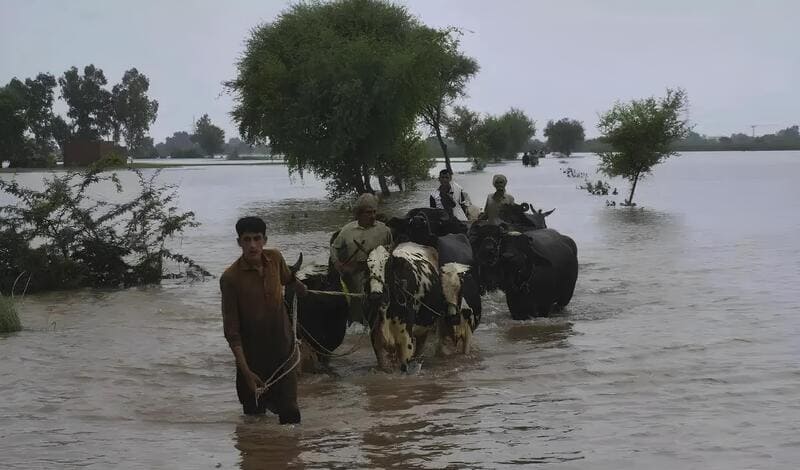
At a time when Pakistan and India are both reeling from devastating floods, the idea of cooperation may seem distant, even naive. Yet the very waters that drown fields, displace millions, and spread disease do not recognize borders.

The Sutlej, Ravi, and Chenab rivers surge across the Punjab plains regardless of passports; Himalayan snowmelt and erratic monsoon cycles devastate villages on both sides. Climate disasters are already forcing our hands. The question is whether we allow them to harden walls of mistrust or to open windows for cooperation.
An avenue for hope lies in climate diplomacy anchored in artificial intelligence. AI is no panacea, but it offers tools that can transform chaos into foresight, turning fragmented warnings into actionable insights. Imagine a transboundary flood intelligence platform that integrates satellite images, river gauges, radar feeds, and weather forecasts from both countries, producing hyperlocal predictions with longer lead times.
Such systems already exist in parts of the world where adversaries have nonetheless recognized the common language of science. If Pakistan and India were to share even processed hazard layers rather than raw sensitive data, both publics could benefit from faster evacuations, pre-positioned relief supplies, and reduced loss of life.
The dividends extend beyond early warnings. Smog chokes Lahore and Delhi in synchrony every winter; air pollutants move seamlessly across the Radcliffe Line. A joint AI-backed air quality network could model smog episodes days ahead and allow coordinated closures of schools, targeted advisories for vulnerable populations, and pre-emptive industrial restrictions.
Floods, meanwhile, incubate outbreaks of cholera, hepatitis, and malaria; here too, machine learning can flag likely hotspots by combining sanitation maps, population density, and inundation zones, giving both health ministries time to dispatch vaccines and safe-water supplies. Farmers, whose fields and livestock lie submerged in Pakistan as well as India, could receive quicker and fairer relief if satellite-based crop-loss models triggered objective compensation schemes, reducing political accusations and easing rural anger.
Skeptics will argue that mistrust runs too deep, that even the Indus Waters Treaty – once hailed as a model of resilience has strained under political friction. The Indo-Pak relationship is layered with territorial disputes, historical grievances, and cycles of hostility that often spill into diplomatic paralysis. But it is precisely because this relationship is so complex that “Science Diplomacy” offers a fresh opening. Technical cooperation on climate risks can operate in spaces where political negotiations stumble.
Climate diplomacy offers what traditional diplomacy often cannot; a low-political-cost, high-human-value pathway. When a joint AI model accurately forecasts a flood surge, and a timely evacuation saves families on both sides, it creates a shared success story that politics alone cannot produce.
Daily or weekly technical exchanges between meteorologists, hydrologists, and health officers build habits of cooperation, insulating them from broader political swings. Each map produced together, each life saved because of a shared algorithm, chips away at suspicion and normalizes contact.
None of this requires reckless openness. Data-sharing can be bounded by memoranda of understanding that limit scope, duration, and use. Sensitive details can be abstracted into processed outputs. International actors like the World Bank, the World Meteorological Organization, or the UN can provide neutral facilitation. Above all, transparency is essential; if the public in Punjab or Uttar Pradesh sees timely flood maps produced by a joint platform, the political incentive to sustain cooperation strengthens.
The alternative is grim. If Pakistan and India continue down parallel tracks – duplicating efforts, withholding data, politicizing disasters – the human toll will mount. Each flood will bring more displacement, each smog season more respiratory deaths, each outbreak more preventable suffering. AI cannot negotiate treaties or dissolve enmity, but it can generate a stream of shared, objective truths that make cooperation not just desirable but unavoidable.
The monsoon floods of 2025 remind us that water respects no boundary and climate respects no ideology. For two nations whose histories are defined by mistrust, climate resilience can become the bridge. Artificial intelligence, deployed in the service of humanity rather than competition, can turn shared vulnerability into shared responsibility.
Through science diplomacy, Pakistan and India may discover that even in their most complex relationship, survival in the face of climate change requires cooperation over confrontation. If they can learn to trust data together, they might yet relearn how to trust each other.
Author: Mirza Abdul Aleem Baig – President of Strategic Science Advisory Council (SSAC) – Pakistan. He is an independent observer of global dynamics, with a deep interest in the intricate working of techno-geopolitics, exploring how science & technology, international relations, foreign policy and strategic alliances shape the emerging world order.
(The views expressed in this article belong only to the author and do not necessarily reflect the views of World Geostrategic Insights).