



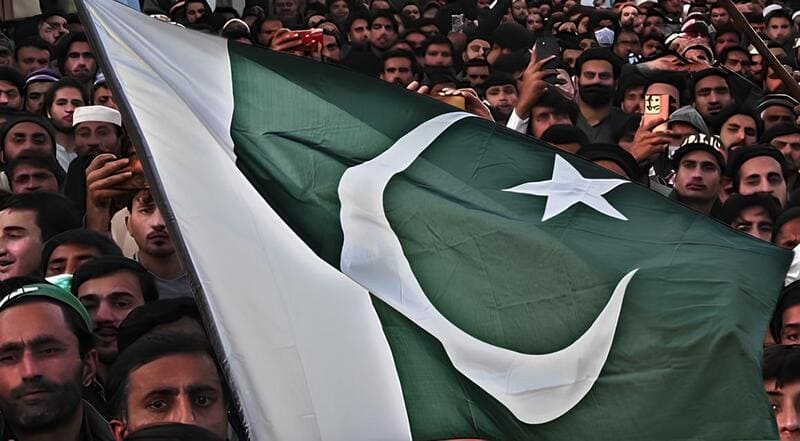
Pakistan approaches 2026 not with the anxiety of an unexpected storm, but with the fatigue of a nation that has been drifting in turbulent waters for far too long. This is not a moment of sudden collapse, nor one of dramatic recovery. It is a slow, grinding stagnation – political, economic, and intellectual where crises overlap, reforms recycle themselves in name only, and ambition has been replaced by managed decline.

The most dangerous illusion confronting Pakistan today is the belief that survival equals stability. It does not. Survival without direction merely prolongs decay. For several years now, the state has functioned in emergency mode. Economic firefighting has become the permanent condition of governance. Inflation spikes are followed by temporary relief, currency stabilization comes at the cost of growth, and IMF programs provide breathing space without addressing structural suffocation.
Investment remains conspicuously absent, not because Pakistan lacks opportunity, but because it lacks credibility. Investors do not flee numbers; they flee uncertainty, inconsistency, and politicized decision-making. In this context, 2026 is shaping up to be less a year of transformation and more a referendum on whether Pakistan can still think strategically as a state.
Political instability remains the core accelerant of all other failures. Pakistan’s democratic process, instead of serving as a mechanism for representation and accountability, has become a battleground for zero-sum power struggles. Government is consumed by survival rather than governance, opposition by obstruction rather than alternative, and institutions by alignment rather than autonomy.
Policy continuity has become a casualty of political vengeance. Every incoming dispensation treats the previous one not as a predecessor but as an enemy whose initiatives must be dismantled regardless of merit. This cycle has crippled long-term planning and eroded public confidence in democratic outcomes.
It is within this dysfunction that initiatives like the Special Investment Facilitation Council (SIFC) and Uraan Pakistan were conceived and subsequently faltered. Both were launched with grand promises – fast-track investment, policy coordination, and a “new beginning” for economic revival. In reality, they became textbook examples of how structural problems cannot be bypassed through administrative shortcuts.
SIFC failed not because investment facilitation is unnecessary, but because investors do not require parallel power structures; they require predictability, rule of law, and institutional coherence. When an economy needs special corridors to function, it is an admission that the mainstream system is broken.
Uraan Pakistan, similarly, suffered from conceptual overreach and practical emptiness. Vision documents without political ownership, bureaucratic capacity, or societal buy-in quickly turn into public relations exercises. Investors were shown slides, roadmaps, and aspirations, but not reforms that could survive a change in government or judicial interpretation.
Neither SIFC nor Uraan Pakistan addressed the fundamental investor question: who guarantees continuity when politics shifts? Without an answer, capital stayed away, and domestic investors continued to park wealth in real estate, foreign currencies, or offshore accounts rather than productive sectors.
Beyond investment failure lies a deeper governance crisis. The Pakistani state increasingly appears extractive rather than facilitative. Citizens encounter it through taxes without services, regulation without protection, and authority without accountability. Corruption, selective enforcement of laws, and bureaucratic inertia continue to drain public trust.
When institutions are perceived as instruments of power rather than neutral arbiters, social contracts fracture. The result is widespread tax evasion, informalization of the economy, and disengagement from civic responsibility. The socioeconomic consequences are severe. Poverty and inequality are no longer temporary setbacks but structural features.
A rapidly growing population collides with stagnant job creation, producing a youth cohort that is educated enough to feel frustrated but not skilled enough to feel empowered. This demographic pressure is not merely economic; it is political and psychological. A society where young people see no future within formal systems becomes vulnerable to brain drain, unrest, and radical narratives.
Pakistan is already witnessing this quiet exodus of talent, capital, and hope. Regional under-development further complicates the national picture. Balochistan and peripheral regions of Khyber Pakhtunkhwa remain locked out of the development mainstream. Infrastructure gaps, weak service delivery, and economic exclusion have fostered deep grievances that cannot be resolved through security measures alone.
Development is not charity; it is state responsibility. Persistent neglect transforms economic disparity into political alienation, undermining national cohesion and increasing the long-term cost of governance. Climate vulnerability now acts as a force multiplier for existing weaknesses. Floods, diseases, water scarcity, and extreme heat are eroding livelihoods, displacing communities, and imposing fiscal burdens on an already stretched state.
At the heart of Pakistan’s predicament lies a democratic deficit, not in the sense of elections alone, but in the absence of rational, evidence-driven governance. This is where the concept of the Scientization of Democracy becomes essential. As articulated, the Scientization of Democracy calls for the transformation of democratic governance from emotion-driven populism and personality-centric politics into a system guided by data, institutional memory, measurable outcomes, and long-term modeling.
Democracy, in this framework, is not weakened by science and expertise; it is strengthened by them. In Pakistan, democratic decisions are too often made in defiance of evidence. Economic policies ignore data, development projects disregard feasibility, and legislation is driven by optics rather than impact assessment.
The Scientization of Democracy demands that policy formulation be grounded in empirical research, that ministries operate with performance metrics, and that public debate shifts from slogans to solutions. It calls for depoliticizing institutions responsible for statistics, planning, health, education, and climate, allowing them to function as professional bodies rather than partisan extensions.
This approach also requires redefining accountability. In a Scientized Democracy, leaders are not judged solely by rhetoric or loyalty, but by outcomes. Did poverty decrease? Did learning outcomes improve? Did investment increase relative to risk? Without such benchmarks, democracy degenerates into theatrical contestation rather than functional governance.
Looking toward 2026, Pakistan faces a narrowing window. Continued reliance on ad hoc initiatives like SIFC-style structures will not substitute for institutional reform. Economic revival cannot occur without political stability, and political stability cannot be sustained without legitimacy, inclusion, and performance.
Policymakers must recognize that suppressing dissent, restricting digital spaces, and constraining media may offer temporary control but inflict long-term damage on innovation, credibility, and global integration. What Pakistan needs is not another vision document or slogan, but a recalibration of the state’s operating system.
Investment policy must be mainstreamed into reformed ministries rather than outsourced to special bodies. Human development must be treated as economic infrastructure, not social charity. Population management and regional equity must be central planning variables, not afterthoughts. Climate resilience must be embedded in development finance rather than addressed post-disaster.
Above all, Pakistan’s leadership – civilian and institutional – must internalize that governance is no longer about managing crises but about designing systems that prevent them. The Scientization of Democracy offers a path forward, not by diluting democratic choice, but by anchoring it in reason, evidence, and accountability. Without such a shift, 2026 will arrive as another year survived rather than a future secured. And survival, as history repeatedly shows, is never enough for a nation that once aspired to lead rather than endure.
Author: Mirza Abdul Aleem Baig – President of Strategic Science Advisory Council (SSAC) – Pakistan. He is an independent observer of global dynamics, with a deep interest in the intricate working of techno-geopolitics, exploring how science & technology, international relations, foreign policy and strategic alliances shape the emerging world order.
(The opinions expressed in this article are solely those of the author and do not necessarily reflect the views of World Geostrategic Insights).