



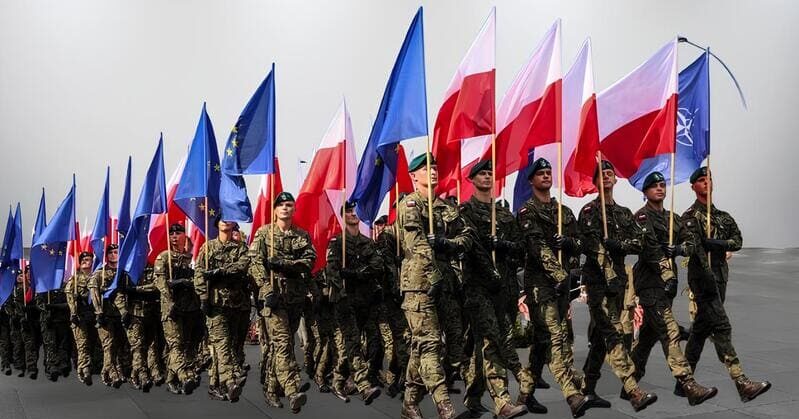
World Geostrategic Insights interview with Michael Werbowski on Ukraine’s aspirations to join the EU, the rebalancing of power in Europe, with Central and Eastern European countries, particularly Poland, increasingly asserting their influence, and challenges to European security.

Michael Werbowski is an independent international affairs analyst and journalist based in Vienna, specialising in European and transatlantic geopolitics. He authored the “Geopolitical Notebook” series of the Warsaw Institute, and currently he continues to contribute to the Warsaw Institute Podcast on Spotify, providing analysis for series such as American Alert. He has worked as a correspondent for publications such as Lidove Noviny, The Prague Post, and Excelsior in Paris, Prague, and Mexico City.
Q1 – While peace negotiations remain uncertain, Volodymyr Zelensky has announced that Ukraine aims to join the European Union in 2027, also emphasising that membership could be part of a series of international security guarantees after the end of the war. From your point of view, would Ukraine’s entry strengthen Europe in general, and Central and Eastern European countries in particular, or could it destabilize the internal balance of the European Union, even jeopardizing its security?
A1 – From my perspective, Ukraine’s entry into the EU could well destabilize Europe as a whole. While Zelensky frames accession as a step toward security guarantees, the reality is far more complex. Ukraine is still at war, and its economy and governance are deeply strained. Rapid integration—especially by 2027—would impose immense economic burdens on the EU budget and slow decision-making. It could also deepen divisions within Central and Eastern Europe, where countries like Hungary or Slovakia already hesitate to expand. Moreover, without stable postwar reforms, Ukraine’s challenges could spill over—exposing the EU to hybrid threats and undermining trust. Thus, while Ukraine’s future is vital, a hurried accession risks fracturing EU unity and weakening its long-term stability.
Q2 – You’ve written extensively about Poland as a model for political transformation. Can you elaborate here?
A2 – Poland’s transition is a textbook example of deliberate, staged reform. After decades of authoritarian rule, the Solidarity movement led mass civic mobilization, opening negotiations with the communist regime. Key leaders like Wałęsa ensured a negotiated transition, balancing stability and change. They pursued gradual economic liberalization—market reforms with social cushions—and built strong institutions: independent courts, media, and civil society. Their NATO membership first, followed by the EU, was strategic—securing security before demanding full integration. Crucially, Poland adhered to all EU norms, accepting tough reforms over years—unlike a rushed approach. This methodical, measured process gave Poland enduring democratic stability—a path Ukraine would be wise to emulate, rather than seeking fast-tracked entry amid crisis.
Q3 – Is the EU’s center of gravity shifting toward Warsaw and, more generally, toward the countries of Central and Eastern Europe, the so-called “New Europe”?
A3 – Indeed, a rebalancing is underway. These Central and Eastern European states in the “New Europe” are coalescing around shared concerns—especially energy security, migration, and a pragmatic stance toward Russia. Leaders like Navrocki and Babiš reflect a nationalist shift, emphasizing sovereignty and skepticism of sweeping EU directives. As they coordinate, they do gain leverage in Brussels, shaping debates on defense and energy. However, it’s important to note their unity is still pragmatic, not monolithic. Divergences remain—Hungary leans further toward Moscow, while others stay more Atlanticist. Still, their growing bloc offers a potent voice—pushing the EU to balance solidarity with realism. The future balance will depend on whether these nations use their influence to unify the EU, or if internal divisions widen the fault lines.
Q4 – How do you see Poland’s evolution from a “logistical hub” to a military leader in the EU? Could Poland’s accelerated militarization serve as a deterrent, or does it risk fueling Russia’s narrative of siege?
A4 – After the fall of communism, it leaned heavily on logistics—serving as a NATO staging ground for exercises and aiding troop movements to allies. But recent years, especially since the Ukraine war began, have seen Poland invest aggressively in defense—tripling its military budget, acquiring modern systems like American Abrams tanks, and positioning itself as a regional security anchor, while serving as, you say, as NATO’s “logistical hub” for weapons delivery to Ukraine.
On the one hand, this militarization serves as a potent deterrent—Poland’s readiness reassures NATO allies and signals that the EU is serious about defending its eastern flank. Yet, it also risks playing into Russia’s narrative—Moscow often portrays NATO expansion as encirclement. Thus, the balance is delicate: Poland’s actions are necessary for deterrence, but they must be paired with diplomacy—ensuring that strength is seen as a stabilizing shield, not a provocation, to avoid escalating the very tensions they seek to prevent.
Moreover, its rapid defense buildup—investing heavily in new hardware—serves as a deterrent and anchors regional security. Yet, this belligerent posture is tempered by Poland’s domestic caution—it avoids direct military intervention in Ukraine, wary of domestic fatigue and political constraints. Moreover, Poland’s militarization amplifies tensions with Germany, as both nations rearm, evoking historical wounds from the 20th century. Thus, while Poland’s stance bolsters deterrence, it’s not without friction—its assertiveness must be balanced, as both Warsaw’s cautious domestic politics and historic tensions with Berlin remind us that military strength alone cannot resolve deeper geopolitical and historical complexities.
Q5 – You have observed that the gradual withdrawal of the United States from European security is forcing the continent to confront a “long-externalized strategic reality.” Do you believe that strategic autonomy by 2030 is a realistic goal for Europe? Who do you believe has the political legitimacy and capacity today to provide the “hard-power backbone” for Europe: a Franco-German-led coalition or the emerging bloc of eastern flank countries led by Poland?
A5 – As the United States disengages from NATO, Europe faces a stark reality: it must build its own strategic autonomy. Achieving this by 2030 is possible, but only if major European powers—Poland’s formidable military investments, alongside Germany and France—forge a tripartite defense identity. While Poland’s massive defense spending gives it key muscle, the enduring political legitimacy and industrial base lie with Germany and France. Together, these three must lead a European defense identity, laying the foundation for a truly autonomous military force—balancing Poland’s front-line readiness with Western Europe’s diplomatic and industrial heft.
Q6 – Debates over war reparations between Poland and Germany still persist. How much do these historical wounds, which have never fully healed, influence Warsaw and Berlin’s ability to form a united front against external threats today?
A6 – Historical wounds between Poland and Germany continue to influence contemporary politics and defense cooperation, though their impact is nuanced. The unresolved debates over war reparations and historical grievances keep memory politics alive in Warsaw, shaping both public opinion and government policy. Polish leaders often invoke these issues to assert national sovereignty and caution against perceived overreach by Germany in EU decision-making.
However, practical geopolitics forces a more pragmatic approach. Both countries recognize that external threats—chiefly Russia—require coordinated defense and intelligence cooperation. NATO and EU frameworks provide institutional mechanisms to work together, and shared security concerns often outweigh lingering historical disputes. That said, these historical sensitivities can limit the speed and depth of integration: for example, joint initiatives may face domestic scrutiny, and mistrust can complicate negotiations over defense spending, troop deployments, or strategic planning.
In short, while past wounds do not prevent Warsaw and Berlin from cooperating against external threats, they act as a persistent undercurrent, shaping the terms, timing, and perception of that cooperation. The alliance is functional, but not fully frictionless; history imposes caution, shaping the politics of unity even when existential risks demand it.
Q7 – The European Union has reached agreements to permanently ban Russian gas. What are the geopolitical risks of this new dependence on other suppliers or on American LNG?
A7 – The European Union’s decision to permanently ban Russian gas marks a profound geopolitical shift, signaling Europe’s determination to reduce Moscow’s ability to use energy as a political weapon. By cutting off Russian supply, the EU is sending a clear message of support for Ukraine and asserting its independence from Russian coercion. Yet this strategic choice comes with significant risks, as it creates new dependencies and exposes the bloc to fresh vulnerabilities.
Europe’s pivot largely depends on American liquefied natural gas (LNG), supplemented by a small set of alternative suppliers, including Qatar and Norway. While the U.S. is generally a reliable partner, this dependency carries strategic costs. Europe’s energy security becomes tied to Washington’s policies and global priorities, which could constrain EU foreign-policy autonomy or leave member states exposed to political pressures from across the Atlantic.
Infrastructure challenges further complicate the transition. LNG requires specialized ports, storage facilities, and transport systems. Any disruption—from geopolitical tensions to technical failures or severe weather—could jeopardize supply. Over-reliance on a handful of suppliers also concentrates risk, leaving the EU more vulnerable to price shocks and supply shortages. Indeed, global LNG markets are volatile, with surging demand in Asia capable of driving prices upward, creating both economic strain and domestic political pressure within member states.
Moscow, for its part, is unlikely to remain passive. Russia could respond by deepening ties with energy-hungry countries like China and India or leveraging hybrid tools, including cyber operations, trade restrictions, and other economic measures, to pressure European markets indirectly. While Europe reduces one avenue of Russian influence, it opens new fronts of potential economic and geopolitical friction.
Q8 – The Baltic Pipe is a strategic 800-950 km subsea natural gas pipeline connecting Norwegian gas fields to Poland via Denmark, providing an alternative to Russian gas. How has the Baltic Pipe fundamentally changed the power balance in Central and Eastern Europe?
A8 – In my view, the Baltic Pipe has fundamentally shifted the power balance in Central and Eastern Europe by reducing the region’s dependence on Russian gas and enhancing energy security. Poland, as the pipeline’s hub, gains greater leverage over its neighbors and within the EU, signaling that it can dictate supply alternatives rather than relying on Moscow. The project strengthens NATO’s eastern flank by ensuring stable energy for critical infrastructure, while diminishing Russia’s ability to use gas as a geopolitical tool. Additionally, it encourages regional cooperation, as countries like Lithuania, Latvia, and Estonia can diversify their supplies via Poland, creating a more resilient Central and Eastern European energy network and shifting leverage away from traditional Western European suppliers.
Q9 – What is your opinion on President Trump’s claims on Greenland? Do you believe that Europe is capable of playing an important role in the Arctic? Even in opposition to the United States?
A9 – I am in favor, though such a move poses serious geopolitical challenges, diplomatic, and military challenges for Trump, who seeks to reassert US control over the Western Hemisphere. Washington’s renewed focus on Greenland has become a serious diplomatic flashpoint as we have seen in the news. Coveting Greenland has exposed deep divisions within NATO… Trump has publicly revisited the idea of the United States acquiring the Arctic territory — an autonomous part of Denmark — arguing it is essential for U.S. national security and that no other nation can adequately defend it. His language has at times been inflammatory and historically inaccurate, suggesting Denmark lacks legal sovereignty and mocking European defense capacities. This rhetoric has strained transatlantic trust and alarmed both Danish and broader European leaders, who emphasize respect for sovereignty and international law.
Although Trump later spoke of a “framework” for a deal with NATO allies, details remain vague, and no transfer of sovereignty has been agreed. European opposition has been strong; leaders repeatedly affirmed that Greenland belongs to its people and to Denmark, and some European troops have been deployed there in a show of support.
From a strategic perspective, Trump’s claims appear to mix legitimate geopolitical concerns — Greenland’s location matters for Arctic routes, early‑warning systems, and rare earth resources — with overblown rhetoric that undermines allied cohesion. The episode has damaged U.S.–European trust and inadvertently spurred European NATO members to rethink their own strategic autonomy.
Q10 – You are a scholar of Zbigniew Brzezinski. Which part of the former US National Security Advisor’s “Grand Chessboard” vision has proved most accurate, and what would the great geopolitical strategist suggest today to resolve the Russian-Ukrainian conflict and avoid permanent fragmentation of Eurasia?
A10 – Zbigniew Brzezinski’s worldview, as laid out in “The Grand Chessboard,” was anchored in the strategic centrality of Eurasia and the need to prevent any single power from dominating it. He argued that Ukraine, as a key pivot state, was vital to maintaining a balance between Russia, Europe, and the U.S., ensuring no hegemon could exploit the vast landmass. In the current war, these insights are starkly relevant. Ukraine’s fight is precisely about keeping this Eurasian balance intact—preventing Russia from reasserting itself as a dominant continental power. Brzezinski would likely argue that the West must not treat Ukraine merely as a chess piece but as a sovereign actor whose stability is crucial to preventing Eurasian fragmentation. His advice today would be to sustain Ukraine’s sovereignty, integrate it into Europe’s security architecture, and engage Russia diplomatically—not by isolating it, but by ensuring a stable, multipolar Eurasia where no single nation dictates the future. In the Ukraine conflict, this means supporting Ukraine’s sovereignty but also ensuring Russia doesn’t spiral into unchecked isolation, and no single bloc’s dominance triggers a chain reaction of instability.
Michael Werbowski – Independent international affairs analyst and journalist.