



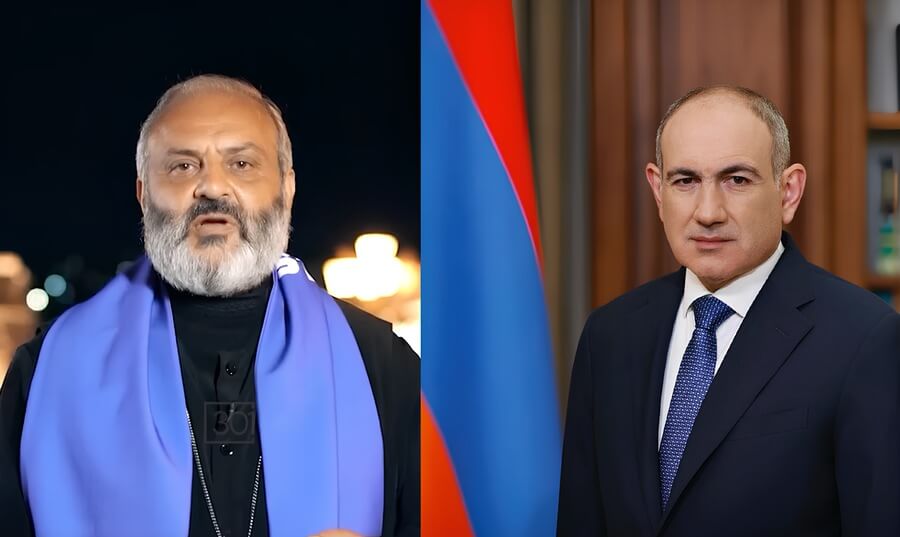
Nikol Pashinyan, Prime Minister of the Republic of Armenia, appears to be following the playbook of Serbian President Aleksandar Vucic and, to some extent, the former Montenegrin leader Milo Djukanovic.

Like Djukanovic’s 2019 attempt to effectively nationalize the property of the Serbian Orthodox Church, Pashinyan is targeting the Armenian Apostolic Church (or at least its top clerics) for political purposes, while also pursuing a Vucic-style policy of making serious concessions to Armenia’s historical adversaries – Turkey and Azerbaijan.
On June 25, Armenian authorities arrested a prominent cleric, Archbishop Bagrat Galstanyan, along with 14 others, charging them with orchestrating an alleged plot to overthrow the government. While Djukanovic never arrested any leaders of the Serbian Orthodox Church in Montenegro, he similarly employed tactics of portraying his opponents as conspirators allegedly seeking to topple his government.
In 2016, Montenegrin police arrested a group of alleged “Russian nationalists” accused of plotting to assassinate Djukanovic. The incident helped the longtime Montenegrin leader – who had effectively ruled the country for three decades – justify a gradual break with Russia, Montenegro’s historic ally. Notably, one year after the alleged coup attempt in Montenegro, the former Yugoslav republic joined NATO. Similarly, following the Second Karabakh War, Pashinyan has been seeking to distance Armenia from Moscow.
Although the landlocked former Soviet republic nominally remains in the Russian-led Collective Security Treaty Organization (CSTO), it is eying to establish closer ties with NATO. That, however, does not necessarily mean that the South Caucasus nation will join the alliance anytime soon, even if it eventually withdraws from the CSTO. What Yerevan’s actions – particularly in the realm of foreign policy – suggest is that the country’s leadership is adopting a strategy similar to that of Djukanovic and Vucic.
What Vucic and Pashinyan have in common is that they both lead countries that suffered military defeats. As a result, they are pursuing a policy of normalization of relations with their advisories – NATO and NATO-backed Kosovo in Serbia’s case NATO, and Turkey and Turkey-backed Azerbaijan in Armenia’s. The problem for the two leaders is that significant portions of their populations oppose the approaches they are taking.
In 2022, 57% of Armenians were against normalizing relations with Turkey, while the most recent survey shows that 68.5% of them do not believe normalization with Azerbaijan is possible. In Serbia, the vast majority of the population strongly opposes recognizing Kosovo’s 2008 unilaterally declared independence, and blames the West and Kyiv for the war in Ukraine. In spite of that, Vucic has recognized Kosovo-issued IDs, diplomas, and license plates, while his government provides ammunition to Ukraine.
Thus, the Serbian and Armenian leaders are pursuing policies that large portions of their societies might perceive as traitorous. At the same time, they are both often accused of lacking the will to tackle corruption. But while Vucic has been facing large-scale anti-corruption protests for months, Pashinyan is contending with demonstrations over the arrest of senior figures in the Armenian Apostolic Church.
From that perspective, his current position more closely resembles Djukanovic in 2019, when his rule was also shaken by Church-led protests following the adoption of a controversial law by the Montenegrin parliament that effectively stripped the Serbian Orthodox Church of ownership of its buildings and estates. Although the protests in Montenegro did not directly lead to his downfall, his party was defeated in the 2020 parliamentary elections. Three years later, Djukanovic was voted out in the presidential election, ending his 32-year grip on power.
Pashinyan does not seem to want to share Djukanovic’s political fate. His crackdown on certain clergymen can be interpreted as an attempt to prepare the ground for the 2026 parliamentary elections.
In 2023, Bishop Bagrat Galstanyan emerged as a leading opposition figure under the “Tavush for the Homeland” movement. His arrest, along with Pashinyan’s ongoing campaign against Church leaders, could potentially help his Civil Contract party improve its very low approval ratings. The problem, however, is that such actions will almost certainly lead to even deeper division within Armenian society.
But even if the Civil Contract suffers the election defeat next year, there is no guarantee that the new government will adopt a fundamentally different geopolitical course. If developments in Montenegro – where post-Djukanovic political actors have continued pursuing his pro-Western policy – are any indication, Armenia is likely to experience a similar path.
Pashinyan has less than a year to shape a political reality that will be difficult to reverse, regardless of who wins the next election. If Yerevan, in the coming months, withdraws from the CSTO, deepens its ties with NATO, further escalates tensions with Russia, and accepts Azerbaijan’s condition to amend the constitution – removing the current preamble that contains direct calls for the unification of Karabakh with Armenia – Pashinyan’s successor will find it difficult to alter the country’s foreign policy direction.
That is why the ongoing tensions between Pashinyan and the Armenian Apostolic Church are more than his ambition to remain in power post-2026. They are about paving the way for Armenia’s irreversible geopolitical reorientation – from a historically Russia-aligned posture toward deeper integration with Western institutions and frameworks, even if it comes at the cost of concessions to Azerbaijan, domestic unity, and traditional national identity.
Author: Nikola Mikovic – Journalist, researcher and analyst based in Serbia.
(The views expressed in this article belong only to the author and do not necessarily reflect the editorial policy or views of World Geostrategic Insights).