



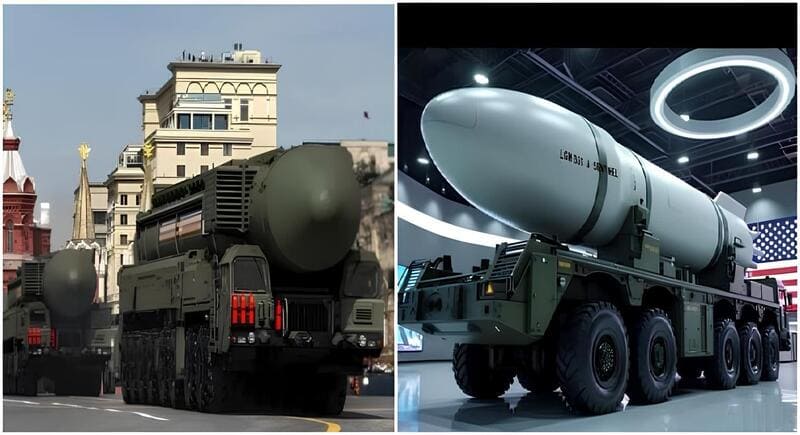
On 23 February, Russian President Vladimir Putin celebrated Defender of the Fatherland Day. This is a day when military personnel and their sacrifices in defending Russia are honored.

During his speech, after praising veterans and current armed forces personnel for their selfless service, he announced the development of Moscow’s nuclear triad, describing it as an “unconditional priority” that would guarantee the country’s security and effectively ensure strategic deterrence and a balance of power in the world. The 28 February attack on Iran by the US and Israel that took place after the US-Iranian talks on Tehran’s nuclear programme ended without a deal, would further strengthen the resolve of President Putin to accelerate the development of the nuclear triad.
Since Russia’s 2022 invasion of Ukraine and escalating West Asia tensions, a US-Russia nuclear arms race looms with New START’s February 2026 expiration, prompting states worldwide to reassess nuclear doctrines, warhead limits, and disarmament commitments. It pressures nations to either bolster capabilities, tighten warhead caps, or revive disarmament via Non-Proliferation Treaty mechanisms and bilateral talks. However, lest unchecked modernization cascades into broader proliferation risks.
New START Expiration Risks
President Putin’s speech and the expiration of the New START treaty between Russia and the US in the first week of February 2025 indicate the possibility of an arms race—a repetition of history as well as the start of a new one. The New START Treaty, the last between the two nations, played a crucial role in maintaining the international nuclear disarmament framework. UN Secretary-General Antonio Guterres warned that the expiration was a “grave moment for international peace and security,” ending decades of legally binding limits on the world’s two largest nuclear arsenals. He noted that, for the first time in more than half a century, the world lacks binding limits on the strategic nuclear arsenals of Russia and the United States, which together possess the overwhelming majority of the global nuclear weapons stockpile.
Nuclear Stockpile Data
According to the SIPRI 2025 report, Russia and the US together possess around 90 percent of all nuclear weapons. The sizes of their respective military stockpiles (i.e., usable warheads) remained relatively stable in 2024, but both states are implementing extensive modernization programs that could increase the size and diversity of their arsenals in the future. Russia’s totals stand at 5,580 (deployed warheads: 1,718; stored warheads: 2,591; military stockpile: 4,309; retired warheads: 1,150), and the US’s at 5,328 (deployed warheads: 1,770; stored warheads: 1,930; military stockpile: 3,700; retired warheads: 1,477):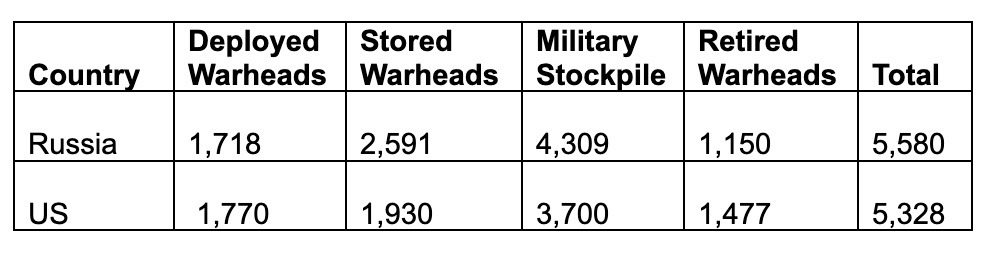 *SIPRI 2025 Report.
The SIPRI 2025 report warns that, without a new agreement to cap these powers’ stockpiles, the number of warheads they deploy on strategic missiles is likely to increase.
Recent Developments and Tensions
President Putin’s latest announcement of the nuclear triad and reports on the US resuming nuclear weapons testing after a long pause do not paint a peaceful picture, especially amid current geopolitical fractures due to the dismantling of the Western-led post-Cold War world order. President Donald J. Trump intends to return to testing on an “equal basis,” framing it as a response to covert tests by rival nuclear powers, Russia and China, rather than a return to Cold War-era detonations. According to the Trump administration, the treaty is “no longer relevant” because Russia’s increases in warhead and launcher limits already violate it, exceeding designated numbers for each country.
Treaty Limits and Compliance Issues
The New START treaty limited each side to 1,550 strategic nuclear warheads between Russia and the US. It served as a stabilizing factor to an extent, helping prevent catastrophe and reduce the risk of devastating miscalculation. Despite these measures the world got a glimpse of nuclear threats to be used against Ukraine and the West since the Ukraine war. President Putin repeatedly has been declaring threats. Interestingly, he along with the other P4 countries in January 2022 during a joint declaration stated about avoiding an arms race and not targeting each other or at any other. However, in a month’s time, Russia conducted its “special military operation” on Ukraine and since then has been repeatedly threatening the country and its supporters with the use of nuclear weapons.
With the New START treaty’s expiration, concerns have been raised by both parties, Russia and the US, as well as China. In September 2025, President Putin stated that Russia was ready to adhere to the treaty’s quantitative limits for another year after expiration, provided the US did the same. At the same time, Moscow made it clear that they would not send official demarches to the US for a response; a non-response from the US is viewed by the Kremlin as a response. However, there are reports that both sides are planning to continue observing the treaty measures beyond the expiration date. It would be important for the two nuclear powers to return to the negotiating table, even if a return to the terms of the expired agreement is questionable, especially given the Trump administration’s actions toward Tehran.
Meanwhile, the expiration date of the treaty is in much focus. However, looking closely then the indifference with both parties were visible on the seriousness of working on the treaty, raising questions on both the countries commitments.
Inspection and Notification Disputes
Russia suspended the US inspections of its nuclear facilities in 2023. The Kremlin argues that sanctions—imposed since 2014 over Crimea’s annexation and intensified by the 2022 “military operation” in Ukraine—prevent Russian inspectors from traveling to America. Beyond deteriorating relations, COVID-19 also hindered mutual inspections. In 2022, the US stated it was prepared to host Russian inspectors, ensuring viable air routes, visas, and no sanctions blocking inspection rights. The US assured it was ready to reverse countermeasures and fully implement the treaty if Russia returned to compliance; the Biden administration noted that Russia cancelled a November 2022 meeting under the Bilateral Consultative Commission. The US also accused Russia of halting treaty-mandated notifications on nuclear force status and movements. Meanwhile, in 2023, President Putin declared the suspension of Russia’s participation during a national address, clarifying no withdrawal.
Broader Geopolitical Complications
With the Ukraine war and deteriorating bilateral relations between Russia and the US, mutual arms control mechanisms are on hold, with both sides accusing each other. Complications from the Ukraine conflict and treaty expiration have left arms race controls in limbo. Further hindering talks or a new agreement is President Trump’s insistence on including China. On February 18, a US State Department official cited seismic data alleging a 2020 Chinese underground nuclear test near the Lop Nur facility in Xinjiang; both Beijing and the Comprehensive Nuclear-Test-Ban Treaty Organization deny it. China refuses to join US-Russia reduction negotiations, citing its smaller arsenal; the SIPRI 2025 report estimates China’s at 600 warheads.
Multilateral Concerns
Interestingly, President Trump’s push to bind China echoes Putin’s 2023 speech, where he noted that Moscow must account for NATO allies like France and the UK in strategic arsenals and offensive capabilities. SIPRI reports UK and France warheads at 225 and 290, respectively. Calculating Trans-Atlantic UNSC P3 allies’ tips numbers toward their side, fuels Russian and Chinese insecurity and reluctance. Russia’s Deputy Foreign Minister Sergey Ryabkov stated post-expiration of the New START treaty that Russia is prepared for a reality without arms control, as stabilizing elements are being lost.
Conclusion
The arguments Russia and the US have advanced regarding New START’s expiration seem rational. Though official expiration occurred in early February 2026, prior years showed trust deteriorating rapidly. Trust-building measures under the treaty were not followed, fostering a subtle blame game. Russia’s recent nuclear triad announcement and US nuclear testing resumption suggest both sides are clandestinely regrouping for a new arms race—Moscow halting notifications and inspections under sanctions pretexts while cancelling the 2022 Bilateral Consultative Commission meeting; the US considering tests matching Russia and China, amid aging weapons prompting upgrades. The US Nuclear Weapons Council’s 2018 certification of pit production in New Mexico and South Carolina (80 pits/year) heightens Russian suspicions of reverting to unlimited Cold War stockpiles.
Though still speculative, the pattern is difficult to ignore. The overlap of historic spheres of influence—Ukraine in Russia’s strategic orbit, New Mexico within America’s uncontested territorial core which shares borders with Mexico—and President Trump’s rhetoric on regional control echoing President Putin’s posture toward Ukraine suggest that the collapse of the treaty regime, stalled negotiations, and Washington’s push for a China-inclusive framework are not isolated developments. Rather, they signal a deeper contest among major powers to regain strategic primacy and redefine the terms of hegemony in an emerging world order.
What we are witnessing is less the accidental erosion of arms control than the deliberate recalibration of power. For Russia, the United States, and China, binding treaties risk constraining long-term strategic ambitions. The retreat from negotiated limits reflects not diplomatic fatigue but calculated statecraft—an effort to preserve flexibility in an era marked by distrust, technological disruption, and shifting balances of power.
Against the backdrop of Ukraine’s protracted war, heightened US–Iran tensions that culminated in the killing of Tehran’s supreme leader Ali Khamenei, and intensifying China–Taiwan frictions, the unravelling of arms control frameworks carries profound consequences. The erosion of guardrails does not merely increase uncertainty; it normalizes strategic brinkmanship. For Moscow in particular, such an environment could embolden President Putin to accelerate the modernization and expansion of Russia’s nuclear triad—whether openly or through calibrated opacity—thereby catalyzing a renewed arms race.
The danger, therefore, is not only the end of a treaty but the end of restraint as a governing principle among great powers. If strategic competition continues to outpace institutional renewal, the international system may drift from managed rivalry toward systemic instability. In that scenario, the absence of credible arms control will not simply reflect geopolitical rivalry—it will deepen it, making the next crisis more combustible than the last.
Author: Dr. Indrani Talukdar – Fellow at the Chintan Research Foundation, New Delhi.
(The opinions expressed in this article belong only to the author and do not necessarily reflect the views of World Geostrategic Insights).