



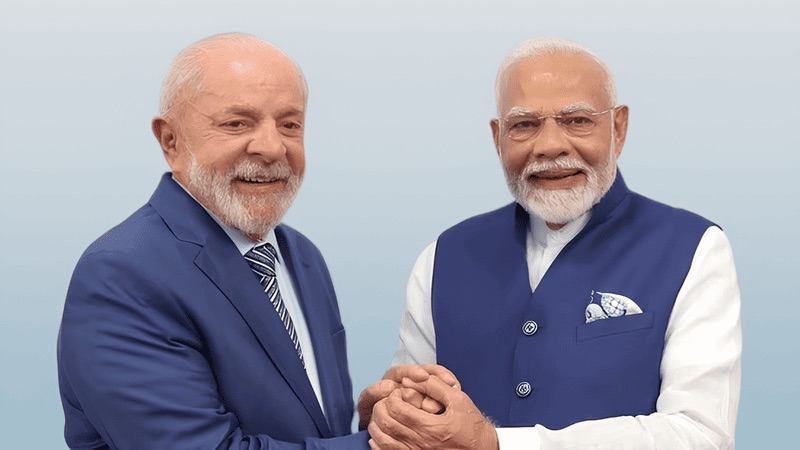
Brazilian President Luiz Inácio Lula da Silva’s arrival in New Delhi comes at a moment of sharp geopolitical churn, lending the visit added strategic significance.

The India-Brazil relationship has long drawn its political heft from multilateral platforms such as BRICS and the G20, where both countries have aligned on reforming global governance and strengthening the voice of the Global South. Despite the geographical distance, their partnership has acquired salience in an international system still struggling to recalibrate the balance between established and emerging powers.
However, while shared advocacy for reform has forged a strong normative bond, the bilateral relationship remains under-leveraged. Trade, technology collaboration, defence exchanges, and energy cooperation have yet to match the political convergence visible in multilateral settings. The distinct geopolitical spaces India and Brazil inhabit-in Asia and Latin America-present both risks and opportunities, especially amid intensifying great-power competition.
Lula’s visit thus offers a timely opportunity to move the partnership beyond its multilateral anchor and inject greater bilateral substance. By deepening cooperation in strategic sectors and institutionalising sustained high-level engagement, New Delhi and Brasília can convert political alignment into a more robust, forward-looking strategic partnership.
Both regions are in the throes of churn as the United States, under the Trump administration, mounts an aggressive push to dominate the evolving power rearrangement in the Western Hemisphere. President Trump’s announcement of a conclave of ideologically aligned Latin American leaders-timed ahead of his much-anticipated trip to China-signals a calculated move to consolidate hemispheric leverage before confronting its pre-eminent strategic rival.
Latin America, like much of the world, is confronting a fundamental reset in its relationship with its northern neighbour. Under a militant interpretation of “Make America Great Again” and “America First,” Washington is rewiring ties with allies, adversaries, and partners alike. Transactionalism, strategic conditionality, and overt political alignment now sit at the core of U.S. diplomacy, displacing older multilateral and institutional habits of engagement. No region is immune to the turbulence this approach generates. What the 2026 Munich Security Conference termed “wrecking-ball politics”-an era of destruction, disruption, and demolition of established arrangements-has injected persistent uncertainty into global affairs.
In this rapidly shifting geopolitical landscape, India and Brazil must move decisively to convert shared convergences into sustained habits of cooperation. President Lula’s visit is not mere diplomatic theatre but signals a strategic recognition that non-Western powers must actively expand their options amid the great power flux. As global alignments grow more fluid and transactional, foreign policy agility depends on diversified partnerships rather than over- dependencies. The renewed thrust in India-Brazil ties reflects a deliberate assertion of strategic autonomy-a conscious effort by New Delhi and Brasília to avoid overexposure to any one power axis. By deepening economic, technological, and security linkages, both seek to guard against the weaponisation of interdependence and preserve room for manoeuvre in an increasingly volatile order.
The visit-reportedly accompanied by the largest-ever Brazilian delegation-signals a decisive push by both sides to forge a relationship that is multifaceted, strategic, and future-oriented. Coming on the sidelines of the ongoing Artificial Intelligence (AI) Summit in India, it gains added weight, as both countries need to navigate the technology ecosystems that will help shape the future architecture of politics, business, and global security.
President Lula is expected to arrive with an expansive delegation of nearly 14 Cabinet Ministers and a high-powered contingent of leading Brazilian CEOs, underscoring the strategic weight of the visit. Business leaders from both sides are slated to convene at a dedicated Business Forum, signalling a push to translate political intent into concrete commercial outcomes.
As India’s largest trading partner in the Latin America and Caribbean (LAC) region, Brazil is seeking to significantly broaden and deepen bilateral engagement across a wide spectrum of sectors. These include trade and investment, defence cooperation, energy particularly renewables, agriculture, health and pharmaceuticals, critical minerals and rare earths, as well as science, technology and innovation. Emerging domains such as Digital Public Infrastructure (DPI), artificial intelligence, space collaboration, as well as strengthened people-to-people linkages are also expected to feature prominently, reflecting an ambition to future-proof the partnership and anchor it in next-generation strategic sectors.
Health and pharmaceuticals stand out as a sector of strong complementariness. India’s globally recognized strength in affordable generic medicines aligns seamlessly with Brazil’s universal healthcare system and its need for cost-effective, high-volume access to essential drugs. The pandemic exposed the fragility of global supply chains and the risks of over-concentration, underscoring the urgency of building more resilient and diversified partnerships. In this context, advancing bilateral mechanisms on market access, regulatory harmonisation, and institutional support will be critical to enhancing predictability and long-term stability. At the same time, joint research initiatives targeting diseases that disproportionately affect the Global South should form a central pillar of deeper India-Brazil cooperation.
Brazil ranks among the world’s top ten producers of nickel, manganese, niobium, iron ore, and bauxite, and has rapidly expanded its footprint in lithium, natural graphite, rare earth elements, vanadium, and copper. As the global race for clean energy accelerates, critical minerals have emerged as the new arena of great power scramble. With supply chain resilience now central to electric vehicles, battery storage, and advanced electronics, Latin America is fast becoming a pivotal theatre for the reordering of resource geopolitics. In this landscape, Brazil stands out as a key partner for India in advancing joint exploration, extraction, processing, and recycling initiatives. As both sides work toward building a trusted minerals corridor, credibility grounded in robust environmental, social, and governance (ESG) standards will be indispensable.
Defence and aerospace are fast emerging as prime pillars of India-Brazil collaboration, particularly as India’s evolving public-private partnership model accelerates its ambition to become a major defence exporter. The partnership is poised to deepen across technology sharing, joint development of defence systems, capacity building, and supply chain integration. Interest in Indian defence platforms is growing across Latin America, including in Argentina, while Brazilian firms such as Embraer are expanding their footprint in India’s defence and civil aviation sectors. Together, these trends create a strategic opportunity to convert geostrategic convergence into a robust and mutually reinforcing industrial base.
Moreover, sustained policy attention to strengthening people-to-people ties between geographically distant India and Brazil is essential to deepening mutual awareness and understanding. Expanding intellectual and academic exchanges, research collaborations, and professional mobility will be central to this effort. In this regard, the reported reciprocal decision to extend the validity of visitor visas from five to ten years marks a significant step forward. By easing mobility, the measure has the potential to stimulate tourism, enhance connectivity, and inject fresh momentum into broader bilateral engagement.
As Washington invokes a “Trump corollary” to the 19th-century Monroe Doctrine, Latin America is entering a phase of strategic churn. With the region fast becoming a theatre of intensifying US-China competition, New Delhi will need to recalibrate its playbook. In this setting, President Lula’s visit to India offers a timely and contextually rich opportunity to inject political ballast into sectoral and functional cooperation-elevating it to a new tempo that aligns with the region’s shifting geopolitics, geoeconomics, and technological transitions. Beyond bilateral convergences, the India-Brazil strategic partnership carries the potential to shape a broader narrative on how non-Western powers can contribute meaningfully to the provision and distribution of global public goods.
Author: Monish Tourangbam – Fellow at Chintan Research Foundation (CRF), New Delhi.
(The opinions expressed in this article belong only to the author and do not necessarily reflect the views of World Geostrategic Insights).