



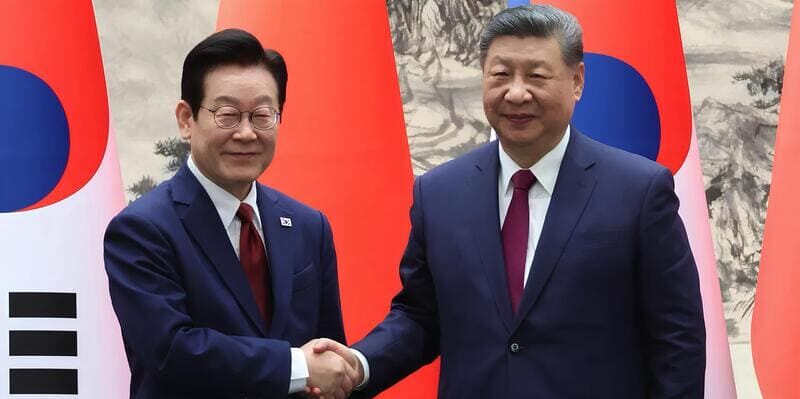
The China–South Korea currency swap agreement concluded on November 1 last year, with a ceiling of 70 trillion won (approximately USD 48.3 billion), has often been portrayed as a purely technical measure to stabilize financial markets. That interpretation, however, significantly understates its strategic implications. In reality, the agreement risks deepening South Korea’s structural economic and financial dependence on China and, over time, constraining Seoul’s strategic autonomy vis-à-vis Beijing.

Viewed alongside recent diplomatic developments, the deal raises a disquieting question: is South Korea—perhaps unintentionally—sliding into China’s orbit?
This concern is reinforced by the December 5 summit in Beijing between South Korean President Lee Jae-myung and Chinese President Xi Jinping, where the two leaders reportedly agreed to coordinate an explicitly anti-Japan stance centered on historical issues. Taken together, the currency swap and the summit point to a trajectory that sits uneasily with Japan–U.S.–South Korea security cooperation, which is designed precisely to manage China’s growing power. The notion that South Korea can indefinitely sustain “bat diplomacy”—benefiting from the liberal security order while edging closer to Beijing—deserves serious skepticism.
In principle, currency swap agreements are technical instruments. They provide bilateral safety nets against foreign-exchange liquidity crises and help reassure financial markets. By themselves, they do not define alliances or political loyalties. Yet finance is never politically neutral. The choice of counterpart and the political context in which such agreements are concluded inevitably carry geopolitical meaning.
What makes the current situation distinctive is the evolving posture of the United States. In October last year, the Trump administration—dissatisfied with South Korea’s policy orientation toward Washington—effectively refused to conclude a U.S.–South Korea currency swap agreement. This decision deprived Seoul of access to the most credible financial backstop available in a crisis: dollar liquidity supported by the U.S. Federal Reserve.
At the same time, negotiations over the renewal of the second Japan–South Korea currency swap agreement are scheduled for this December, with the outcome uncertain. History offers a sobering precedent. The second swap was gradually reduced from USD 70 billion to a mere USD 3 billion as bilateral relations deteriorated, before being terminated altogether in 2013. Only after years of diplomatic repair was a new, much smaller swap—capped at USD 10 billion—concluded in June 2023.
Today, however, bilateral relations are once again strained. South Korea has reaffirmed an anti-Japan diplomatic line centered on historical grievances while continuing its illegal occupation of Takeshima (Dokdo). Under these circumstances, Japan faces a difficult strategic choice: whether to conclude a currency swap that would effectively turn it into an “ATM” for South Korea in the name of regional stability, or to prioritize the credibility of its own strategic and normative commitments.
If Japan were to refuse a new swap agreement, the consequences for South Korea would be substantial. Such a refusal would signal South Korea’s gradual exclusion from the financial safety net of the liberal camp, indicating that it is no longer regarded as a fully reliable partner. In that scenario, Seoul’s tilt toward China would reflect not strategic preference but strategic elimination—China as the only remaining option.
This process already appears to be underway. Despite its formal symmetry, the China–South Korea currency swap is fundamentally asymmetric. China possesses vast foreign-exchange reserves and a renminbi shielded by capital controls, and it has repeatedly demonstrated a willingness to attach political conditions to economic arrangements. South Korea, by contrast, operates fully open capital markets, and the won remains highly vulnerable to speculative pressure. In times of crisis, dependence on foreign currency—above all, U.S. dollars—is unavoidable.
The resulting imbalance is stark. For China, the swap is insurance it is unlikely ever to need. For South Korea, it is insurance that may well have to be used. If activated, China would acquire assets denominated in Korean won at a moment when its own economy is rapidly upgrading and eroding South Korea’s competitive niches. The likely outcome would be increased Chinese acquisition of South Korean real estate and other national assets, deepening dependence and raising the specter of economic colonization.
Even without explicit directives from Beijing, such dependence would inevitably constrain South Korea’s diplomatic freedom. Seoul would find itself increasingly unable to “provoke China” in foreign-policy decisions. Once Chinese cooperation becomes indispensable during economic or financial crises, the assumption that security and economics can be neatly separated collapses. South Korea would retain formal sovereignty, but its substantive policy discretion would be sharply curtailed.
It would be premature to declare that South Korea is becoming a Chinese tributary state. Yet if financial ties with the United States and Japan continue to weaken while asymmetric dependence on China deepens, the cumulative effect will be unmistakable. South Korea would be actively shrinking its own strategic autonomy and embedding itself more deeply within China’s sphere of influence.
From this perspective, Japan’s policy choice becomes clearer. Rather than rushing into a third Japan–South Korea currency swap, Tokyo should either refrain from concluding such an agreement or limit it to a strictly minimal scale. Economic and social exchanges can and should not be impeded as a matter of policy, but Japan’s strategic priority must remain the reinforcement of Japan–U.S.–South Korea security cooperation.
Ultimately, what is at stake is not finance alone, but strategy. Prime Minister Sanae Takaichi appears to be on the right strategic track, as demonstrated by her summit with President Lee on January 13 in Osaka and the following day in Nara, which emphasized the importance of cooperation in economic security and trilateral Japan–ROK–U.S. security coordination. Whether South Korea chooses to reinforce or erode that framework will shape the region’s strategic balance for years to come.
Author: Masahiro Matsumura – Professor of International Politics and National Security at St. Andrew’s University in Osaka (Momoyama Gakuin Daigaku), Japan.
(The views expressed in this article belong only to the author and do not necessarily reflect the views of World Geostrategic Insights).