



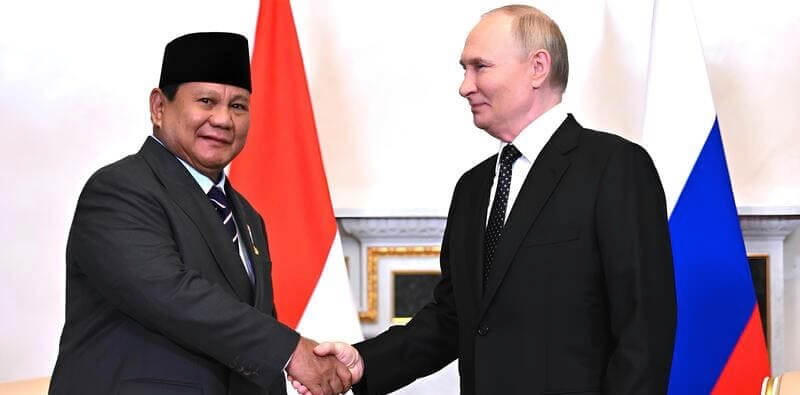
World Geostrategic Insights interview with Tatiana Pokrovskaia on the significance of the free trade agreement between Indonesia and the Eurasian Economic Union, the strategic partnership with Russia, and the growth of Indonesia’s economic and diplomatic influence in the Indo-Pacific region.

Tatiana Pokrovskaia is an international business development expert with more than 20 years of experience in the markets of Africa, CIS, Asia and the Middle East, repeatedly bringing Russian companies into international markets. She is based in St. Petersburg, Russia.
Q1 – Indonesia and the Eurasian Economic Union (EAEU) – comprising Russia, Armenia, Belarus, Kazakhstan, and Kyrgyzstan – have officially concluded negotiations on a free trade agreement (FTA), which is expected to be signed in December 2025 during the EAEU summit. What is the significance of such a deal?
A1 – Indonesia is the largest country in Southeast Asia, rich in natural resources, with a population of over 280 million. It is not only the world’s largest island nation but also the fourth-most populous country in the world. Its economy is growing steadily at 5% annually, leading to a positive trend toward becoming the world’s fifth-largest economy after 2030.
One of the key trends in Indonesia’s foreign economic policy is expanding cooperation with EAEU countries. The upcoming agreement on Indonesia’s accession to the EAEU opens up more opportunities for all allied countries, with a significant increase in trade and joint projects expected. It will also create new opportunities for foreign trade and enhance the competitiveness of EAEU products in the Southeast Asian market.
It is expected, the agreement will create conditions for deepening trade and economic ties, attracting investment, and implementing joint projects, which will positively impact the development of Indonesian industry and agriculture. Indonesia will be able to reduce its dependence on traditional suppliers by gaining alternative channels for purchasing raw materials and finished goods from EAEU countries.
It is also worth noting the positive impact on businesses in the participating countries in terms of cost reduction. Simplifying customs procedures and reducing tariffs will reduce costs for businesses, which could lead to lower final prices and market expansion. An important factor is supply diversification.
The Eurasian Economic Union and Indonesia intend to eliminate duties on a wide range of export and import goods within a few years, including key mutual trade items in agriculture, chemicals, metallurgy, electronics, radioelectronics, and other sectors.
Q2 – 2025 marks the 75th anniversary of diplomatic relations between Indonesia and Russia. Indonesian President Prabowo Subianto and Russian President Vladimir Putin signed a strategic partnership agreement in June 2025 during their meeting in St. Petersburg. How do you assess the development of relations between Russia and Indonesia? What are the prospects for bilateral ties?
A2 – Indeed, in 2025, Russia and Indonesia will celebrate the 75th anniversary of diplomatic relations. Indonesia’s recent accession to BRICS and the upcoming free trade agreement with the Eurasian Economic Union (EAEU) open a new chapter in relations with Russia.
On the sidelines of the St. Petersburg International Economic Forum in June 2025, Russian President Vladimir Putin and Indonesian President Prabowo Subianto adopted the “Declaration on Strategic Partnership” between their countries.
The Declaration covers several areas of cooperation: political, economic, law enforcement, human rights, scientific, educational, cultural, and informational aspects.
The Declaration notes that the strategic partnership is based on mutual benefit, mutual understanding and trust, international law, and the goals and principles enshrined in the UN Charter in their entirety and interrelatedness, as well as in the Declaration on Principles of International Law.
The strategic partnership aims to take Russian-Indonesian relations to a new level by intensively expanding and deepening cooperation bilaterally, as well as in regional and international forums, including the Association of Southeast Asian Nations (ASEAN), BRICS, and the G20.
The significance of this cooperation is underscored by the changing geopolitical landscape, particularly in the Indo-Pacific region.
Q3 – Trade relations between Indonesia and Russia have continued to grow over the past five years, rising from $1.9 billion in 2020 to $3.55 billion in 2024. Russian trade with Indonesia is dominated by oil, fertilizers, and chemicals, while Indonesia exports palm oil products and other plantation products to Russia. Is there still much room for growth in trade and investment ties?
A3 – As you rightly noted, trade and economic relations between Russia and Indonesia are reaching a new high. In 2024, Indonesia’s total trade with Russia reached four billion US dollars, an 11% increase compared to 2023 (3.6 billion).
Cooperation in investment, energy, and infrastructure is also growing. Forums like BRICS are opening up new opportunities to strengthen economic ties.
As Indonesian Trade Minister Budi Santoso noted, Russia is not just an alternative market for Indonesia, but a strategic partner with a special status. Under the Indonesia-EAEU Free Trade Agreement, Russia will affect 98% of Russia’s exports to the country, gaining a competitive advantage. Meanwhile, Indonesia gains the opportunity to stimulate its economy, becoming a significant player in the region.
Opportunities are opening up across many sectors. Indonesia is importing increasingly more petroleum products (fuel oil, naphtha, diesel), and its demand for agricultural products, such as wheat and dairy products, is also growing.
In industrial production, Russian fertilizers, metals, steel, equipment, construction materials, and timber are in demand in Indonesia. Strengthening cooperation ensures energy and food security for Indonesia.
Indonesian products will gain a competitive advantage in the Russian market after the introduction of the free trade zone, which will also open up new prospects for the digital economy – fintech, e-commerce, ICT, and startup ecosystems. Opportunities for mutual investment projects are also opening up.
Q4 – Indonesia is one of Southeast Asia’s leading economies with a population of 281 million, a GDP (PPP) of US$4.98 trillion, and a projected GDP growth rate of 5% for 2025, driven by domestic demand and government initiatives. It is a member of the ASEAN bloc and, since early 2025, a full member of BRICS (the first Southeast Asian nation to join BRICS), while seeking to preserve Indonesian President Prabowo Subianto’s approach of “friend to all, enemy to none.” Many analysts believe that Indonesia is increasing its economic and diplomatic influence in the Indo-Pacific region and can make an important contribution to global governance reform and the rise of South-South cooperation. What is your opinion?
A4 – The “Golden Indonesia 2045” vision envisions Indonesia becoming one of the world’s five largest economies, with a GDP of approximately $30 trillion. Trade will be the primary driver of this growth. Strategic priorities include increasing the share of exports in GDP, strengthening competitiveness in international markets, developing services exports (digital technologies, creative industries, professional services), as well as more active participation in global value chains and strengthening intraregional trade within the country.
Indonesia’s strategic geographic location, its participation in international organizations, and its growing economic strength contribute to its increasing influence in the Pacific region. The country, comprising thousands of islands, strives to play the role of an independent power center, promoting South-South cooperation. A key element of its foreign policy agenda is strengthening ties with developing countries through various partnerships, including the Gulf states, striving to shape a new world order based on the principles of pragmatism and strategic balance. Expanding partnerships lie in the areas of food security, energy, and digitalization.
Indonesia positions itself as an autonomous power center, striving to actively participate in shaping a new global architecture.
Tatiana Pokrovskaia – International business development professional.
Image Credit: Ria Novosti