



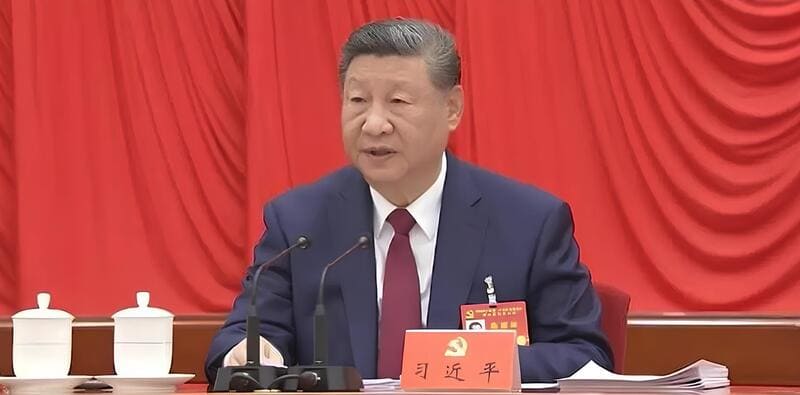
Beijing’s Fourth Plenary Session of the 20th Central Committee of the Communist Party of China (CPC) marks another defining moment in the evolution of Chinese governance and global engagement.

Concluded on October 23, 2025, the session adopted the recommendations for the 15th Five-Year Plan, setting the direction for China’s next phase of economic and social development. It is both a domestic roadmap and a message to the world, a reaffirmation that China’s modernization remains steady, inclusive, and outward-looking even in an era of global uncertainty.
At a time when international politics is marked by fragmentation and economic volatility, the communique offers a narrative of continuity and confidence. It reflects the CPC’s commitment to reform-driven governance, technological renewal, and people-centered development, elements that have underpinned China’s transformation into the world’s second-largest economy.
China’s planners have entered a new stage, moving from quantitative growth to qualitative transformation. The communique highlights high-quality development as the overarching theme of the 15th Five-Year Plan. It stresses the need to preserve the strength of manufacturing, upgrade traditional industries, and embrace green transformation across all sectors. This aligns with the “Beautiful China” initiative, which seeks to integrate environmental protection with economic progress.
For developing economies, particularly across Asia and Africa, this model offers an alternative template for modernization one that demonstrates how industrial advancement and ecological responsibility can coexist. It also shows that state-led planning, when rooted in public welfare and long-term vision, can yield sustainable outcomes in a volatile global economy.
A defining aspect of the session was the emphasis on scientific and technological self-reliance, which should not be seen as an isolation act rather it should be a pathway to resilience. The term “new quality productive forces” encapsulates China’s vision of integrating education, research, and industrial innovation to build an economy powered by knowledge. By strengthening domestic innovation ecosystems, China seeks to reduce vulnerabilities in strategic technologies while contributing to global scientific progress.
For partners like Pakistan, this approach opens new horizons for cooperation under frameworks such as the China–Pakistan Economic Corridor (CPEC) and Belt and Road Initiative (BRI). Joint research, digital infrastructure, agricultural innovation, and clean energy cooperation can translate these principles into shared development outcomes.
The communique’s reaffirmation of expanding domestic demand carries broader significance. A stronger Chinese consumer base sustains global trade flows and offers new market opportunities for partner economies. The dual circulation strategy is, in fact a balancing internal growth with external openness and is a reflection of a response to global economic shifts. It also suggests that China is positioning itself as both a stabilizer of global supply chains and a driver of demand for emerging markets.
The emphasis on high-standard opening-up reinforces China’s long-standing support for multilateralism and international cooperation. The document pledges to safeguard the global trading system and advance “high-quality” Belt and Road cooperation. For Pakistan and other BRI partners, this continuity ensures that development partnerships remain anchored in connectivity, mutual benefit, and shared prosperity.
Central to China’s political model is the idea that effective governance requires both discipline and innovation. The Fourth Plenary Session highlights full and rigorous Party self-governance as the “fundamental underpinning” of national progress. By linking institutional integrity with economic modernization, the CPC reaffirms that accountability and reform are essential to sustaining growth and public trust.
Equally important is the focus on national security and social stability, ensuring that progress in defense, technology, and governance is harmonized with peace and stability. China’s modernization of its national defense force, rooted in President Xi Jinping Thought on Strengthening the Military , and is framed not as militarization but as a means of safeguarding development gains and ensuring peace in a turbulent world.
For countries across the Global South, the outcomes of this session offer lessons in strategic continuity and adaptive reform. China’s success in lifting nearly 800 million people out of poverty and steering its economy toward sustainability demonstrates that modernization need not follow a Western template. It can instead emerge from indigenous wisdom, gradual reform, and a commitment to people-centered governance.
The emphasis on common prosperity and mutually beneficial cooperation resonates with developing nations seeking inclusive growth models. As China continues to deepen South–South cooperation through the Belt and Road, SCO, BRICS+, and other multilateral platforms, its policy trajectory will shape not only its domestic future but also the contours of global development governance.
The communique has a deep message of unity, self-reform, and collective modernization that carries universal relevance. It recognizes that economic transformation cannot be sustained without institutional discipline, environmental responsibility, and human-centered policymaking. By aligning its domestic priorities with global cooperation, China continues to advance the idea of a community with a shared future for humanity.
For Pakistan, the lessons are profound. As both nations enter new planning cycles, the integration of innovation, sustainability, and inclusive growth should remain the shared priority. China’s Fourth Plenary Session serves as both a reaffirmation of stability and a roadmap for joint progress — one that envisions modernization not as a solitary national goal, but as a collective endeavor for peace, prosperity, and global balance.
Author: Muhammad Asif Noor – Founder Friends of BRI Forum, Advisor to Pakistan Research Center, Hebei Normal University.
(The views expressed in this article belong only to the author and do not necessarily reflect the views of World Geostrategic Insights).