



By Ahmad Ali
The common perception that the identity of a state is based on its territory has always been deeply rooted in established international treaties and beyond.

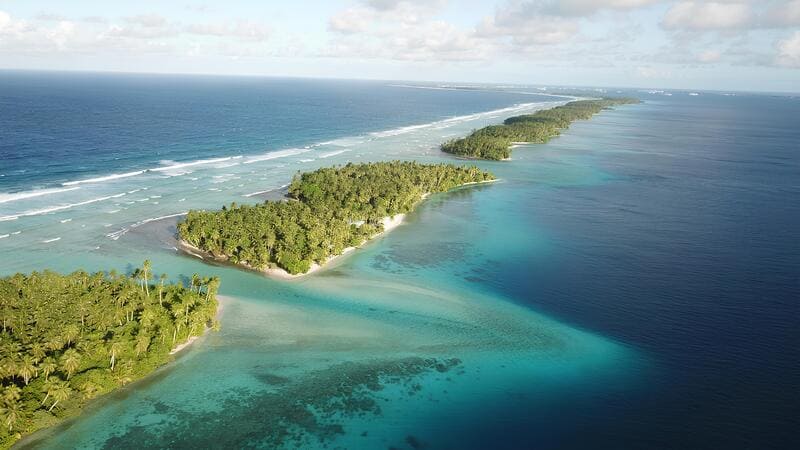
However the increasing change in sea level, due to global warming, is threatening to shatter that notion, and take entire nations in the course of extinction not due to war, but because of climate change. The threat is tangible and imminent especially in small atoll and low based island states. The sea is not only washing away the coastline, but endangering the very concept of being a state, possessing land and being a citizen.
Low-lying island states such as Tuvalu, Kiribati, the Maldives and other atoll states are already on the front line. As sea levels rise, fresh water is displaced by salt water, storms become more severe, buildings are eroded, and settled areas simply disappear.
Entire Islands cannot support life any longer and the population has to be moved or seek refuge elsewhere.
The international law has long indicated that a state should possess four essentials: a defined territory, permanent population, a functioning government, and capacity to transact business with other states. When a state loses its land, that is, when, say, one state drowns in the water, this would, as a matter of law, imply that that state itself no longer exists. Over the last few years, it has been challenged as scholars, international agencies, and innocent island nations have begun to assert that land is not the most essential subject.
The International Court of Justice, in a landmark move in 2025, stated that increasing seawater levels would not necessarily alter marine boundaries, but added that once a state existed; the loss of one of its vital components did not necessarily imply the loss of statehood. This concept of continuing statehood which initially had been largely theoretical, today provides a legal lifeline to the impoverished island states. It states that sovereignty, sea-rights and state identity do not need solely to rely on physical geography.
Nevertheless, the legal backing is not that strong and definite. The statement of the ICJ is, nevertheless, cautious. It recognizes the fact that land degradation is among the biggest threats of some small states. However, it falls short towards providing a blanket assurance of the process that all states will retain full rights in case their land is washed away.
When the atoll states lose the real territory -or cease to exist in reality- the human impact might be disastrous: whole nations might be reduced to statelessness. Statelessness is losing nationality, loss of legal identity, the right to own property, to seek justice, to vote, to utilize the sea-zones with the gifts of fish, minerals, and employment. There would also be the disappearance of cultural and communal identity. To communities that have been relying on land to form a sense of belonging as is the case with most indigenous atoll communities, the loss would be very psychological and cultural.
There would also be severe geopolitical backlash on the eradication of states. Once the sea zones of the island-states are opened to the ocean, it is possible to observe stronger countries, corporations, or regions beginning to quarrel about the rights to the seas, value resources, or new territory. This space created by the disappeared nations might turn into a new arena of war not only to survive but to dominate by means of strategy dominance over the seas, resources, and migration routes.
The moral aspect is clearer: the individuals who are the most vulnerable tend to be those who have brought the least amount of emissions to the world. States with small islands can contribute to almost nothing, although they are the ones who are threatened the most. People may lose entire nations and cultures just because a planet is growing warmer, and gradually stealing their land.
This crisis looks like it requires immediate action on a number of fronts. First, the notion that climate-disappearing states can continue to enjoy the rights of citizenship, sea-rights, resources and diplomatic recognition even when under water must be formally accepted and enshrined in the world. Vulnerable states must change their national constitutions to accommodate this; some of them already have started to request their fellow nations and international institutions to substantiate this continuity.
Second, there should be the revision of legal regulations such as maritime law, human-rights law, migration law, and the conventions of the refugees, which should be revised to take care of the individuals displaced as a result of climate change. New or revised agreements should immediately address statelessness because it serves the interests of displaced individuals to have a right to nationality, protection, resettlement, property, resources, and cultural preservation.
Third, developed high-emitting nations and global financial institutions are to offer high loss and damage payments, climate-adaptation funds, relocation assistance, and infrastructure aid to the vulnerable states. These countries ought to be assisted in having their governments functioning even though the institutions are relocated to other countries in order to retain their diplomatic rights, and the rights to their treaties.
Critics also assert that instead of legal and institutional changes, building sea walls, reclaiming, raising islands and moving populations can also be a legitimate option. Numerous island states do invest in these defenses, salt-resistant agriculture, desalination of water, and relocating communities. However these measures are usually costly, just but temporary, and possibly do nothing but postpone the unavoidable. Long-term security even in engineered resistance will not be possible in a world where sea levels continue to increase over decades or centuries and where severe weather patterns become more common.
Some draw our attention to the fact that natural adaptation such as the alteration of an island form may reduce the perceived risk, yet it does not necessarily mean that it will be livable, and will be regarded and prosecuted by the law, as well as that it will retain its identity. What is more important, individual successes do not lead to the solution to the bigger issue of disappearance of many at-risk countries due to climate.
In the new age, the meaning of a state has to be redefined on a large scale. The Anthropocene of the present day must shift the statehood conceptualization that revolves around land solely to revolve around people and their rights that are founded not only on geography but also on the legal identity, dignity of humans, continuity, and responsibility to the world.
Unless we do so, our history may have to be marked with one of the greatest mass failures: not with war, or colonization, and ideology, but with neglect and inertia and legal paralysis. The new generation may be saddened not only by the loss of the islands, but also by the loss of identity, culture, and human dignity.
It is time to do something- before the tides wash away yet another pound of sand and soil.
Author: Ahmad Ali – MPhil Scholar at the National Defence University, Islamabad.
(The opinions expressed in this article are solely those of the author and do not necessarily reflect the views of World Geostrategic Insights).
Image Credit: AP