



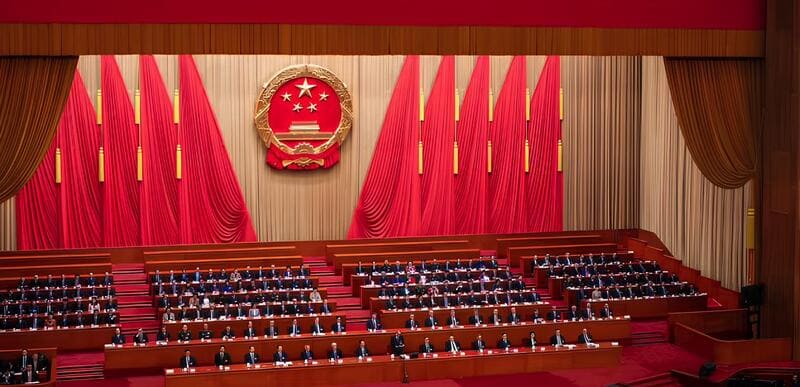
As China convenes its annual “Two Sessions”, the meetings of the National People’s Congress and the Chinese People’s Political Consultative Conference, both happening on March 4 and 5th, global attention once again turns to Beijing. These sessions are essential and central to China’s governance model, where macroeconomic targets are clarified, legislative priorities are advanced, and policy continuity is reaffirmed.

What makes the 2026 Two Sessions particularly significant is the context in which they take place. China stands at a critical juncture in its modernization drive. Global headwinds from renewed trade fragmentation and technological decoupling to geopolitical volatility and an uncertain multilateral order are reshaping the external environment that China must navigate. Externally, geopolitical tensions and trade fragmentation continue to reshape global supply chains. Internally, structural transformation toward innovation-led and consumption-driven growth is accelerating.
The deliberations of the NPC and CPPCC will therefore offer clear signals about China’s strategic direction for 2026 and beyond. The 15th Plan is expected to double down on what President Xi Jinping has described as “new quality productive forces” , an economy powered by indigenous innovation, artificial intelligence, green energy, and advanced manufacturing, rather than the factor-intensive, export-led model of previous decades.
In 2025, China’s GDP surpassed 130 trillion yuan, maintaining its position as the world’s second-largest economy. While global growth remained subdued at around 3 percent, China contributed roughly one-third of global economic expansion. The Two Sessions are expected to consolidate this momentum, likely reaffirming a growth target in the range of around 5 percent. Such a target is not merely a numerical benchmark. It reflects the balance between stability and reform that characterizes China’s policy framework.
A defining feature of China’s governance system is the institutionalized linkage between long-term planning and annual execution. The 14th Five-Year Plan has already placed strong emphasis on high-quality development, technological self-reliance, and green transformation. With the 15th Five-Year Plan approaching, the upcoming sessions will refine implementation pathways while ensuring policy continuity.
Technological innovation remains central. China’s research and development spending has risen steadily. surpassing 3 trillion yuan annually in recent years, accounting for over 2.5 percent of GDP. Breakthroughs in artificial intelligence, quantum computing, and advanced manufacturing are gradually reducing dependence on external technology supply chains. The Two Sessions are likely to reinforce support for strategic sectors such as semiconductors, new energy vehicles, and digital infrastructure.
Green development is another pillar. China has already become the world’s largest producer of renewable energy. In 2024 alone, newly installed solar and wind capacity exceeded 200 gigawatts. Investments in green industries surpassed 10 trillion yuan, reflecting both environmental commitment and industrial opportunity. The Two Sessions will likely emphasize carbon peaking and neutrality goals, advancing ecological civilization while sustaining economic vitality.
Equally significant is the emphasis on improving people’s livelihoods. Over the past decade, China has lifted nearly 100 million rural residents out of extreme poverty. Urbanization now exceeds 65 percent, and social insurance coverage has expanded to over 95 percent of the population. In upcoming deliberations, policymakers are expected to prioritize employment stabilization, healthcare reform, and pension sustainability. These measures strengthen domestic demand and enhance social cohesion.
China’s governance approach during the Two Sessions reflects a consultative model. Deputies to the NPC and members of the CPPCC submit thousands of proposals annually. In 2024, more than 8,000 suggestions were reviewed and addressed by relevant authorities. This structured feedback mechanism ensures that policymaking incorporates grassroots concerns, sectoral expertise and regional diversity.
Fiscal and monetary coordination will also be in focus. China has maintained prudent monetary policy while deploying targeted fiscal tools to stimulate growth. The fiscal deficit ratio has remained manageable by international standards. Infrastructure investment continues to support modernization. particularly in digital networks, transportation corridors and urban renewal projects. The Two Sessions are expected to outline calibrated fiscal expansion without compromising long-term financial stability.
Internationally, China’s commitment to openness will be reaffirmed. Despite global headwinds, China’s total trade in goods exceeded 40 trillion yuan in 2025. It remains the largest trading partner for more than 120 countries and regions. Initiatives such as the Belt and Road continue to facilitate connectivity and development. The Two Sessions will likely underscore China’s resolve to expand high-standard opening-up. attract foreign investment and participate actively in global governance reform.
The significance of the Two Sessions extends beyond domestic policymaking. For international observers, these meetings provide insight into how China manages complexity. The integration of central planning with market mechanisms. long-term vision with pragmatic execution. and national objectives with global engagement demonstrates a governance model that prioritizes stability while embracing change.
Critically, the Two Sessions reflect institutional confidence. China does not rely on abrupt shifts or populist cycles. Policy direction emerges from structured consultation, data-driven analysis and long-term strategic alignment. This continuity has been instrumental in navigating challenges such as the global financial crisis, the pandemic and ongoing geopolitical uncertainty.
Looking ahead, the deliberations will likely reaffirm three central themes. First, consolidating economic recovery through innovation and consumption. Second, advancing green and digital transformation. Third, safeguarding social stability while deepening reform and opening-up.
For the international community, understanding the Two Sessions is essential to understanding China’s trajectory. These meetings do not merely set annual targets. They articulate a broader narrative of modernization rooted in stability, inclusiveness and sustainable growth.
In a world marked by volatility and fragmentation, China’s upcoming Two Sessions are poised to send a clear message. steady governance, forward planning and shared development remain at the core of its national strategy.
Author: Muhammad Asif Noor – Founder Friends of BRI Forum, Advisor to Pakistan Research Center, Hebei Normal University.
(The views expressed in this article belong only to the author and do not necessarily reflect the views of World Geostrategic Insights).