



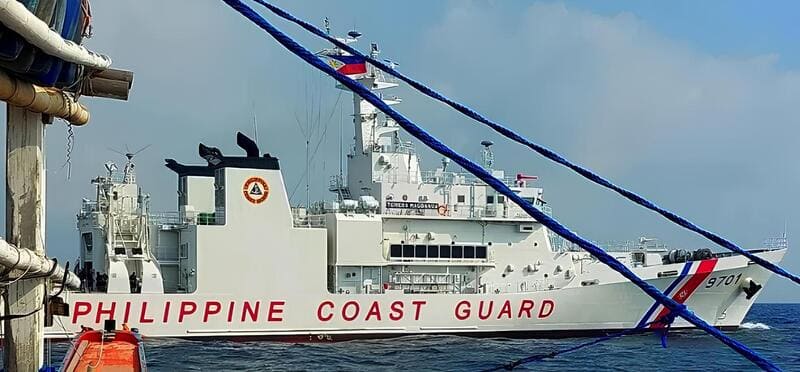
In this tumultuous year, the Philippine Coast Guard (PCG) prevailed over what their counterparts in the Philippine Navy (PN) would characterize as gray zone attacks, also defined as Chinese Coast Guard (CCG) “illegal, coercive, aggressive, and deceptive (ICAD)” actions.

Indeed, Philippine white ships encountered numerous incidents of water cannon assaults, dangerous maneuvers, blocking actions, and collisions presenting a persistent pattern of Chinese hostility at sea.
By first month of the year, CCG intruded near the coastline of Zambales province, inside the Philippine Exclusive Economic Zone (EEZ), prompting radio challenges from PCG’s BRP Magbanua (MRRV-9701) — Manila’s lead ship and deemed the most modern maritime ship rotating around the West Philippine Sea (WPS).
A few months after the confrontation, Chinese vessels blocked two PCG ships on a routine patrol east of Scarborough Shoal, a traditional fishing ground for the two-claimant countries. During summer, CCG and People’s Liberation Army-Navy (PLA-N) performed unsafe maneuvers in what is called Bajo de Masinloc for the Philippines and Huangyan Island for China.
However, the biggest blunder the Chinese made in modern naval strategy as the world saw it was on the eighth month of the year when two Chinese gray and white ships collided with each other in a consented bid to blockade a Philippine patrol boat causing huge damage from Beijing. The following month, in retaliation, a CCG water cannon strike near the challenged coral atoll shattered the windows of the Philippine Bureau of Fisheries and Aquatic Resources (BFAR) vessel, injuring one crew member.
Two months later, another CCG white ship rammed and fired water cannons at Philippine ships off Pag-asa island (Thitu Island). For the first time, in the last month of 2025, Chinese vessels targeted around 20 Filipino fishing boats near Sabina Shoal in their risky blocking maneuvers, injuring three fishermen and damaging two boats.
The constant incidence of swarming campaigns of Chinese armada in key areas in the WPS reached a high tension since mid-year, a total of 49 vessels detected despite high tide during the rainy season in the South China Sea (SCS). Even if the PCG white hulls performed consistent assertive or measured transparency, a social science tool of maritime security, which kicked in to effectuate strategic communication in controlling Manila’s narrative aimed at debunking Beijing’s ICAD campaigns, there remains a vacuum in the coastal defenses that should anchor to a new multi-pronged coastal strategy matched by material capability to discredit the scale of sea blindness under the shadow of grey zone doings.
The Chinese flotilla remained an eye sore in the Philippines’ territorial integrity. Fielding dynamic defense and diplomatic networks for hedging strategy, and a full-scale military execution of the Comprehensive Archipelagic Defense Concept (CADC) triggered the Armed Forces of the Philippines (AFP) to mount a proactive external defense posture. But expected aggregated tit-for-tat for counter-tactics such as mirroring Chinese maneuvers are yet to be seen.
There was a curated transition from “naming and shaming” plan to a divergent coastal strategy that transcended on tangible deterrence and legislative curing brought by the enactment of archipelagic sea lanes and maritime zones acts in advancing the country’s jurisdictional rights. It provided a strong legal basis for enforcement actions to withstand customary international law provisions of the United Nations Convention on the Law of the Sea (UNCLOS) and the 2016 Arbitral Award to defy China’s establishment of the Huangyan Island National Nature Reserve in the ninth month of the year.
The vast coral reef ecosystem, covering more than 8,000 acres, may cause irreparable environmental damage if continued propeller dragging and high-pressure hosing, pollution, and extensive giant clam harvesting are practiced. Environmental crimes should not just be recorded but penalized as benchmark cases for small island-states in the Pacific that suffer from illegal fishing and poaching of natural resources in the blue oceans.
To beat the external security threat, the Philippines is investing heavily in modern defense assets including missile systems, new corvettes and frigates, warfighting aircrafts, and cyber systems, to enhance the military’s ability to respond against coercions to show visible presence of the AFP and PCG in the contested domains while conducting frequent and coordinated maritime patrols as means of assertion in the spirit of national sovereignty.
Increased frequency of Inter-Agency Maritime Operations (IAMO) of the Navy, Coast Guard, and the Philippine National Police (PNP)-Maritime Group around critical features in cays and atolls in the WPS emphasize infrastructure hardening as the government fast-track security deals to fill gaps in response to steady sea denial and ships “going dark” by turning off their Automatic Information System (AIS) transponders to conceal illegal sails and navigation.
Ensuring a 360-degree protection of the country’s CADC across its 200-nautical-mile EEZ, a total force at sea of interoperable coast guard and armed forces’ multi-domain readiness must be sustained as the Philippine government pursues infrastructure development of sheltered ports in remote islands from Batanes to Sulu, serving as logistical hubs for maritime patrols and refuges for Filipino fishers.
However, cognizant of Manila’s current limited air and sea assets, a mandated praxis of maximum tolerance is likely encouraged, and increased maritime cooperative endeavors, exercised bilaterally or multilaterally, bolster relentless leverage among allies and strategic partners to protect itself from repeating Chinese attacks.
The multi-pronged coastal strategies must set layered maritime presence composed of outer layer from the Navy to provide a deterrent backstop, fortified by a middle layer of the Coast Guard as primary law enforcers and disaster responders for prima facie case of grey zone, and the inner layer must be surrounded by the BFAR to uphold fishers’ rights, giving prominence to the UNCLOS decision as pro-fishermen’s ruling.
Continuous modernization for coastal defense systems must be known to the public for approved national acceptance of increasing defense economy to make aware of the cognitive domain as Manila bears to rally continuously for global opinion against unlawful acts in its maritime domain. Lastly, codified coastal and naval legal frameworks mark legal clarity and mutual understanding, not only for various claimant-states in the South China Sea, but for countries in the newly fashioned geographic corridor of the Indo-Pacific by bannering new policies on marine environmental protection and sustainable development in the world’s largest disputed sea lanes of communications.
Author: Dr. Chester Cabalza – Founding President of the Manila-based think tank International Development and Security Cooperation (IDSC).
(The views expressed in this article belong to the author and do not necessarily reflect the views of World Geostrategic Insights).
Image Source: Philippine Coast Guard