



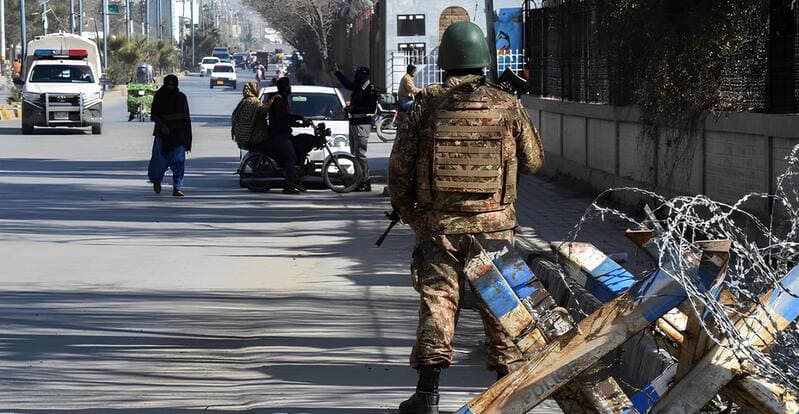
Balochistan – Pakistan’s largest yet most underdeveloped province has once again moved from the margins to the center of national and international strategic attention. A recent wave of coordinated insurgent attacks, unfolding alongside intensifying global competition over rare earth minerals, signals that the province is no longer merely a domestic security concern.

Balochistan is fast becoming a decisive arena where internal governance failures, economic opportunity, and great-power rivalry intersect. The simultaneity of violence and mineral techno-geopolitics is not coincidental. It reflects a deeper structural contest over who controls territory, resources, and strategic direction in a province whose significance now extends far beyond Pakistan’s internal fault lines.
The late-January 2026 coordinated attacks “Operation Hereof 2.0” marked a qualitative shift in Baloch insurgency. Coordinated suicide bombings and armed assaults across Quetta, Gwadar, Mastung, Panjgur, and other districts demonstrated an unprecedented level of operational synchronization. Police stations, paramilitary posts, prisons, railway infrastructure, and civilian facilities were all targeted in a manner more reminiscent of hybrid warfare than sporadic rebellion.
The casualty figures of 33 dead, including civilians and security personnel tell only part of the story. More revealing was the operational depth; prison breaks, infrastructure sabotage, and targeted abductions across multiple districts. This was not tactical opportunism; it was strategic signaling.
The state’s response was forceful. Security forces reported killing over 170 militants within 48 hours, one of the largest counter-insurgency operations in recent decades. Yet the scale of retaliation, while necessary, also underscores an uncomfortable reality; insurgent networks have evolved in complexity, messaging, and psychological warfare.
Consequently, three trends are prominent. Firstly, insurgents now demonstrate multi-district coordination, suggesting improved logistics, command coherence, and intelligence penetration. Secondly, the target set has expanded beyond security forces to include economic infrastructure, transport networks, and civilian institutions – an explicit attempt to undermine investor confidence and developmental momentum. Lastly, the use of female suicide attackers reflects a deliberate turn toward symbolic warfare, designed to amplify media impact and ideological resonance.
These developments are unfolding amid a steady rise in violence. Recorded terrorist incidents in Balochistan jumped sharply over recent years, with fatalities surpassing a thousand annually. This trajectory cannot be arrested by kinetic means alone.
At its core, the insurgency remains rooted in unresolved political and socio-economic grievances; perceptions of systemic marginalization, disputes over resource ownership, weak governance, chronic underdevelopment, and unemployment. The province’s harsh terrain and sparse population only magnify these challenges, giving militant groups mobility and operational cover while stretching state capacity.
What fundamentally alters the strategic equation, however, is Balochistan’s mineral endowment. Geological assessments suggest Pakistan holds reserves of at least twelve of the world’s seventeen critical rare earth elements (REEs), many concentrated in Balochistan.
In an era defined by electric vehicles, renewable energy systems, advanced defense technologies, semiconductors, and aerospace industries, REEs have become the backbone of modern power. Control over these supply chains increasingly translates into techno-geopolitical leverage.
China’s dominance exceeding 80 percent of global rare-earth refining capacity has already reshaped global industrial dependencies. Predictably, the United States and its allies are now seeking to diversify supply chains. In this context, Pakistan, and Balochistan in particular, has emerged as a potential alternative node in the global minerals map.
Yet mineral wealth, in weak governance environments, often invites instability rather than prosperity. The “resource curse” is not an abstraction in Balochistan; it is a lived risk. Insurgent groups have long targeted railways, mining installations, and foreign-backed projects precisely because these symbolize state authority and external extraction.
Compounding this is the strategic rivalry already embedded in the province. China’s deep footprint through CPEC, Gwadar, and mining ventures such as Saindak and Reko Diq has firmly anchored Beijing’s interests. Similarly, emerging Western interest in Pakistan’s critical minerals adds another layer of competition. Without careful calibration, Balochistan risks becoming a proxy theatre within a broader US-China contest.
Crucially, mineral sovereignty is not secured by extraction alone. Global supply-chain vulnerabilities often lie in processing and refining. Pakistan currently lacks indigenous rare-earth separation and high-value manufacturing capacity, leaving it structurally dependent even if extraction expands. Strategic depth, therefore, demands vertical integration not merely concession agreements.
For strategic focus, the policy directions are clear. A security-only approach will continue to treat symptoms while leaving causes intact. Counter-insurgency must shift decisively toward governance, political and socio-economic reconciliation, and credible provincial autonomy. As a consequence, transparent resource governance potentially through an unconstrained revenue authority can undercut insurgent narratives of exploitation by ensuring visible local benefit.
Correspondingly, strategic balance abroad, maintaining a balance of power and preventing hegemony is critical. Pakistan must avoid over-reliance on any single external partner, diversifying investment and technology partnerships while retaining sovereign control over critical assets. Strategic depth, in this context, lies in flexibility, not alignment rigidity.
Balochistan today stands at a historic crossroads. It remains Pakistan’s most persistent internal security challenge, yet it also holds the potential to anchor the country’s future economic resilience and strategic relevance. The convergence of insurgency and mineral techno-geopolitics means that what unfolds in Balochistan will shape Pakistan’s national security posture and international standing for decades.
To cut a long story short, transforming the province from a theatre of conflict into a pillar of stability will require more than force. It demands statecraft integrating security, governance, economic inclusion, and diplomatic foresight into a single coherent national strategy. Anything less risks ceding both territory and opportunity at a moment when history is offering Pakistan a rare strategic opening.
Author: Mirza Abdul Aleem Baig – President of Strategic Science Advisory Council (SSAC) – Pakistan. He is an independent observer of global dynamics, with a deep interest in the intricate working of techno-geopolitics, exploring how science & technology, international relations, foreign policy and strategic alliances shape the emerging world order.
(The opinions expressed in this article are solely those of the author and do not necessarily reflect the views of World Geostrategic Insights).
Image Credit: AFP