



By Anchita Borthakur and Angana Kotokey
The relationship between Afghanistan and Pakistan has rarely been easy, but in 2025, it reached one of its most volatile phases in years.

What began as sporadic border incidents in early October quickly escalated into heavy fighting along the 2,600-kilometre Durand Line, described by observers as the worst clashes since the Taliban’s return to power in Kabul in 2021. Dozens were killed on both sides, trade ground to a halt, and diplomatic channels collapsed despite mediation efforts by Qatar, Turkey, and other West Asian countries. At the heart of the crisis are unresolved historical disputes, diverging approaches to militancy, and shifting regional alignments that are reshaping the geopolitics of South and Central Asia.

The roots of the Afghanistan–Pakistan rift stretch back more than a century to the drawing of the Durand Line in 1893 by British colonial authorities. The boundary sliced through Pashtun tribal lands, dividing communities bound by shared language, culture, religion, and a strong code of conduct known as Pashtunwali.
No Afghan government—monarchical, republican, communist, or Islamist—has formally recognised the Durand Line as an international border, dismissing it as a colonial relic imposed under duress. For Pakistan, however, the line represents a settled frontier and a critical security boundary that must be controlled and defended. This disagreement gave rise to the enduring and deeply contested idea of Pashtunistan—a proposed homeland for Pashtuns.
Yet Pashtun nationalism has never been a unified movement. Some Pashtun leaders in Pakistan have demanded greater autonomy within the Pakistani federation; others have imagined an independent Pashtun state, while Afghan nationalists have historically supported the notion of a “Greater Afghanistan.” These competing visions, combined with the strategic calculations of Kabul and Islamabad, have ensured that the Pashtun question remains a persistent fault line in bilateral relations.
Over the decades, Pakistan sought to manage this challenge by privileging Islamist identities over ethnic nationalism. During the 1980s and 1990s, Islamabad supported Pashtun Islamist factions, including the Taliban, believing that religious solidarity would blunt separatist impulses. This strategy had profound consequences. While it helped Pakistan project influence in Afghanistan, it also reshaped Pashtun society and fostered militant networks that later turned against the Pakistani state itself. Militancy is now the most immediate and volatile issue between the two neighbours.
Pakistan accuses the Taliban government of harbouring the Tehrik-e-Taliban Pakistan (TTP), a militant group responsible for hundreds of attacks inside Pakistan, especially after the Taliban’s re-capturing of power in Kabul in mid-2021. Afghan authorities deny these allegations, insisting they will not allow Afghan soil to be used against any country and framing the TTP as Pakistan’s internal problem. Yet the reality is more complex. TTP fighters, many of whom fled into eastern Afghanistan after Pakistan’s military operations in 2014, operate from provinces such as Kunar, Nangarhar, Khost, and Paktika. Their historical ties with the Afghan Taliban, forged during the insurgency against US and NATO forces, constrain Kabul’s willingness to act decisively against them.
In 2025, these tensions exploded. Pakistani airstrikes targeting alleged TTP hideouts inside Afghanistan—including strikes that reportedly hit civilian areas in Paktika—prompted furious protests from Kabul. Heavy exchanges of fire around key crossings such as Torkham and Chaman killed soldiers and civilians alike. A brief ceasefire brokered in mid-October failed to produce a lasting settlement, as talks in Istanbul broke down over Pakistan’s demand for concrete action against militants and the Taliban’s insistence on sovereignty and non-interference.
However, the fallout has not been confined only to the battlefield. Economic ties—long a stabilising yet fragile pillar of the relationship—have collapsed. For decades, Pakistan served as Afghanistan’s primary trade and transit corridor, handling up to half of Afghan imports and exports through its ports and border crossings. Therefore, border closures in late 2025 stranded goods, disrupted supplies of food and medicine, and inflicted losses estimated at hundreds of millions of dollars on Afghanistan’s already fractured economy. Afghan leaders responded by urging traders to seek alternative routes through Central Asia, Iran, and China, highlighting the growing importance of Iran’s Chabahar port, developed with Indian assistance.
Pakistan, meanwhile, has used its control over geography (since Afghanistan is a landlocked country) as leverage, arguing that trade cannot resume until Kabul ceases backing anti-Pakistan militant groups. This strategy, however, carries long-term risks for both sides. Every major rupture pushes Afghanistan further toward diversifying its trade partnerships, eroding Pakistan’s economic influence. Pakistani traders, particularly in Khyber Pakhtunkhwa, have already protested the closures, warning of lost markets and livelihoods.
While for Afghanistan, humanitarian pressures have compounded the crisis. Since 2023, Pakistan has accelerated the repatriation of Afghan refugees, framing their presence as a security and economic burden. By 2025, hundreds of thousands had been returned, often under precarious conditions. While officially justified on domestic grounds, the timing suggests a deliberate attempt to pressure the Taliban without resorting to open war. For Kabul, the influx has strained housing, employment, and basic services, heightening the risk of social unrest and undermining claims of restored stability.
These bilateral tensions are unfolding against a backdrop of shifting regional geopolitics. Pakistan’s long-standing fear of Indian influence in Afghanistan has been reignited as New Delhi deepens its engagement with the Taliban. In 2025, India upgraded its diplomatic presence in Kabul, hosted high-level Taliban delegations, and expanded humanitarian and development assistance. The Taliban, for their part, have assured India that Afghan territory will not be used against any country. For Islamabad, this rapprochement is deeply unsettling, signalling the erosion of Pakistan’s once-privileged position in a Taliban-controlled Kabul.
Major powers are also watching closely. China, concerned about the security of its Belt and Road investments and the extension of the China–Pakistan Economic Corridor into Afghanistan, has sought to mediate between Kabul and Islamabad (Recent attacks against Chinese nationals in Kabul this month have also heightened Beijing’s sense of vulnerability). The United States, despite its military withdrawal, remains wary of Afghanistan as a permissive environment for transnational militant groups, while grappling with the limits of its reliance on Pakistan as a counterterrorism partner.
President Trump’s repeated references to reclaiming Bagram Air Base reflect this reality. Russia, by extending recognition to the Taliban government, has signalled a pragmatic bid to secure influence and manage regional spillovers. The consequences of the Afghanistan–Pakistan rupture extend far beyond their shared border. Persistent instability threatens ambitious regional connectivity projects such as the Trans-Afghan railway and CASA-1000 power transmission line, undermining hopes of linking South and Central Asia. Moreover, informal trade and smuggling networks have expanded after border closures, fuelling corruption and depriving both states of revenue. Similarly, militant spillovers threaten to destabilise neighbouring regions across Iran, South Asia, and Central Asia
By the end of 2025, Afghanistan–Pakistan relations stood at a dangerous crossroads. The crisis revealed not only the persistence of historical grievances but also the limits of coercion, proxy politics, and short-term leverage. Without a fundamental recalibration—one that prioritises cooperative counterterrorism, pragmatic economic engagement, and sustained regional diplomacy—the relationship is likely to remain a chronic source of instability. The stakes are high: for Kabul and Islamabad alike, the path chosen now will shape not only their bilateral future but the wider regional order for years to come.
Dr Anchita Borthakur – Research Associate at the Chintan Research Foundation (CRF), New Delhi, India.
Dr. Angana Kotokey – Independent researcher based in New Delhi, India.
(The opinions expressed in this article belong only to the authors and do not necessarily reflect the views of World Geostrategic Insights).
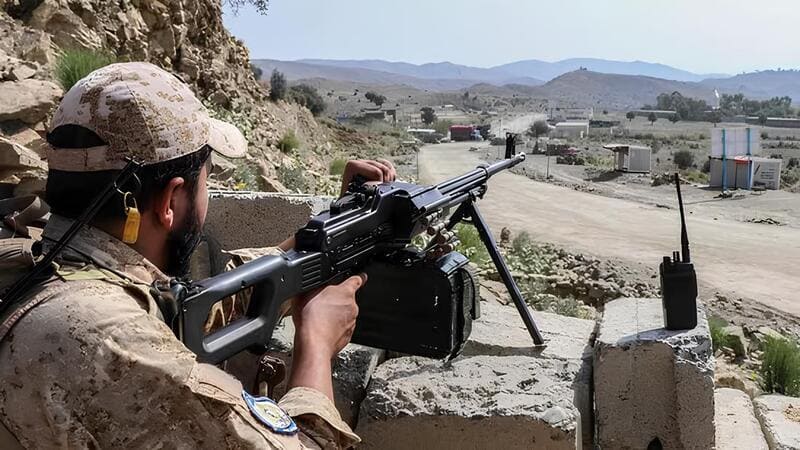
Image Credit: AFP (A member of the Taliban security forces stands guard on a road near the Ghulam Khan border between Afghanistan and Pakistan in the Gurbuz district).