



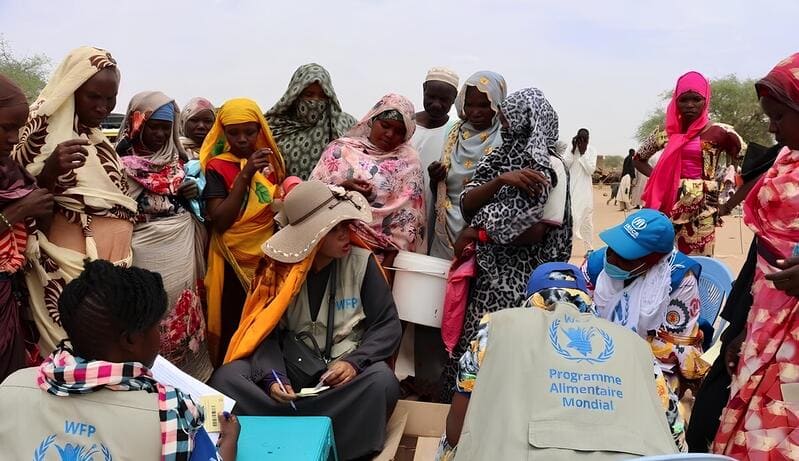
The United Nations World Food Programme (WFP) has published its Global Outlook 2025, calling for $16.9 billion to be allocated to meet global food needs and try to bridge the gap between demand and resources.

The report indicates that 343 million people in 74 countries are facing sudden food insecurity, an increase of 10% over last year and 200 million more than before the pandemic. The national contexts in which the World Food Programme operates are becoming increasingly complex, making the implementation of aid more difficult and costly.
The intensification and escalation of conflicts, extreme weather events, and economic shocks have triggered a series of global crises, pushing hunger to record levels and increasing demand for humanitarian aid. However, funding shortfalls in 2024 have forced the World Food Programme to scale back its humanitarian efforts, leaving some of the most vulnerable populations struggling to access assistance.
The report indicates that approximately 1.9 million people are on the brink of famine. In Gaza and Sudan in particular, as well as in parts of South Sudan, Haiti, and Mali, the number of people suffering from hunger have reached unprecedented levels. World Food Programme Executive Director Cindy McCain said:
“Devastating conflicts, frequent climate disasters, and widespread economic turmoil have led to a growing global humanitarian need. However, financial support has not kept pace. The World Food Programme is committed to ending hunger, but to achieve this goal, we urgently need the financial and diplomatic support of the international community to reverse the trend of growing global demand and help vulnerable groups develop long-term resilience to food insecurity.
Persistently high levels of hunger are worrying, yet the funds needed to address them are dwindling. Last year, the World Food Programme provided life-saving food assistance to 124 million people. This year, the Programme’s funding has been cut by almost 40%, meaning that tens of millions of people will lose our vital lifeline. While the slight decline in overall food insecurity is encouraging, the continued failure to provide essential assistance to those in need will soon undo these hard-won gains and introduce further instability to unstable regions of the world.
In 2025, approximately $16.9 billion in aid would have been needed to help 123 million hungry people, roughly equivalent to global spending on coffee in two weeks. Also in 2025, the World Food Programme continued to tailor its response to the specific needs of each country, identify priorities, and match capacities and resources to implement high-quality projects.
In the Asia-Pacific region, 88 million people face the serious threat of sudden hunger due to climate change, and the World Food Programme needs to raise $2.5 billion to further strengthen social safety nets and proactive initiatives to address the consequences.
In sub-Saharan Africa, 170 million people are facing sudden food insecurity, representing 50% of the World Food Programme’s projected funding needs for 2025. In July, a region of Sudan declared a state of famine, and now conflict in the country is causing a massive influx of displaced people into neighboring countries. In the Democratic Republic of Congo (Kinshasa) and the Sahel region, conflict has forced millions of people into hunger, and food insecurity in southern Africa is worsening due to extreme weather events, exacerbated by El Niño: a periodic climate phenomenon characterized by abnormal warming of the surface waters of the central and eastern Pacific Ocean. This warming, which peaks around Christmas (hence the Spanish name ‘il Bambinello’), alters global weather patterns, causing drought in some regions and torrential rains in others. The phenomenon is part of a larger climate cycle called the El Niño-Southern Oscillation (ENSO), which also includes the opposite phase, La Niña (water cooling).
Hostilities in Lebanon have exacerbated the already dire situation in the Middle East, North Africa, and Eastern Europe, and the conflict has also triggered food insecurity in the Gaza Strip, Syria, and Yemen. The situation in Gaza remains dire, with 91% of the population facing sudden food insecurity and 16% in catastrophic conditions. In Yemen and Syria, 17.1 million and 12.9 million people, respectively, are facing sudden-onset food insecurity. Funding shortfalls across the region are severely limiting World Food Programme operations, and millions of people are suffering as a result of cuts in food aid. The World Food Programme is raising $4.9 billion to continue its aid operations. For example, Programme staff are distributing emergency food aid to internally displaced persons in Lebanon.
In Latin America and the Caribbean, 40.8 million people are food insecure, of whom the World Food Programme has identified 14.2 million as beneficiaries of standard assistance. The Programme also needs to raise $1.1 billion to support vulnerable populations and expand interventions to strengthen food systems, climate resilience, and social well-being.
The aforementioned Global Outlook 2025 report assesses the latest state of global food security in countries where the World Food Programme operates and where data is available. It identifies the need for targeted action for specific populations in various countries, regions, and key areas and provides a brief overview of the Programme’s action plan to tackle hunger in 2025.
The report also provides details on food insecurity, needs, and planned response measures for each region: Asia-Pacific, East Africa, West Africa, Southern Africa, Latin America and the Caribbean, the Middle East, North Africa, and Eastern Europe.
Other sources related to the Food & Agriculture Organization of the United Nations (FAO), the International Fund for Agricultural Development (IFAD), the United Nations Children’s Fund (UNICEF), and the World Health Organization (WHO) have published a report on the state of food security and nutrition in the world in 2025.
The report estimates that around 673 million people worldwide will suffer from hunger in 2024, with the percentage of the population falling to 8.2%, continuing the steady decline recorded in 2023 (8.5%) and 2022 (8.7%). However, the global hunger situation is mixed; the overall improvement cannot mask the regional situation, with hunger continuing to worsen in most subregions of Africa and West Asia.
The report indicates that the global number of people suffering from hunger in 2024 was between 638 and 720 million. According to a point estimate, 673 million people globally are suffering from hunger, a decrease of 15 million compared to 2023 and 22 million compared to 2022.
Although this downward trend is commendable, the latest estimates are still higher than pre-COVID-19 levels, and high food price inflation in recent years has been a key factor contributing to the slow recovery of food security.
South Asia and Latin America have performed particularly well. In Asia, the food insecurity rate fell from 7.9% in 2022 to 6.7% in 2024, affecting 323 million people. Furthermore, in Latin America and the Caribbean, the food insecurity rate peaked at 6.1% in 2020 and fell to 5.1% in 2024, affecting 34 million people.
Unfortunately, this positive trend stands in stark contrast to the growing hunger situation in Africa and West Asia, particularly in many countries long mired in food crises, where the situation is becoming increasingly dire. In 2024, the percentage of people suffering from hunger in Africa exceeded 20%, with 307 million people going hungry; the situation in West Asia is equally dire, with about 12.7% of the population (over 39 million) suffering from hunger.
It is estimated that by 2030, 512 million people worldwide will be chronically food insecure, with nearly 60% of them in Africa.
Faced with these worrying figures, specialized United Nations agencies have clearly warned that achieving the vision of “zero hunger” set out in Sustainable Development Goal 2 (SDG2) remains a long and arduous task.
As an indicator reflecting the difficulty of finding sufficient food at a given time of year, the global prevalence of moderate or severe food insecurity declined slightly, from 28.4% to 28.0% between 2023 and 2024. However, the affected population remains enormous, reaching 2.3 billion. This figure is 335 million higher than in 2019 (before the COVID-19 pandemic) and 683 million higher than in 2015 (the year the 2030 Agenda for Sustainable Development was adopted).
As a key indicator of child nutrition, the incidence of stunting in children under five has decreased from 26.4% in 2012 to 23.2% in 2024, demonstrating the continued improvement in child nutrition status globally. The prevalence of childhood overweight (5.3% in 2012, 5.5% in 2024) and childhood wasting (7.4% in 2012, 6.6% in 2024) has remained generally stable. The rate of exclusive breastfeeding for infants under six months of age has increased significantly from 37.0% in 2012 to 47.8% in 2023, demonstrating growing public understanding of its health benefits. The obesity rate among adults rose from 12.1% in 2012 to 15.8% in 2022. The latest data show that the global rate of anemia among women aged 15 to 49 increased from 27.6% in 2012 to 30.7% in 2023.
According to a Sustainable Development Goals indicator used for the first time in the report, only one-third of infants aged 6 to 23 months worldwide meet the minimum standard for dietary diversity; in contrast, the compliance rate for women aged 15 to 49 is two-thirds.
The State of Food Security and Nutrition in the World 2025 systematically reveals the causes and knock-on effects of the surge in food prices between 2021 and 2023 and focuses on assessing their far-reaching impact on global food security and nutrition.
The report highlights that the policy responses of various countries during the COVID-19 pandemic, consisting mainly of large-scale fiscal stimulus and monetary easing, combined with the impact of the war in Ukraine and extreme weather events, have jointly contributed to the recent sustained increase in inflationary pressures.
Food price inflation has severely hampered the recovery of global food security and nutritional levels in the post-pandemic era. Since 2020, global food price inflation has consistently exceeded overall inflation. In January 2023, the difference between the two reached a historic peak, with the food price inflation rate rising to 13.6%, 5.1 percentage points higher than the overall inflation rate of 8.5%.
As food prices continue to rise, low-income countries are the most affected and have suffered the most severe impact. From December 2020 to early 2023, the median global food price inflation rate rose from 2.3% to 13.6%; in contrast, low-income countries faced even more severe inflationary pressures, with inflation peaking at 30% in May 2023.
Even in the context of continued global food price increases, the total number of people who cannot afford healthy meals is expected to decline slightly. However, this improvement is not uniform. In low-income countries, the cost of healthy meals has increased significantly more than in high-income countries, causing the number of people who cannot afford healthy meals to rise from 464 million in 2019 to 545 million in 2024. In lower-middle-income countries (excluding India), this population will increase from 791 million in 2019 to 869 million over five years.
In response to food price inflation, the report recommends a multi-pronged policy approach, including targeted and time-limited fiscal measures, such as social protection programs, to safeguard the livelihoods of vulnerable households; the implementation of credible and transparent monetary policies to curb inflationary pressures; and strategic investments in agricultural and food science and technology research and development, the modernization of transport and production infrastructure, and the construction of market information systems to improve production efficiency and industrial resilience.
FAO Director-General Qu Dongyu emphasized: “The continued decline in global hunger rates is encouraging, but while we must recognize the hard-won achievements, we must also be keenly aware of the stark contradictions in regional development imbalances. The ‘State of Food Security and Nutrition in the World 2025’ serves as a wake-up call: the international community must urgently and comprehensively scale up its actions to ensure that everyone can eat their fill and have safe and nutritious food. To this end, we must work with governments, organizations at all levels, and grassroots communities to innovate our operating models, implement targeted assistance for the specific challenges of vulnerable groups, and provide precise support to regions where hunger remains a persistent problem.”
IFAD President Álvaro Lario said: “Faced with the dual pressures of rising food prices and disrupted global value chains, we must invest in the future of rural areas and promote agricultural transformation. Such investments are not only the cornerstone of food and nutrition security, but also crucial to maintaining global stability.”
Catherine Russell, Executive Director of UNICEF, said: “Every child deserves the opportunity to thrive. However, more than 190 million children under the age of five worldwide face food insecurity, which can negatively impact their physical and mental development and deprive them of the opportunity to reach their full potential. The report ‘The State of Food Security and Nutrition in the World 2025’ highlights the urgent need for action for the world’s youngest and most vulnerable children, as rising food prices could exacerbate nutritional insecurity for millions of families. We must work with governments, the private sector, and communities to ensure that vulnerable families have access to affordable, nutritious food that meets children’s developmental needs. This includes strengthening social protection programs, educating parents about locally produced child nutrition, and emphasizing the importance of breastfeeding, as it represents the best start in life for a child.
When it comes to improving world hunger, small percentage differences are assessed on data involving half a billion people and far beyond: ‘encouraging’ figures that do not affect the serious problem at all. As long as a single person risks starvation on planet Earth, it is a disgrace to humankind.
Author: Giancarlo Elia Valori – Honorable de l’Académie des Sciences de l’Institut de France, Honorary Professor at the Peking University. Giancarlo Elia Valori is a highly regarded Italian manager, playing a leading role in fostering dialogue and cooperation between countries. He is currently President of the Foundation for International Studies and Geopolitics.
(The opinions expressed in this article are solely those of the author and do not necessarily reflect the views of World Geostrategic Insights).
Note: This article, like all articles published on World Geostrategic Insights, cannot be republished without the written permission of the editor of World Geostrategic Insights.