



The humiliating Chinese warship collision last 11 August 2025, caught global attention as Beijing dreams of a total invasion of the South China Sea.

A Chinese Coast Guard cutter (CCG-31-04) and Chinese Navy destroyer (Guilin, DDG-164) crashed while chasing the Philippine Coast Guard ship BRP Suluan near the Scarborough Shoal. The maritime mishap, vividly captured on video by the Philippine crew aboard the medium-sized vessel, resulted in hazardous and close quarters maneuvers that clearly violated maritime safety protocols. The catastrophe implies Chinese lack of navigational precision and weakness on advanced marine engineering that explicitly tells the world that China is not yet a naval power despite possessing the largest naval armada and coast guard fleet in their intimidating voyages around the disputed international waterways, and within the Exclusive Economic Zone of the Philippines.
While the Philippines and its allies condemned the reckless contrives, China framed the incident as necessary enforcement against alleged Philippine incursions. The CCG ramification underscores growing instability in the South China Sea. In the days that followed, Beijing deployed research vessels, including the Xiang Yang Hong 10 and the autonomous drone mothership Zhu Hai Yun to the area, raising concerns about increasing surveillance, swarming of Chinese militia, and strategic entrenchment. On 24 August 2025, AFP Chief of Staff General Romeo Brawner Jr., claimed that Philippine troops had successfully repelled Chinese incursions, signaling a more assertive posture. The CCG deployed fourteen coast guard vessels and militia ships, armed and supported by a helicopter and drone approaching the grounded BRP Sierra Madre.
Last 17 June 2024, the CCG personnel escalated tensions dramatically, when they boarded a Philippine Navy RHIB, wielding knives, machetes, and even axes, and punctured boats, rendering them unusable with bladed weapons. The Chinese also seized disassembled rifles intended for the Philippine personnel aboard the grounded vessel amid tear gas, sirens, and strobe lights used to create chaos. One Filipino soldier lost a thumb during the ramming and eight other marines were deliberately injured. The piracy-tactic led to diplomatic fallout and legislative response from Manila and called China’s actions as illegal and aggressive, urging Beijing to adhere to international law and UNCLOS. Following the June 2024 clash, both nations forged a provisional arrangement to minimize maritime confrontations as China notably retained its objections to Filipino transport of construction materials.
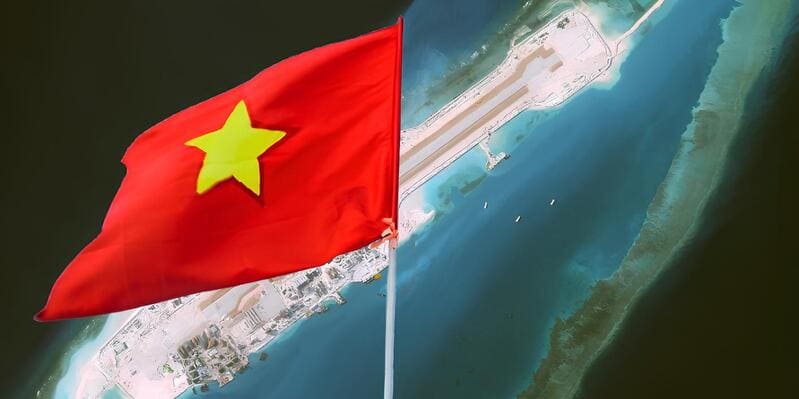
While the two South China Sea claimant-states are quarreling over maritime features and defense postures, Vietnam quietly reclaims more islands and builds thalassocracy—a kingdom in the ocean. Hanoi’s island-building push saw rapid expansion in reclamation between November 2023 and mid-2024. It created 280 hectares of new land across ten Spratly features, a volume nearly matching the land reclaimed in 2022 and 2023 combined. Vietnam is now the second-most active claimant in terms of dredging and landfill activity, behind only China. But soon it will overtake Beijing’s supremacy of owning artificial islands. In just three years from 2022 to 2025, Hanoi added 1,000 hectares of new land, accelerating massive dredging across all twenty-one features it occupies. If this pace continues, Vietnam’s total reclaimed land could rival or even exceed China’s expansive military outposts in the contested South China Sea.
Vietnam physically occupies twenty-one maritime features in the Spratly Islands covering reefs, cays, and shoals and rejects China’s nine-dash line illustration arguing it has no basis in international law, and it backed the Philippines’ legal triumph in the 2016 UNCLOS tribunal ruling. Hanoi asserts continuous sovereignty in the Paracel Islands and went to battle against China to defend a thalassocrat regime in June 1974 when China expelled South Vietnamese forces from the Paracels made up of 130 small islands, atolls, reefs, and sandbanks split into Amphitrite and Crescent groups. Although Vietnam maintains that China’s occupation is illegal and protests Chinese continuous aggression. However, Hanoi’s claims of Paracel Islands and the Spratly Islands are rooted in historical sovereignty, colonial secession, and modern international law.
There is a strategic value that while Beijing and Manila fights for their own versions of maritime order in the South China Sea—China’s medium-term goal to dislodge the United States as the superpower in the Indo-Pacific and the Philippines’ favorable act of expansive security networks and widened defense partnerships with like-minded nations; Hanoi quietly observes the tensions between China and the Philippines and forges strong base expansion and immediately build runways, radars, missile sites, and naval outposts by enhancing its deterrence posture against Beijing and other claimants.
If China is tied down fighting the Philippines in the West Philippine Sea, Vietnam could expand uncontested, consolidating its occupied features in the Spratlys, and perhaps even attempting to reclaim total ownership of the Paracels its lost in 1974 and allow Vietnamese fishermen to dominate one of the world’s richest fishing grounds. Vietnamese maritime governance could give Hanoi major leverage over shipping and naval movements in the South China Sea and emerge as the de facto security leader in Southeast Asia. Allies and security partners of the Philippines might even tolerate or even encourage Vietnam’s strategic rise if it prevents Chinese resurgence to becoming the next superpower. If Vietnam rises as the unexpected maritime power, controlling resources and sea lanes, ASEAN realigns around Vietnam’s centrifugal leadership and Hanoi will reshape Asia’s balance of power.
Author: Dr. Chester Cabalza is the Founding President of the Manila-based think tank International Development and Security Cooperation (IDSC).
(The views expressed in this article belong to the author and do not necessarily reflect the views of World Geostrategic Insights).