



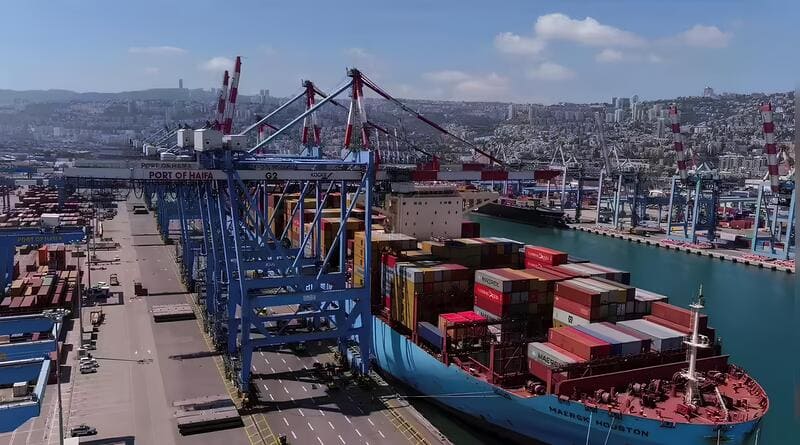
As environmental scrutiny intensifies around port expansions in the Global South, the shipping industry’s vast carbon footprint continues largely unchecked.
Maritime transport is the backbone of the global economy, carrying over 80% of the world’s traded goods by volume.

Yet while this colossal engine of commerce sails mostly under the radar of environmental critique, selective infrastructure developments in the Global South, such as India’s Great Nicobar project or Thailand’s Landbridge initiative, are placed under a microscope, vilified as environmental catastrophes in the making. Their opponents frequently highlight ecological damage, cultural displacement, loss of forest cover and coral reefs, sedimentation and erosion. These are important concerns. But what is rarely said, or rarely confronted, is that the Global South’s infrastructure needs are not optional: they are essential for human development, for reducing global inequality, and even for enabling climate resilience. And meanwhile, the much larger, systemic ecological threat – the global maritime transport system – is often sidestepped, under-regulated, and under-challenged.
This double standard is not just unhelpful – it is deeply unjust.
This needs to change. Because unless we shift our focus from selective condemnation of “development” in poorer regions to the real monster in the room – that is, the shipping industry – marine ecologies, littoral communities, and global climate agendas will continue to suffer.
The Global South is not the problem. In fact, its aspirations for economic mobility, regional connectivity, and infrastructure development are both legitimate and non-negotiable. What should be under far greater scrutiny is the highly polluting, largely unregulated global maritime system that has quietly become one of the most ecologically damaging industrial systems on the planet.
Ports of No Return: The Real Pollution Lies in the Global Maritime Shipping
First, let’s look at what shipping already does, and what it’s on track to do if business as usual persists.
– Shipping emits nearly 1,000 Mt CO2 per year, which is roughly 3% of global CO2 emissions (in 2018), and roughly 11% of life-cycle transportation CO2 emissions in 2020. (Maritime shipping – International Council on Clean Transportation)
– In 2023, global shipping emitted about 911 million tonnes (Mt) of tank-to-wake (TTW) carbon dioxide equivalent emissions using 100-year global warming potentials (CO2 e100), or 925 Mt using 20-year global warming potentials (CO2 e20). Nearly 86% of CO2 e100 emissions resulted from international shipping. (ID-332-–-Global-shipping_report_final.pdf)
– According to the Review of Maritime Transport 2023 by the United Nations Conference on Trade and Development (UNCTAD), greenhouse gas (GHG) emissions from international shipping increased by 20% in the last decade. (International Shipping emissions increased by 20% in the last decade: UNCTAD)
– According to the Fourth IMO Greenhouse Gas Study, due to rapid growth in the use of natural gas as a marine fuel, methane emissions grew 145% between 2012 and 2018. (Maritime shipping – International Council on Clean Transportation)
– If no strong regulatory or fuel shifts occur, shipping emissions are projected to increase steeply. Without additional policy action, shipping’s greenhouse gas (GHG) emissions are expected to grow 16% from 2018 to 2030, and 50% by 2050. (Maritime shipping – International Council on Clean Transportation)
– Beyond CO₂: ships produce nitrogen oxides (NOₓ), sulfur oxides (SOₓ), black carbon (which has strong short-term warming effects), underwater noise, sewage and grey water discharges, invasive species via ballast water, and physical damage via anchoring and ship strikes. These cumulative pressures degrade marine biodiversity, particularly in coastal, shallow, coral, and estuarine ecosystems. (UNOC addresses shipping’s hidden impact on marine biodiversity | World Ports Organization)
– Biggest emission increases coming from the biggest ships. Emissions from ships between 14 500 and 20 000 TEU hit 24.2 Mt in 2024. This is up 7.3 Mt (+43%) compared to 2023. Ships over 20 000 TEU also saw large increases, up 35% from 2023 to 19.6 Mt. (Record-breaking carbon emissions in ocean container shipping: here’s what shippers need to know).
Importantly, growth in emissions has not been decoupled from growth in trade volume. Between 2019 and 2024 global maritime transport CO₂ emissions rose from 889 million tonnes to 974 million tonnes, an average increase of 1.8% per year. (Maritime transport CO₂ emissions | OECD). Meanwhile, overall transport work (a measurement of tons of cargo moved multiplied by nautical miles sailed) continues to increase (increased by 18% in 2024). (Record-breaking carbon emissions in ocean container shipping: here’s what shippers need to know).
So, the picture: a sector responsible for nearly a gigaton of CO₂ emissions each year, growing in impact, with multiple collateral harms to marine and coastal ecologies.
The Scale of the Real Problem
Let’s be clear: if the international shipping industry were a country, it would be the sixth-largest emitter of greenhouse gases (If shipping were a country, it would be the world’s sixth-biggest greenhouse gas emitter). It is a major contributor to underwater noise pollution, oil spills, marine litter, and the spread of invasive species through ballast water. Ship strikes continue to threaten endangered marine mammals, and large-scale port operations degrade coastlines around the globe.
Yet, despite this sprawling ecological footprint, international shipping operates under weak regulatory frameworks and enjoys immunity from national carbon commitments under the Paris Agreement. Progress on decarbonization remains incremental at best, and enforcement is patchy or non-existent.
This global system continues to serve the world’s largest economies, whose consumption and trade flows are disproportionately responsible for driving maritime demand. And still, the ire of global environmental discourse frequently falls not on this systemic culprit, but on localized development projects in emerging economies.
The IMO Net-Zero Framework (NZF): Net-Zero by Name, Shipwreck by Nature?
The IMO Net-Zero Framework (NZF) is the regulatory response of the International Maritime Organization’s 2023 GHG Strategy, aiming to achieve net-zero greenhouse gas (GHG) emissions by or around 2050. The NZF aims to ensure international shipping can meet the strategy’s GHG emissions reduction targets; also, to accelerate the uptake of zero or near-zero GHG fuels, technologies and energy sources (ZNZs); and to support a just and equitable transition of the maritime sector. The new regulations were approved in April 2025 and expected to be adopted in October 2025, taking effect from 2028. The ships of over 5,000 GT engaged in international trade are subjected to the NZF. (Understanding the IMO Net-Zero GHG Framework).
It is important to highlight here that the existing efforts to decarbonise international shipping have been grossly inadequate and patchy. One of Europe’s leading advocates for clean transport and energy, in their April 2025 briefing-report, titled “Assessing the impact of the IMO’s draft Net-Zero Framework”, cast serious doubts on the success and delivery of emission reduction targets, both intermediate and full terms. (Impact of the IMO’s draft Net-Zero Framework – April 2025).
The IMO Net-Zero Framework (NZF), otherwise, hailed as “historic breakthrough for multilateral action on climate, marking the first mandatory emission limits and GHG pricing across an entire global sector” (IMO Net-Zero Framework), will have grossly insufficient revenue to support the desired transition. Almost 90% of shipping’s climate pollution will escape penalties on excess carbon under the IMO Net-Zero Framework. (Impact of the IMO’s draft Net-Zero Framework – April 2025).
As the expected time of the adoption of the framework is approaching, several major shipowners have highlighted that the framework lacked a comprehensive impact assessment, did not ensure level-playing field, is wildly unrealistic, and also lacked clarity on governance and use of funds. (Major shipowners condemn Net-Zero Framework in unprecedented statement | World Ports Organization).
The SEA-LNG’s IMO MEPC 83: SEA-LNG Initial Analysis report concludes: “From an industry decarbonisation perspective, there is a risk that steep targets coupled with relatively weak investment signals locks the industry into a pay-to-pollute scenario and a smaller asset base into which ZNZ fuels can be deployed.” (140525_IMO-MEPC-83_FINAL.pdf).
An international association of civil society environmental protection organizations, the Clean Shipping Coalition, criticized IMO member states for falling far below the UN body’s own 2030, 2040 and 2050 climate targets and “failing the people and regions most vulnerable to climate change”. (Aftermath of IMO’s net-zero framework: ‘Historic’ agreement or ‘total shipwreck’? – Offshore Energy).
Infrastructure in the Global South Is Not Optional
Now, contrast this with infrastructure projects in the Global South.
When critics focus on individual port or corridor projects, whether they are deep-sea ports, transshipment hubs, connecting road/rail links, or coastal reclamation, what is often missing is the context: without sufficient infrastructure, millions lack access to basic utilities, markets, health and education; many developing economies cannot diversify beyond low-value agricultural or extractive exporting; resilience to climate change (flooding, storms, supply disruptions) remains weak; trade costs remain high, imports expensive, exports hindered, local jobs constrained.
Take for example small island developing states (SIDS) or least developed countries (LDCs). In UNCTAD’s analyses, high freight rates due to port inefficiencies or exclusion from global shipping networks can raise import prices by 24%, especially for essential goods (High freight rates cast a shadow over economic recovery | UN Trade and Development (UNCTAD)). For many countries, freight and transport costs are large parts of final consumer prices. Delays and inadequate infrastructure cost lives and livelihoods.
Moreover, without ports and connectivity, these countries cannot adequately participate in global supply chains. They remain peripheral. They cannot benefit equally from globalization, green trade, or even from policies designed elsewhere (e.g., subsidies for cleaner shipping) which assume efficient nodes of entry/exit.
Ports, logistics corridors, and coastal infrastructure in the Global South are not vanity projects. They are essential arteries for development, trade, and resilience. For many developing countries, new port facilities are about more than just container throughput- they are lifelines for energy security, food imports, disaster response, and economic inclusion.
India’s Great Nicobar project, for example, aims to establish a transshipment hub that could shift regional shipping dynamics closer to Indian control, reducing dependence on congested Southeast Asian chokepoints. Similarly, Thailand’s Landbridge seeks to provide an alternative to the Strait of Malacca, enabling faster and more secure movement of goods.
Are these projects without risks? Of course not. But treating them as uniquely egregious while giving the shipping industry a perpetual “green pass” amounts to environmental myopia, and geopolitical hypocrisy.
The Danger of Selective Scrutiny
This leads to a troubling paradox. Opposing infrastructure projects in the Global South on environmental grounds, while needed in many cases, can delay or block developments that are in fact essential. Meanwhile, global shipping continues to pollute, expand, and degrade marine ecologies almost unchecked.
The disproportionate criticism directed at infrastructure development in the Global South ignores three critical realities:
1 – Ecological Impact Is Not a North-South Issue: Fragile ecosystems exist everywhere, from the Arctic to the Andaman Sea. The environmental impacts of infrastructure must be evaluated based on science, not geopolitical convenience.
2 – Development Delays Cost Lives and Livelihoods: Over-regulation or obstruction of infrastructure in developing countries risks exacerbating poverty, deepening inequality, and impeding climate adaptation, particularly in vulnerable island and coastal nations.
3 – The Real Leverage Lies Elsewhere: If the goal is to protect marine ecosystems and stabilize the climate, then the top priority must be systemic reform of how goods move across the globe. That means:
– Maritime decarbonization: decarbonizing ships through zero-emission fuels and technologies.
– Investing in green ports and sustainable bunkering infrastructure.
– Enforcing stronger international maritime regulations through the IMO.
– Rethinking global supply chains to reduce overdependence on just-in-time maritime logistics.
A Call for Environmental Justice and Strategic Clarity
We are at a pivotal moment. The choices we make today will define whether the world severely erodes marine and coastal ecologies, or whether we succeed in creating a maritime system that is clean, fair and sustainable.
The future of our oceans cannot be secured by sacrificing development in the Global South. Nor can it be won through performative outrage at individual infrastructure projects, while the global shipping industry remains structurally unsustainable and under-regulated.
Yes, we should care about ports in Great Nicobar, Landbridge in Thailand, new ports in Africa, Latin America, and Asia. But these are not the front lines of environmental harm compared to what the global shipping industry is already doing: flying under regulatory radar in many respects, growing emissions, degrading marine ecosystems on an industrial scale.
If we are serious about protecting marine ecosystems and confronting the climate crisis, we need to shift focus from the periphery to the core, from isolated development projects to the global trade system that makes such infrastructure necessary in the first place.
Human development in the Global South, through infrastructure, ports, logistics, is non-negotiable. Delaying it harms millions, perpetuates injustice. But development alone is not enough. It must be matched, and overtaken, by systemic transformation of global maritime transport.
Environmental justice requires consistency. It demands that we hold the largest polluters to account, not just the most convenient targets. The Global South deserves the infrastructure it needs to thrive. The planet deserves a maritime system that is clean, just, and sustainable.
Let’s not confuse the two.
Author: Yashwant Singh – Assistant Professor at the Department of Sociology at GITAM (Deemed to be) University, Bengaluru Campus, Bengaluru, Karnataka, India. He has an M.Phil in Sociology from the University of Delhi and Ph.D in Sociology from University of Hyderabad, India. His research interests include urban sociology and sociology of development.
(The views expressed in this article belong only to the author and do not necessarily reflect the views of World Geostrategic Insights).