



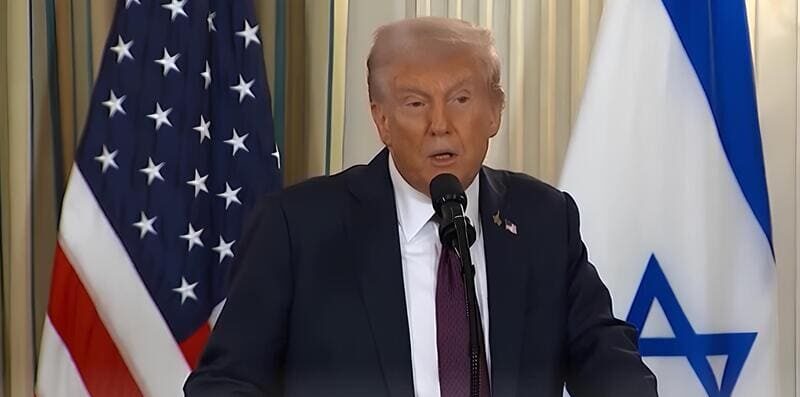
Donald Trump’s newly unveiled 20-point Gaza peace plan arrives not as a neutral framework for resolution, but as a bold, high-stakes political maneuver cloaked in the language of peace. With Israel’s government expressing conditional acceptance and much of the Muslim world watching cautiously, in many cases, with deep suspicion. The plan is poised to define the next chapter of one of the most enduring tragedies of the modern age.

At first glance, the plan appears promising. It calls for a ceasefire, the release of hostages, a phased withdrawal of Israeli forces, and the eventual rebuilding of Gaza under international supervision. If implemented with fairness, the plan could halt the devastating cycle of violence, allow humanitarian aid to flow freely, and offer relief to millions of besieged Palestinians.
The potential for peace, however fragile, must be acknowledged. Yet what is troubling is not just what the plan includes but what it omits, ignores, or redefines in deeply political terms. In its current form, the plan leans heavily toward Israeli strategic interests, demanding the disarmament and exclusion of Hamas, while offering no comparable concessions from the Israeli side on issues of occupation, settlement expansion, or long-term sovereignty.
It establishes an unelected technocratic governance model in Gaza, overseen by a foreign “Board of Peace,” with little clarity on Palestinian political agency or path to statehood. The language of “deradicalization” and “terror-free zones” may resonate with certain audiences, but in practice, it risks becoming a justification for prolonged foreign surveillance and control – echoing the very conditions that led to past resistance.
In the eyes of many, including the Muslim world and human rights activists, the plan reads more as a blueprint for containment than liberation. The plan’s vision of Gaza seems to remove its people from the equation, treating them as subjects of charity and stabilization, rather than active political agents with historical grievances and legal rights.
Without meaningful Palestinian inclusion – including factions like Hamas that, whether liked or not, maintain significant popular support in Gaza – the plan risks lacking legitimacy among the very people it aims to govern.
This disconnect fuels fears of a worst-case scenario; a future where Gaza is turned into a security buffer zone under international or Israeli control, where reconstruction is weaponized through conditional aid, and where political sovereignty is indefinitely delayed under the pretext of peace.
On the other hand, a best-case scenario remains just barely within reach. If the plan were amended to reflect Palestinian demands; respect for sovereignty, legal accountability for war crimes, and a clear timeline for full statehood – it could indeed serve as a catalyst for broader peace. If hostilities ceased, if aid flowed into Gaza’s ruins, and if Palestinians were given real agency over their future, the plan could help de-escalate a regional crisis.
At this moment in time, Muslim states could play a constructive role not just as donors or spectators, but as active guarantors of justice, sovereignty, and reconstruction. This brings us to the Organization of Islamic Cooperation (OIC), a body that has long claimed moral and political stewardship over Muslim causes none more central or enduring than that of Palestine.
The OIC’s relevance and credibility are on the line. The world is no longer impressed by symbolic resolutions or carefully worded communiqués. What is needed is leadership, coordination, and courage. The OIC must unify the Muslim world around a clear and enforceable position. Beyond declarations, the OIC must activate all its diplomatic tools. It must present a united front at the United Nations, the International Criminal Court, and every other legal forum.
The OIC must call for independent war crimes investigations where necessary, support Palestinian efforts for justice, and push for binding international guarantees not just vague promises from major powers and also coordinate reconstruction efforts so that aid is not politicized or filtered through occupying powers, but reaches civilians directly and sustainably.
What’s more, the OIC must also serve as a bridge not just between Muslim-majority nations, but between fractured Palestinian factions. Internal political unity is essential for external diplomatic leverage. The OIC can help facilitate intra-Palestinian dialogue, bringing together representatives from Gaza, the West Bank, the diaspora, and civil society to form a representative voice.
The outcomes for the Muslim world hang delicately in the balance. A plan that succeeds because it respects justice and inclusion could bring not only stability to Gaza, but also elevate the global standing of Muslim nations as peace-builders and responsible actors. It could empower Muslim diplomacy, strengthen pan-Islamic cooperation, and offer a model for dealing with other crises in Yemen, Syria, Kashmir, and beyond.
But a plan that fails, especially one endorsed or accepted without conditions, could devastate Palestinian lives and unleash a tidal wave of anger, disillusionment, and radicalization across Muslim populations. It could further fracture the OIC, deepen divisions between “pragmatic” and “principled” Muslim states, and allow the narrative of helplessness and betrayal to take deeper root in young Muslim minds.
This is more than a test of one peace plan. It is a test of Muslim unity, of the OIC’s purpose, and of the world’s willingness to confront not just the symptoms of conflict, but the structures of power and injustice that sustain it. The Muslim world must not be lulled into accepting peace without justice. It must not confuse silence for diplomacy, or passivity for strategy.
History will judge this moment. Either as the time when powerful actors manipulated another order in the Middle East, or when a fractured Muslim world found enough unity, courage, and clarity to change the course of history – not just for Gaza, but for all who believe that peace cannot come without dignity, sovereignty, and truth.
Author: Mirza Abdul Aleem Baig – President of Strategic Science Advisory Council (SSAC) – Pakistan. He is an independent observer of global dynamics, with a deep interest in the intricate working of techno-geopolitics, exploring how science & technology, international relations, foreign policy and strategic alliances shape the emerging world order.
(The views expressed in this article belong only to the author and do not necessarily reflect the views of World Geostrategic Insights).