



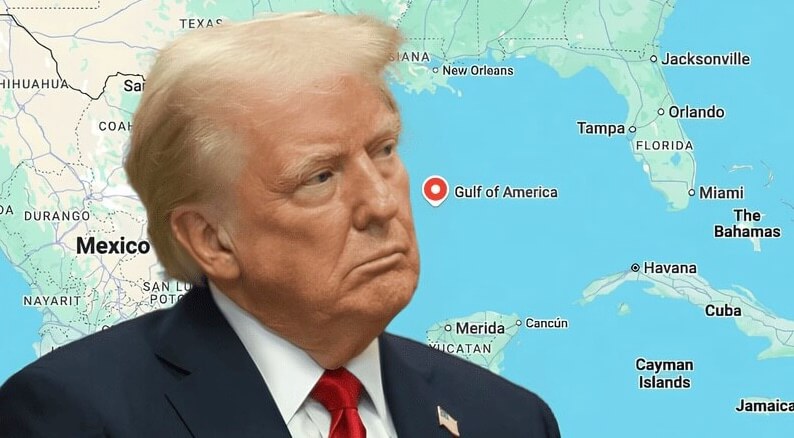
Tech giant Google recently took an important step by complying with President Trump’s executive order and renaming the Gulf of Mexico the “Gulf of America.” The change currently applies only to Google Maps users in the United States.

Google stated on its official blog that users outside the United States and Mexico will see both the old and new names for the Gulf of Mexico, a move consistent with its handling of other controversial locations. Those using Google Maps in the United States will see “Gulf of America,” while those in Mexico will see “Gulf of Mexico,” Google explained. Users in other countries will see both names.
Google emphasized that the change is in line with its policy of following the official geographic names provided by the U.S. Geographic Names Information System (GNIS), which means that Google follows the Washington government’s official position on naming.
However, this is not the only geographic name change under the Trump administration. The executive orders signed by Trump since he took office not only affect the Gulf of Mexico, but also restore the name of the nation’s highest peak, Denali (6,144 m), to Mount McKinley. Notably, in 2015, then-President Barack Obama officially recognized the Alaskan mountain as Denali, the traditional name used by Native Americans for centuries.
These geographical name changes have sparked widespread debate. Supporters argue that they demonstrate the sovereignty and historical traditions of the United States of America, while critics point out that they could cause diplomatic controversies, particularly with Mexico.
According to the US news agency Associated Press, Trump has always taken a hard line against Mexico. Since his first presidential campaign in 2016, he has repeatedly clashed with Mexico on issues such as border security and trade tariffs. He once claimed that Mexico would pay for the construction of the wall along the US-Mexico border: during his first term, 720 kilometers of border wall were completed, but the Mexicans did not pay.
The wall—a word reminiscent of the Berlin Wall, which is much shorter in comparison—is called, in politically correct terms in Italy, the “barrier separating the United States and Mexico,” while in Mexico, which has a flag similar to ours but different governments at the ‘service’ level, they call it the “wall of shame.” This is its extent: California (Baja California: 226.0 km), Arizona (Baja California-Sonora: 599.5 km), New Mexico (Sonora-Chihuahua; 288.9 km). Texas (Chihuahua, Coahuila, Nuevo León, Tamaulipas: 1,997.2 km) for a total of 3,111.6 km); in comparison, the aforementioned Berlin Wall looks like a children’s playpen at the supermarket.
Construction of the wall began in 1993, and all presidents, Democrats and Republicans alike, have enthusiastically contributed to its completion. Mexicans and the world have always called this body of water the “Gulf of Mexico,” long known as the “Third Coast” of the United States, and it borders three countries on the continent: Mexico, the United States, and Cuba. This is not the first time that the United States and Mexico have disagreed on the name. For example, the river on the border between Texas and Mexico is called the “Rio Grande” in the United States, while in Mexico it is called the “Rio Bravo.”
Is it possible to change the name? Who has the final say? Does Trump have the power to unilaterally change the name of the Gulf of Mexico? The answer is no.
The International Hydrographic Organization (IHO), of which both the United States and Mexico are members, is responsible for the unified mapping and naming of the world’s oceans and waterways. Although countries may use different names domestically, name changes in international contexts require multilateral coordination.
Shortly after Trump’s statements, Georgia Representative Marjorie Taylor Greene said in an interview that she intends to draft a bill supporting the name change and propose funding for the production of new maps and government administrative materials. However, it is not yet clear whether the bill will be passed.
The name “Gulf of Mexico” has been in use for over 400 years and is believed to derive from the Nahuatl word Mēxihco, the place name for the Valley of Mexico and the term used to refer to the Mexica (Aztec) people who inhabited it. Although its exact meaning is debated, the most widely accepted theory suggests that it derives from metztli (“moon”), xictli (“navel” or “center”) and the locative suffix co (‘place’), meaning “the place of the moon’s navel” or “the center of the moon’s lake.” This refers to the location of the ancient Aztec capital, Tenochtitlán, on an island in Lake Texcoco. The name was already present on maps during the colonial period.
It is worth noting that this is not the first time someone has proposed changing the name of the Gulf of Mexico. In 2012, a Mississippi lawmaker proposed renaming the Gulf of Mexico off the coast of the federal state “American Gulf,” but later rejected the proposal, calling it a “joke.” The proposal did not go through, and some time later, American comedian and television host Stephen Colbert joked on his show that the Gulf of Mexico should be renamed the “American Gulf” because of the oil spill, arguing that “we broke it, so we have to buy it.”
Trump’s proposal to rename the Gulf of Mexico the “American Gulf” is bound to spark further controversy. From international norms to cultural connotations, place names embody complex historical and sovereign symbols. Implementing this proposal will require a complex process, and the final outcome is uncertain, often giving rise to embarrassing and, we would say, dangerous situations.
The White House revoked the press credentials of the U.S. news agency Associated Press for insisting on using the term “Gulf of Mexico,” sparking a controversy over freedom of the press and legal action. In April 2025, a federal court ruled that the Associated Press had the right, guaranteed by the First Amendment, to use journalistic language, ordering the White House to restore access to its journalists. Nevertheless, the Associated Press stated that it would continue to use the term “Gulf of Mexico” and considered “American Gulf” to be a political term that was not universally accepted.
The Mexico City newspaper El Universal (founded in 1916) analyzed the Gulf of Mexico as one of the richest regions in the world in terms of oil and natural gas reserves. According to the U.S. Energy Information Administration, oil production in the Gulf of Mexico accounts for 17% of total U.S. production, making it critical to the country’s energy independence. The region is also a key hub for global maritime trade, with 60% of U.S. grain exports passing through its ports, reaching 30 million tons per year.
Furthermore, its geographical location not only facilitates commercial and political relations between the United States and Latin American countries, but also forms a natural barrier that protects Washington from invasions and conflicts, allowing it to focus more on domestic development. Historically, the Gulf of Mexico has been instrumental in the United States’ rise to superpower status.
El Universal points out that, under the United Nations Convention on the Law of the Sea, countries have the right to exploit resources within their exclusive economic zones. Mexico has jurisdiction over 829,000 square kilometers of the Gulf of Mexico, while the United States controls 662,000. These jurisdictional boundaries have long been clearly defined and protected by international law.
Former Mexican ambassador to the US Martha Elena Federica Bárcena Coqui has publicly warned that Trump’s proposal to change the name is the first step in an attempt by the US to redistribute the Gulf of Mexico’s resources, and that it is more akin to a form of “diplomatic coercion” aimed at strengthening unilateral control over the region.
If the change to “American Gulf” becomes an international reality, it could have a significant impact on oil and gas extraction in the region, global energy market prices, and international trade, and even alter the political dynamics of the region.
Scholars point out that the unilateral assertion of U.S. jurisdiction over the entire Gulf of Mexico is bound to provoke strong opposition from Mexicans and the international community, as any such change would have to be negotiated within multilateral institutions such as the International Maritime Organization (IMO). Although this symbolic move to rename the Gulf may redefine US global leadership and reinforce Trump’s “America First” political philosophy, it is also bound to provoke the ire of neighboring countries and allies.
Trump’s proposal to rename the Gulf the “American Gulf” undoubtedly has significant political significance, aiming to consolidate Washington’s geostrategic advantage in the region. However, in practice, the US will face multiple legal, diplomatic, and economic challenges. The international community will also closely monitor any regional disputes and their potential impact on global energy markets.
Disputes over international place names are not isolated cases and are common throughout the world. For example, the naming of the Sea of Japan remains an unresolved issue between Japan, the Democratic People’s Republic of Korea (North) and the Republic of Korea (South), and Russia. The Republic of South Korea argues that the name dates back to the Japanese colonial period and should be renamed the “East Sea.” In 2020, the International Hydrographic Organization decided to replace names with digital identifiers and develop new digital standards for modern geographic information systems.
In addition, the United States has historically debated the naming of its own waters. In 2013, former Secretary of State Hillary Clinton, a Democrat, said in a speech that, following China’s logic regarding the South China Sea, the United States could have called the Pacific Ocean the “American Sea” after World War II; a pathetic attempt to imitate a history and culture dating back thousands of years with a geographical position that saw the United States achieve full territorial unity only on August 21, 1959, i.e., yesterday (foundation of the 50th federal state: Hawaii).
The name of the Persian Gulf has also been the subject of much debate. Trump is expected to announce sooner or later his intention to rename the Persian Gulf the Arabian Gulf or Gulf of Arabia. This would provoke a strong and natural reaction from Iran, as it is clearly a politically motivated hostile operation, given that world public opinion strongly condemns any attempt to change historically established names.
This move would not only involve the symbolism of a geographical name change, but would also have repercussions on Washington’s military deployments and investment agreements in the Middle East. This would have significant political implications, especially as Trump seeks to attract investment from the Gulf states, curb Iran’s nuclear development, and mediate in the Gaza Strip.
The name of the Persian Gulf is the subject of a long-standing dispute. This 1,600-kilometer stretch of sea, which runs along Iran’s southern coast, has been called the “Persian Gulf” since the 16th century, reflecting Iran’s historical role as the predecessor of the Persian Empire. Iran argues that the Persian Gulf is part of its territory and that “Persian Gulf” is the correct name.
However, Arab states have long advocated the use of the term “Arabian Gulf,” arguing that modern geopolitics should no longer perpetuate imperial nomenclature. As early as 2010, Iran threatened to ban any airline using the name “Arabian Gulf” from its airspace. In 2012, Tehran protested against Google for not including the name “Persian Gulf” on its maps.
Currently, on Google Maps (US version), the waters are labeled as “Persian Gulf (Arabian Gulf)” alongside “Persian Gulf,” while Apple Maps uses only the label “Persian Gulf.” The Pentagon has long used “Arabian Gulf” as the official term in press releases and images, signaling a shift in the language preferred by the U.S. military in its dealings with regional allies.
Trump’s use of the name “Persian Gulf” during his presidency in 2017-2021 caused a further rift with Tehran. Iranian officials then criticized him for his “need to take geography lessons.” Trump’s announcement of a name change sparked a negative reaction in Iranian politics and public opinion. Seyed Abbas Araghchi, Tehran’s current foreign minister, reiterated: “The Persian Gulf is an undeniable historical fact and an integral part of the Iranian people and culture.”
Trump’s policy on the name change is widely interpreted as a political maneuver aimed at bolstering his image among conservative and nationalist voters and strengthening ties with certain Gulf states. Commentators point out that this is not just a linguistic issue, but rather another attempt by Trump to assert his “right to interpret history” and control the national narrative. Faced with negative reactions from Iran, the media, and the international community, the Trump administration seems unwilling to back down. On the contrary, it may resort to more symbolic actions to test the international reaction and further redefine the boundaries of its foreign policy logic.
Author: Giancarlo Elia Valori – Honorable de l’Académie des Sciences de l’Institut de France, Honorary Professor at the Peking University.
Giancarlo Elia Valori is a highly regarded Italian manager, playing a leading role in fostering dialogue and cooperation between countries. He is currently President of the Foundation for International Studies and Geopolitics.
(The opinions expressed in this article are solely those of the author and do not necessarily reflect the views of World Geostrategic Insights).
Note: This article, like all articles published on World Geostrategic Insights, cannot be republished without the written permission of the editor of World Geostrategic Insights.