



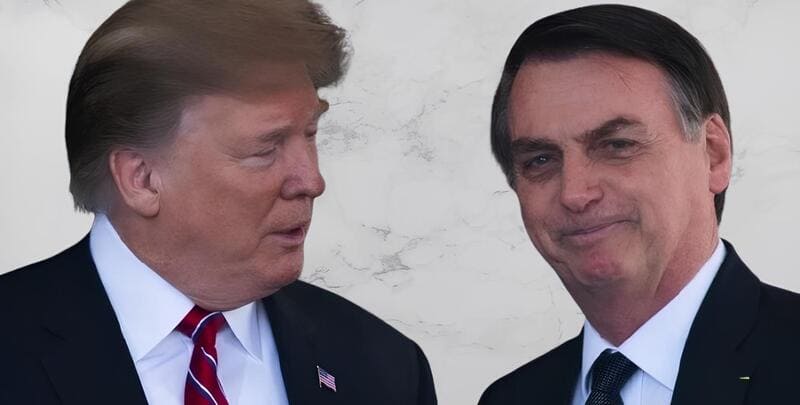
We are increasingly seeing efforts by the Trump administration to lend its support to foreign political figures with whom it sympathizes when they get into difficulties in their home countries.

While until recently, Trump and his top aides had confined themselves to employing the “bully pulpit” of the Presidency to scold those it saw as harassing their allies, a naked threat to use American power on behalf of one, former Brazilian President Jair Bolsonaro, has now appeared.
While such interventions have been sporadic thus far, they do indicate some impulse on Trump’s part to internationalize his ideological predilections.
Putting Brazil on Notice…
On July 9, Trump sent a letter to Brazilian President Luiz Inacio Lula da Silva (“Lula”) announcing his intention to impose 50 percent tariffs on imports from that country, effective August 1. Remarkably, Trump led off not with complaints about unfair trade practices, but rather with an unrelated issue, the indictment of Lula’s predecessor, Jair Bolsonaro, for alleged coup plotting.
Trump asserted: “The way that Brazil has treated former President Bolsonaro, a Highly Respected Leader throughout the World during his term, including by the United States, is an international disgrace. This Trial should not be taking place. It is a Witch Hunt that should end IMMEDIATELY!” (Capitalizations are all in Trump’s original text.) Bolsonaro, whose time in office overlapped with Trump’s own first term, had enjoyed a close relationship with his American counterpart, aligning with him on a range of international and social issues and employing similarly hot rhetoric against his domestic opponents.
Bolsonaro faces charges for allegedly participating in efforts to overthrow Lula in the aftermath of the latter’s victory over him in his failed re-election bid, including the attempted takeover of key government buildings on January 8, 2023, events which echoed the assault on the U.S. Capitol two years earlier.
The importance which Trump has assigned to gaining relief for Bolsonaro (one of whose sons has been in the United States for several months lobbying on his behalf) can be seen by comparing the 50 percent tariff rate to be imposed on Brazil (with which the United States actually has a trade surplus) with those set for the European Union (30 percent), Mexico (30 percent), India (26 percent), and Japan (25 percent). National Economic Council Director Kevin Hassett has cited other grievances, such as Chinese firms transshipping products to the United States through Brazil to avoid their own steep tariffs, while admitting that the remarkably high tariff to be imposed is directly related to “the President’s frustration with Bolsonaro.”
…and also Israel, France and Germany
This injection into Brazil’s internal judicial processes is but the latest, if the most aggressive, effort on behalf of those Trump feels have been mistreated. On June 26, he called for the trial of Israeli Prime Minister Benjamin Netanyahu on corruption charges to be “cancelled” or for Netanyahu to be “pardoned,” here too terming the trial a “witch hunt” and “travesty of justice.” He followed up with a post on June 29 with a threatening edge, stating: “The United States of America spends Billions of Dollar (sic) on Israel a year, far more than on any other Nation, protecting and supporting Israel. We are not going to stand for this.” Trump’s interest in Netanyahu’s legal fortunes was underscored by the subsequent appearance at his trial of the U.S. ambassador to Israel.
And earlier, on March 31, after Marine Le Pen, leader of France’s hard right, anti-immigration “National Rally” party, was convicted of embezzlement for having used for campaign purposes funding provided to her as a member of the European Parliament, Trump came to her defense, first calling the case “a very big deal,” and then posting a statement saying that “just before what would be a Big Victory, they get her on a minor charge…. This is so bad for France and the Great French People…. FREE MARINE LE PEN!”
The administration’s solidarity with those of whom it approves was also demonstrated on February 14 when Vice President Vance, speaking at the prestigious Munich Security Conference, denounced the refusal of Germany’s mainstream parties to consider including the ulltra-right “Alternative for Germany” (AfD) party in any future coalition, saying “(t)he voice of the people matters. There is no room for firewalls.” And when in May Germany’s domestic security service declared AfD to be extremist and thus subject to greater scrutiny, Vance hailed the party’s growing popularity and said: “Now the bureaucrats try to destroy it.” For his part, Secretary of State Rubio called the action “tyranny in disguise.”
Leading a Global Movement?
Are we now seeing the beginning of a U.S.-led “Trumpist International” in which those figures and parties that have views that coincide with the President’s can count on rhetorical and even material support from the United States while looking to it for leadership? One notable early attempt at cross-border ideological coordination was an abortive effort on the part of Trump-adjacent Steve Bannon to establish a school in a former Italian monastery to train cadres in right-wing populist political activism; however, it fell apart amid legal and financial difficulties as well as European suspicions of the high-profile American role.
To a degree a coordinating function is also being assumed by the Conservative Political Action Conference (CPAC) which in addition to meeting annually inside the United States, where it has become a showcase for “Make America Great Again” politics, has branched out to include annual events in both Europe and Latin America. CPAC has increasingly acted as a “switchboard” for the new global hard right politics, providing venues at which activists can exchange ideas on strategy and raise their own profiles.
It is still early days for the phenomenon of an internationally linked political hard right; it lacks any institutional form although within the European Parliament there does exist the “patriots.eu” caucus which includes members from such parties as France’s National Rally, Hungary’s Fidesz, Italy’s Northern League and Spain’s Spain’s Vox.
Globally, traditional mainstream conservatism has had a home in the International Democracy Union, in which such entities as Britain’s and Canada’s Conservative Parties participate, as does the United States’ Republican Party. Of course, on the left there is the Socialist International which has existed in its current form since 1951, and which can trace its roots back as far as 1864, and in its day the Communist International, directed from Moscow, was a powerful force in world politics.
But it is difficult to find a direct historical precedent for any serious effort at globally linking together right wing populist movements and leaders. Mussolini tried to create in effect a “Fascist International” which culminated in a conference held in 1934 in Montreaux, Switzerland at which seventeen groups participated. However, as he became increasingly Hitler’s junior partner, any impulse towards leading what was termed “universal fascism” faded away.
But to the extent that this new brand of hard conservative internationalism has any center, it may be virtual, existing for now largely at CPAC meetings, and as the spirit moves him, in the form of Trump’s social media postings in defense of figures such as Bolsonaro, Netanyahu, or Le Pen. Given the power of the American Presidency, this is of genuine importance.
But some factors may militate against a Trump-led global rightist alliance. He himself is notoriously mercurial and transactional. Thus, if he gets what he wants on trade from Brazil, he may have few qualms about leaving Bolsonaro to his fate. And should his policies converge more with those of established governments in Europe, as seems to be happening regarding Ukraine right now, gaps may begin to appear between him and these emerging hard right forces. But for now at least, to a greater or lesser extent, they have a friend in the White House.
Author: Richard M. Sanders – Senior Fellow, Western Hemisphere at the Center for the National Interest. A former member of the Senior Foreign Service of the U.S. Department of State, he served as Director of its Office of Brazilian and Southern Cone Affairs, 2010-13.
(The views expressed in this article belong only to the author and do not necessarily reflect the views of World Geostrategic Insights).